


Temporal trends of particulate matter pollution and its health burden, 1990-2021, with projections to 2036: a systematic analysis for the global burden of disease study 2021
- PMID: 40308905
- PMCID: PMC12041061
- DOI: 10.3389/fpubh.2025.1579716
Temporal trends of particulate matter pollution and its health burden, 1990-2021, with projections to 2036: a systematic analysis for the global burden of disease study 2021
Abstract
Background: Particulate matter pollution (PM2.5) is a leading global health risk factor. We analyzed the spatiotemporal trends of diseases attributable to PM2.5 at global, regional, and national levels from 1990 to 2021.
Methods: Using data from the Global Burden of Disease (GBD) 2021 study, we assessed global, regional, and national deaths and disability-adjusted life years (DALYs) due to PM2.5, along with age-standardized mortality rates (ASMR) and age-standardized DALY rates (ASDR), categorized by age, sex, year, location, and disease type. We used average annual percentage change (AAPC) to illustrate trends from 1990 to 2021. Spearman correlation analysis was conducted to examine the relationship between the socio-demographic index (SDI) and age-standardized rates (ASRs) across 204 countries. Bayesian age-period-cohort (BAPC) analysis was used to project trends for 2022-2036.
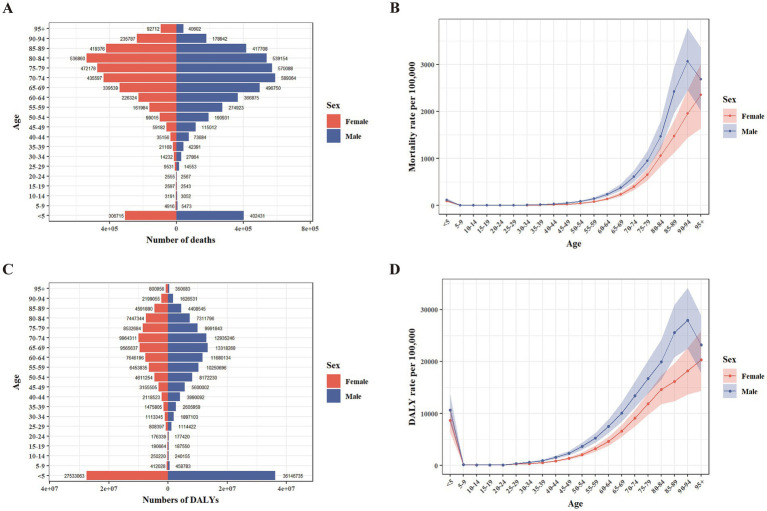
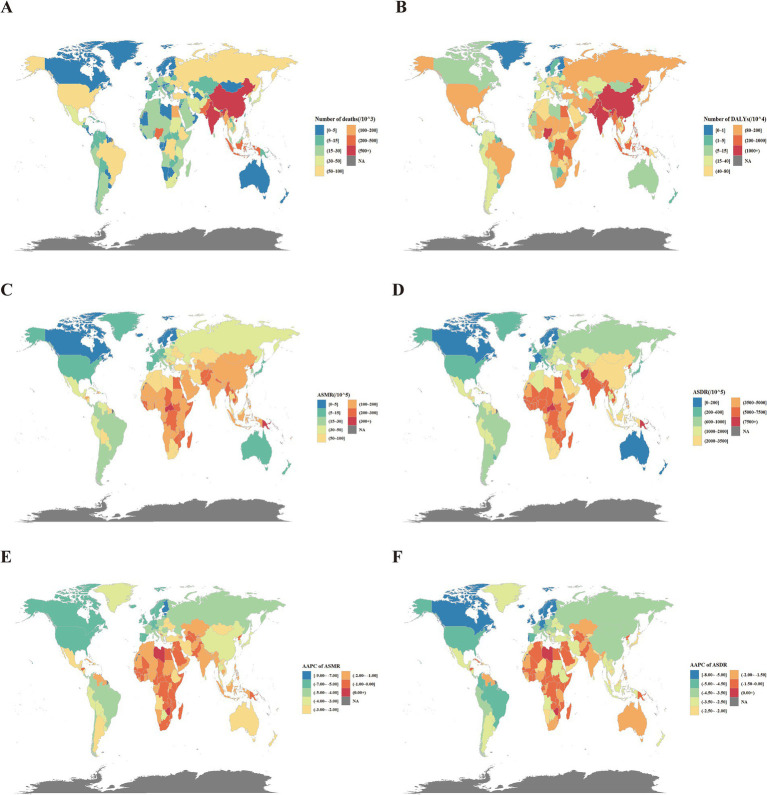
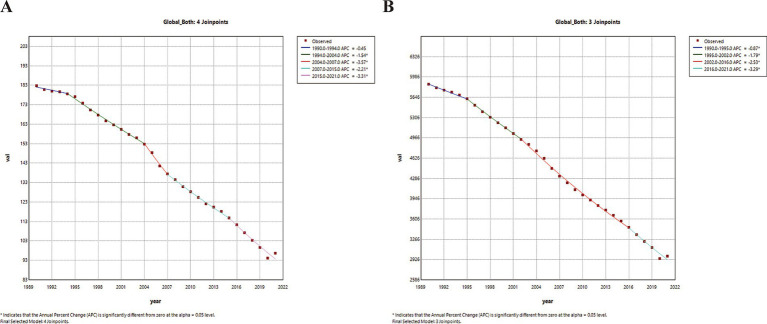
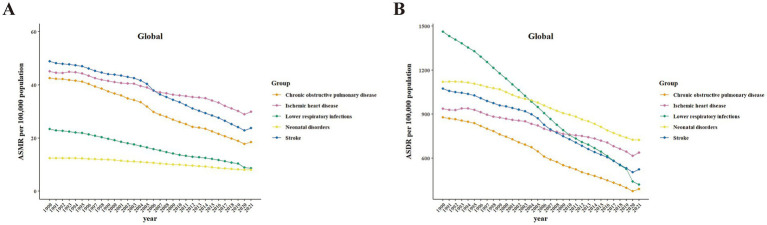
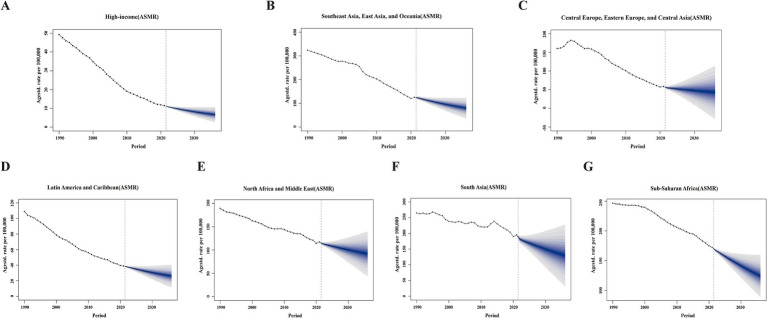
Results: In 2021, PM2.5 exposure contributed to 7.83 million deaths and 231.51 million DALYs globally. The age-standardized rates decreased to 95.69 per 100,000 for deaths (AAPC = -2.12) and 2984.47 per 100,000 for DALYs (AAPC = -2.22), compared to 1990. Disease burdens related to PM2.5, as reflected by ASMR and ASDR, declined across SDI quintiles and GBD super regions from 1990 to 2021. The low SDI quintile had the highest disease burden (ASMR: 211.39, ASDR: 6,114.26). Correlation analysis revealed a significant negative relationship between ASRs and SDI. South Asia and sub-Saharan Africa experienced the highest disease burdens. Males had higher disease burdens than females globally and in all regions. The burden was particularly severe for children under five and older adults. Ischemic heart disease and stroke were the leading causes of PM2.5-related deaths and DALYs. Diabetes mellitus saw an increase in both deaths and DALYs. The BAPC model predicts continued declines in PM2.5-related ASDR and ASMR over the next 15 years.
Conclusion: With population growth and an aging demographic, the public health burden associated with PM2.5 exposure remains a major concern. It is imperative to develop targeted and proactive strategies that account for the unique circumstances and challenges of different regions.
Keywords: Level-3 diseases; PM2.5; burden of disease; particulate matter pollution; projection; temporal trends.
Copyright © 2025 Fang, Di, Xu, Shen, Fan, Hou and Li.
Conflict of interest statement
The authors declare that the research was conducted in the absence of any commercial or financial relationships that could be construed as a potential conflict of interest.
Figures
References
-
- Chung Y, Dominici F, Wang Y, Coull BA, Bell ML. Associations between long-term exposure to chemical constituents of fine particulate matter (PM2.5) and mortality in Medicare enrollees in the eastern United States. Environ Health Perspect. (2015) 123:467–74. doi: 10.1289/ehp.1307549, PMID: - DOI - PMC - PubMed
MeSH terms
Substances
LinkOut - more resources
Full Text Sources
Medical
