


Constructing a screening model to identify patients at high risk of hospital-acquired influenza on admission to hospital
- PMID: 40308921
- PMCID: PMC12041216
- DOI: 10.3389/fpubh.2025.1495794
Constructing a screening model to identify patients at high risk of hospital-acquired influenza on admission to hospital
Abstract
Objective: To develop a machine learning (ML)-based admission screening model for hospital-acquired (HA) influenza using routinely available data to support early clinical intervention.
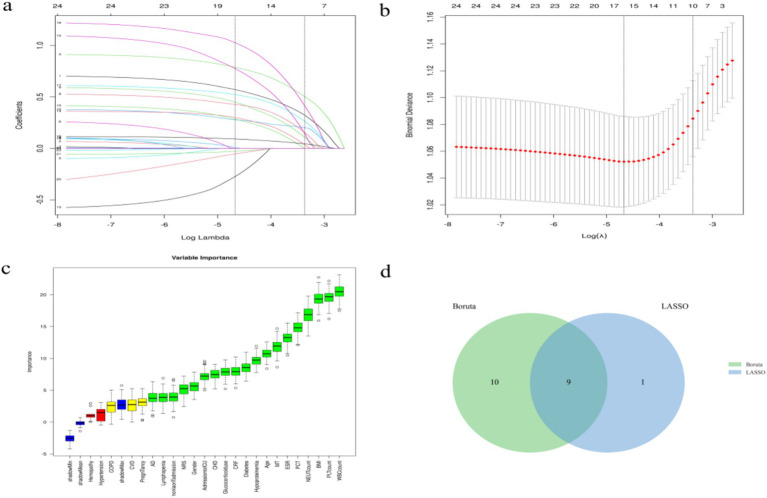
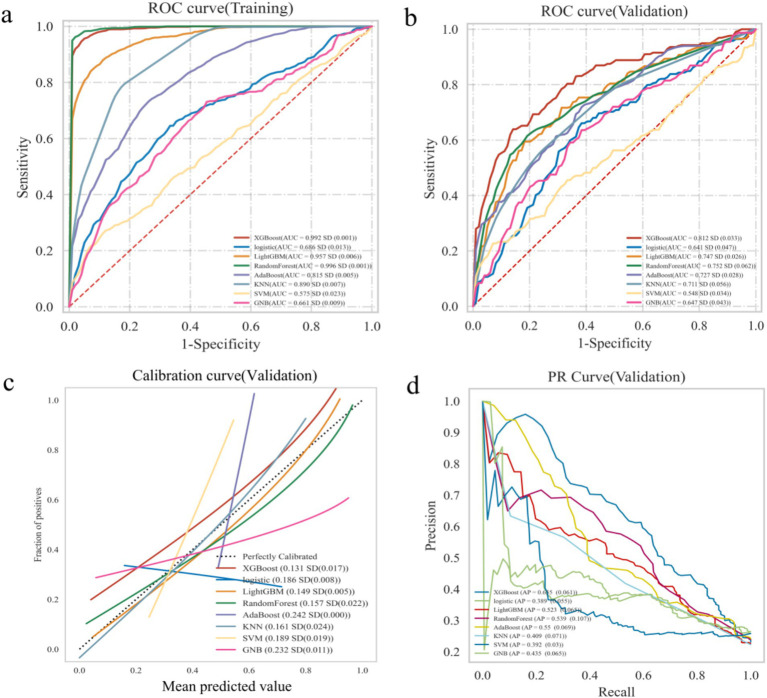
Methods: The study focused on hospitalized patients from January 2021 to May 2024. The case group consisted of patients with HA influenza, while the control group comprised non-HA influenza patients admitted to the same ward in the HA influenza unit within 2 weeks. The 953 subjects were divided into the training set and the validation set in a 7:3 ratio. Feature screening was performed using least absolute shrinkage and selection operator (LASSO) and the Boruta algorithm. Subsequently eight ML algorithms were applied to analyze and identify the optimal model using a 5-fold cross-validation methodology. And the area under the curve (AUC), area under the precision-recall curve (AP), F1 score, calibration curve and decision curve analysis (DCA) were applied to comprehensively assess the predictive effectiveness of the selected models. Feature factors were selected and feature importance's were assessed using SHapley's additive interpretation (SHAP). Furthermore, an interactive web-based platform was additionally developed to visualize and demonstrate the predictive model.
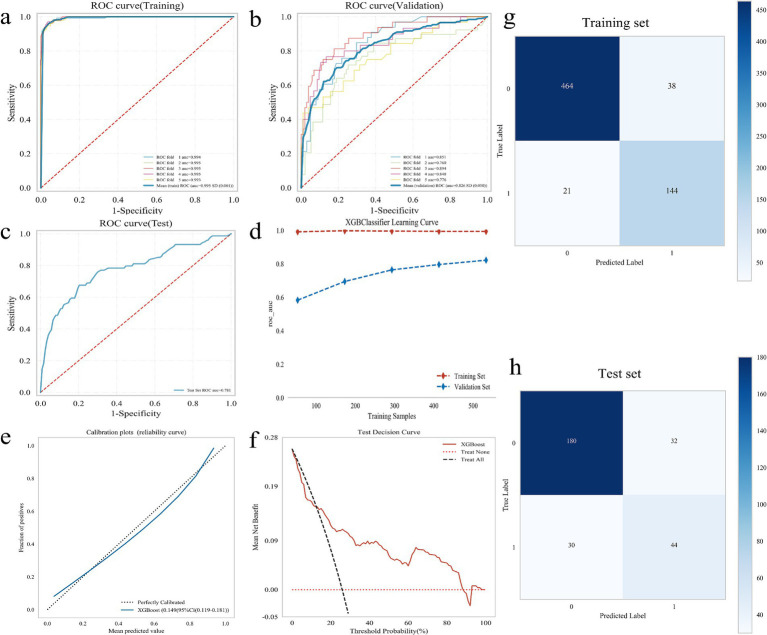
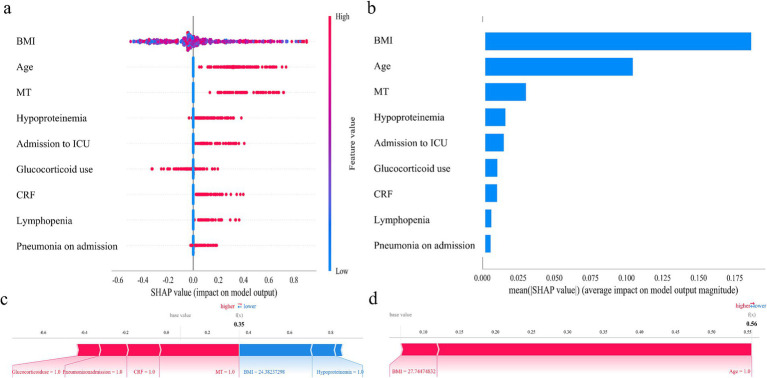
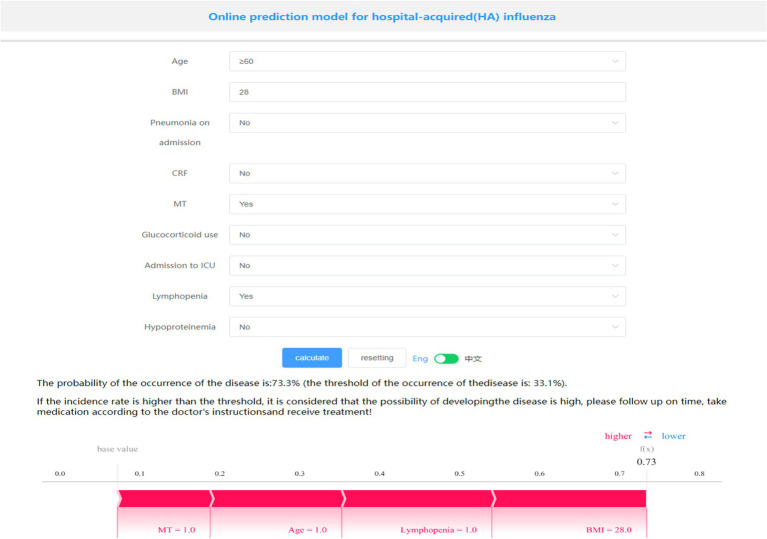
Results: Age, pneumonia on admission, Chronic renal failure, Malignant tumor, hypoproteinemia, glucocorticoid use, admission to ICU, lymphopenia, BMI were identified as key variables. For the eight ML algorithms, ROC values ranging from 0.548 to 0.812 were observed in the validation set. A comprehensive analysis showed that the XGBoost model predicted the highest accuracy (AUC: 0.812) with an F1 score of 0.590 and the highest A p value (0.655). Evaluating the optimal model, the AUC values were 0.995, 0.826, and 0.781 for the training, validation and test sets. The XGBoost model showed strong robust. SHapley's additive interpretation (SHAP) was utilized to analyze the contribution of explanatory variables to the model and their correlation with HA influenza. In addition, we developed a practical online prediction tool to calculate the risk of HA influenza occurrence.
Conclusion: Based on the routine data, the XGBoost model demonstrated excellent calibration among all ML algorithms and accurately predicted the risk of HA influenza, thereby serving as an effective tool for early screening of HA influenza.
Keywords: SHAP (SHapley’s additive explanation); hospital-acquired influenza; machine learning; practical tool; prediction model.
Copyright © 2025 Zhang, Li, Qiao, Qin, Wu and Guo.
Conflict of interest statement
The authors declare that the research was conducted in the absence of any commercial or financial relationships that could be construed as a potential conflict of interest.
Figures
References
-
- Salmanton-García J, Wipfler P, Leckler J, Nauclér P, Mallon PW, Bruijning-Verhagen PCJL, et al. . Predicting the next pandemic: VACCELERATE ranking of the World Health Organization's blueprint for action to Prevent Epidemics. Travel Med Infect Dis. (2024) 57:102676. doi: 10.1016/j.tmaid.2023.102676, PMID: - DOI - PubMed
-
- Deng LL, Han YJ, Li ZW, Wang DY, Chen T, Ren X, et al. . Epidemiological characteristics of seven notifiable respiratory infectious diseases in the mainland of China: an analysis of national surveillance data from 2017 to 2021. Infect Dis Poverty. (2023) 12:99. doi: 10.1186/s40249-023-01147-3, PMID: - DOI - PMC - PubMed
-
- 2023-2024 U.S . Flu season: Preliminary in-season burden estimates. Centers for Disease Control and Prevention. (2024). Available at: https://www.cdc.gov/flu-burden/php/data-vis/2023-2024.html.
MeSH terms
LinkOut - more resources
Full Text Sources
Medical
