


Replenish Revenue by Low-Cost Medicines, an Institution-Specific Action to Improve Access to High-Cost Medicines Used for Chronic Illness in Ethiopia: Narrative Review
- PMID: 40309621
- PMCID: PMC12040719
- DOI: 10.1002/hsr2.70775
Replenish Revenue by Low-Cost Medicines, an Institution-Specific Action to Improve Access to High-Cost Medicines Used for Chronic Illness in Ethiopia: Narrative Review
Abstract
Background: Over one-quarter of the global population has no access to essential medicines. Improving access to medicines for chronic illness requires multi-level interventions. Nearly half of the people who need insulin cannot afford it.
Aim: To describe institution-specific interventions that can be applied to improve access to high-cost medicines used for chronic diseases without affecting revenue generated from pharmaceuticals.
Methods: A narrative review was conducted by using articles written in the English language from January 2000 to May 2020 and retrieved from PubMed/Medline, Embase, Cochrane Library, Scopus, Web of Science, and Google Scholar with the following systematic search query.
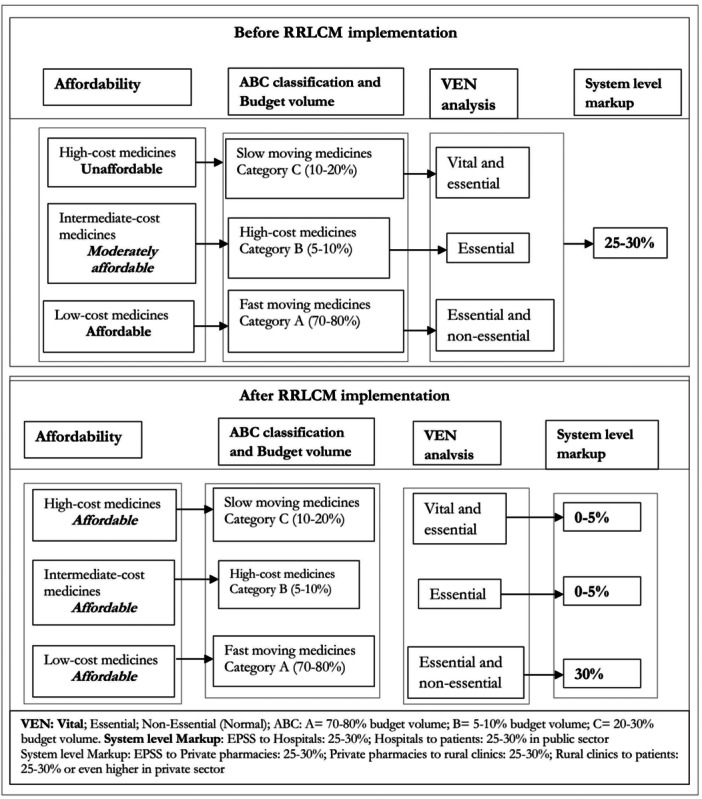
Results: Fifty-three studies were included. Most of the drugs used for the treatment of hypertension, diabetes, chronic asthma, and cancer are not available in adequate quantity. It requires more than 4 months' wage for a lowest-paid worker to buy one cycle of treatment for non-Hodgkin lymphoma, cervical cancer, or breast cancer in Ethiopia. The replenish revenue by low-cost medicines (RRLCM) model theoretically improved access to high-cost medicines. This model's steps include: (1) Estimate the number of patients who will take high-cost medicine for specific chronic diseases. (2) Estimate the amount of high-cost medicine required in a given period. (3) Calculate the markup-related change in revenue. (4) Select fast-moving items with better affordability in the supply chain. (5) Estimate revenue by modifying the markup of fast-moving items with better public affordability, and (6) calculate the difference and compare the markup-related revenue resulting from adjusting markups.
Conclusion: Medicines used for chronic diseases are neither available nor affordable. The RRLCM model has potential to improve affordability, pending empirical validation. Therefore, it is important to reform national drug policy in light of pricing and markup regulation system. Researchers, who are willing to work in the similar area should evaluate the applicability of RRLCM model in different set-ups.
Keywords: access to high‐cost medicines; facility‐specific regressive markup; non‐communicable diseases; pharmaceutical price regulation; replenish revenue by low‐cost medicines.
© 2025 The Author(s). Health Science Reports published by Wiley Periodicals LLC.
Conflict of interest statement
The author declares no conflicts of interest.
Figures

References
-
- National Academies of Sciences, Engineering, and Medicine, Health and Medicine Division, Board on Health Care Services , et al., eds., Making Medicines Affordable: A National Imperative . (National Academies Press, US; 2017). - PubMed
-
- World Health Organization ,“WHO Guideline on Country Pharmaceutical Pricing Policies, 2nd ed.,” licence: CC BY‐NC‐SA 3.0 IGO, (World Health Organization, 2020).
-
- Atun R., Davies J. I., Gale E. A. M., et al., “Diabetes in Sub‐Saharan Africa: From Clinical Care to Health Policy,” Lancet Diabetes & Endocrinology 5, no. 8 (2017): 622–667. - PubMed
LinkOut - more resources
Full Text Sources
