


Evaluating the Role of School-Based Physical Activity in Mitigating Cardiometabolic Risk Factors in Children and Adolescents with Overweight or Obesity: A Systematic Review and Meta-Analysis
- PMID: 40310073
- PMCID: PMC12025731
- DOI: 10.3390/children12040439
Evaluating the Role of School-Based Physical Activity in Mitigating Cardiometabolic Risk Factors in Children and Adolescents with Overweight or Obesity: A Systematic Review and Meta-Analysis
Abstract
Background: Overweight or obese children and adolescents have a higher risk of developing cardiometabolic health problems compared with their healthy-weight peers, which are likely to progress to cardiovascular disease and are associated with a range of negative impacts.
Objectives: To evaluate the effects of school-based physical activity (PA) interventions on cardiometabolic risk factors in children and adolescents with overweight or obesity.
Method: A search of online databases was conducted to identify relevant studies up to 31 January 2025.
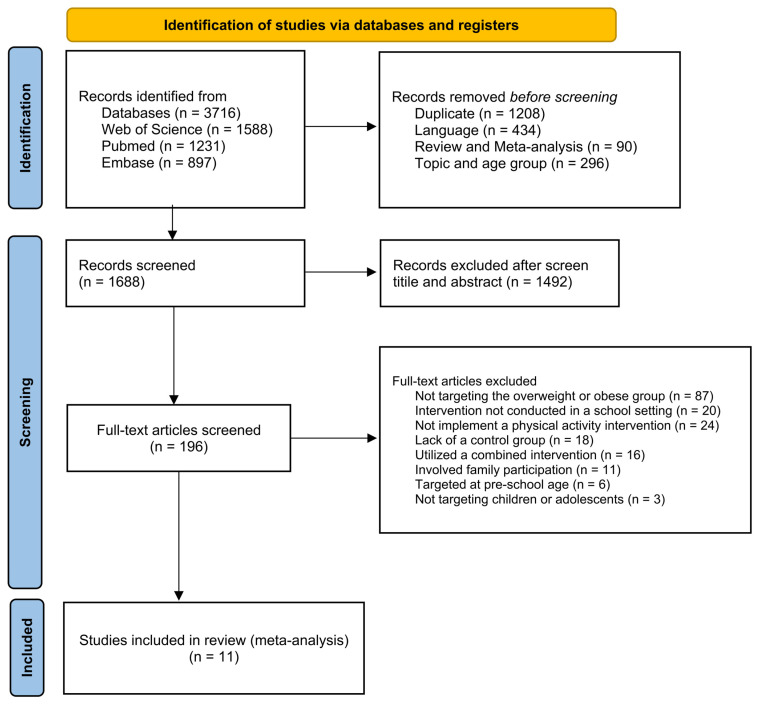
Results: Eleven studies were included, involving 963 participants aged 7 to 18 years. School-based PA interventions have a significant effect size (ES) in reducing body fat percentage (ES = -0.43, p < 0.01), diastolic blood pressure (ES = -0.27, p < 0.05), triglycerides (ES = -0.38, p < 0.01), fasting blood glucose (ES = -0.60, p < 0.01), blood insulin (ES = -0.62, p < 0.01), and homeostatic model assessment-insulin resistance (ES = -0.58, p < 0.01) in overweight or obese students. However, no significant improvements were observed in body mass index, body mass index z-score, waist circumference, waist-to-height ratio, maximal oxygen consumption, systolic blood pressure, high-density lipoprotein cholesterol, low-density lipoprotein cholesterol, and total cholesterol.
Conclusion: School-based PA interventions lasting 6 weeks longer, twice a week or more, can significantly mitigate some cardiometabolic risks of overweight or obese children and adolescents. Effective, targeted PA programs should be considered in the school setting to promote the cardiometabolic health of this vulnerable group.
Keywords: cardiometabolic health; exercise; pediatric obesity; school; teenager.
Conflict of interest statement
The authors declare no conflicts of interest.
References
-
- Phelps N.H., Singleton R.K., Zhou B., Heap R.A., Mishra A., Bennett J.E., Paciorek C.J., Lhoste V.P.F., Carrillo-Larco R.M., Stevens G.A., et al. Worldwide trends in underweight and obesity from 1990 to 2022: A pooled analysis of 3663 population-representative studies with 222 million children, adolescents, and adults. Lancet. 2024;403:1027–1050. doi: 10.1016/s0140-6736(23)02750-2. - DOI - PMC - PubMed
-
- Sun M., da Silva M., Bjorge T., Fritz J., Mboya I.B., Jerkeman M., Stattin P., Wahlstrom J., Michaelsson K., van Guelpen B., et al. Body mass index and risk of over 100 cancer forms and subtypes in 4.1 million individuals in Sweden: The Obesity and Disease Development Sweden (ODDS) pooled cohort study. Lancet Reg. Health Eur. 2024;45:101034. doi: 10.1016/j.lanepe.2024.101034. - DOI - PMC - PubMed
Publication types
LinkOut - more resources
Full Text Sources
