


Deep Learning Approaches to Forecast Physical and Mental Deterioration During Chemotherapy in Patients with Cancer
- PMID: 40310358
- PMCID: PMC12025769
- DOI: 10.3390/diagnostics15080956
Deep Learning Approaches to Forecast Physical and Mental Deterioration During Chemotherapy in Patients with Cancer
Abstract
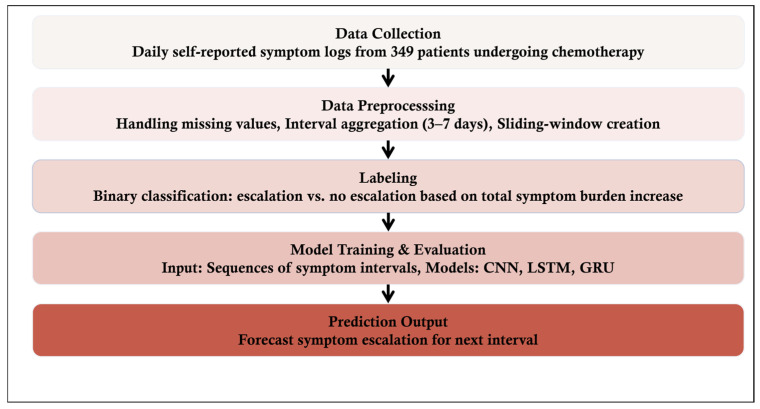
Background/Objectives: Predicting symptom escalation during chemotherapy is crucial for timely interventions and improved patient outcomes. This study employs deep learning models to predict the deterioration of 12 self-reported symptoms, categorized into physical (e.g., nausea, fatigue, pain) and mental (e.g., feeling blue, trouble thinking) groups. Methods: The analytical dataset comprises daily self-reported symptom logs from individuals undergoing chemotherapy. To address class imbalance-where 84% of cases showed no escalation-symptoms were grouped into intervals of 3 to 7 days. Convolutional Neural Networks (CNNs), Long Short-Term Memory (LSTM), and Gated Recurrent Unit (GRU) models were trained on 80% of the data and evaluated on the remaining 20%. Results: Results showed that 3-day intervals yielded the best predictive performance. CNNs excelled in predicting physical symptoms, achieving 79.2% accuracy, 84.1% precision, 78.8% recall, and an F1 score of 81.4%. For mental symptoms, GRU outperformed other models, with an accuracy of 77.2%, precision of 71.6%, recall of 62.2%, and an F1 score of 66.6%. Performance declined for longer intervals due to reduced temporal resolution and fewer training samples, though CNNs and GRU remained relatively stable. Conclusions: The findings emphasize the advantage of categorizing symptoms for more tailored predictions and demonstrate the potential of deep learning in forecasting symptom escalation. Integrating these predictive models into clinical workflows could facilitate proactive symptom management, allowing timely interventions and enhanced patient care during chemotherapy.
Keywords: AI; AI-driven symptom monitoring; CNN; GRU models; LSTM; chemotherapy symptom prediction; digital health; oncology symptom management.
Conflict of interest statement
The authors declare no conflict of interest.
Figures
References
-
- Kamdar M., Jethwani K., Centi A.J., Agboola S., Fischer N., Traeger L., Rinaldi S., Strand J., Ritchie C., Temel J.S., et al. A Digital Therapeutic Application (ePAL) to Manage Pain in Patients with Advanced Cancer: A Randomized Controlled Trial. J. Pain Symptom Manag. 2024;68:261–271. doi: 10.1016/j.jpainsymman.2024.05.033. - DOI - PubMed
Grants and funding
LinkOut - more resources
Full Text Sources
