. 2025 May 29;32(6):e240188.
doi: 10.1530/ERC-24-0188. Print 2025 Jun 1.

Real-world effectiveness of darolutamide in metastatic castration-resistant prostate cancer

Real-world effectiveness of darolutamide in metastatic castration-resistant prostate cancer

Alyssa Liang et al. Endocr Relat Cancer. .

Abstract

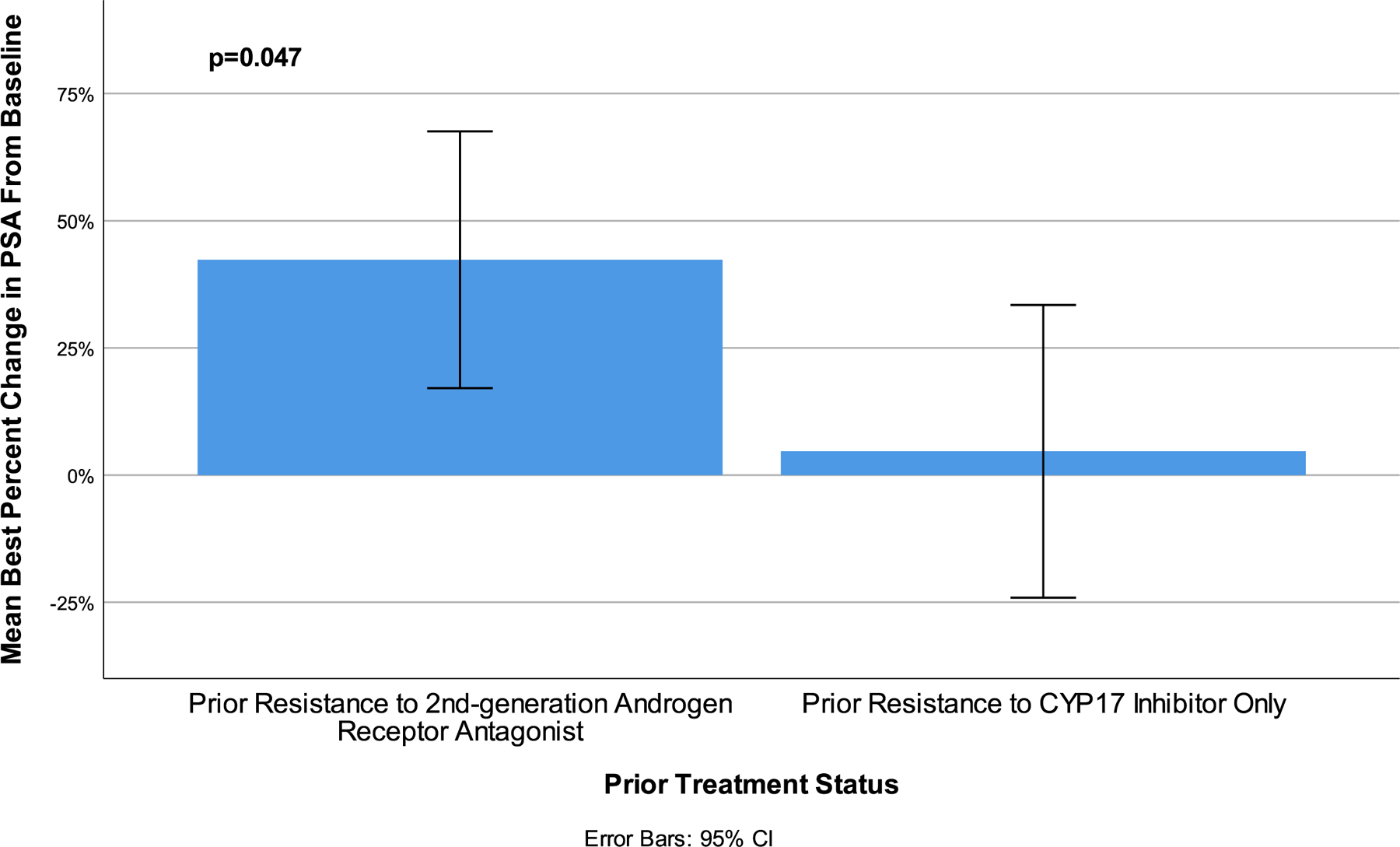
Darolutamide is a second-generation androgen receptor (AR) antagonist (2GARA) with established benefit in treating patients with non-metastatic castration-resistant prostate cancer (M0-CRPC) and metastatic castration-sensitive prostate cancer. Its real-world effectiveness in the treatment of patients with metastatic (M1) CRPC, including those who have progressed on CYP17 inhibitors (CYP17Is) or other 2GARAs (enzalutamide/apalutamide), is not well-described. We assessed the real-world effectiveness of darolutamide in a racially diverse cohort of 44 M1-CRPC and 11 M0-CRPC patients and collected data on baseline and emerging AR mutations in circulating tumor DNA (ctDNA) in these patients. The median progression-free survival (PFS) was 2.15 months for M1-CRPC and 21.16 months for M0-CRPC patients. In the M1-CRPC cohort, the median PFS was longer in those who had only received prior CYP17Is compared to 2GARA-resistant patients (2.43 vs 1.61 months; P = 0.03). Darolutamide suppressed serum PSA levels by >50% in 5/44 M1-CRPC patients (11.4%), all previously 2GARA-naïve. M1-CRPC patients resistant only to CYP17Is had improved mean best percent PSA changes from baseline compared to 2GARA-resistant patients (4.68 vs 42.34%; P = 0.047). PFS was not significantly different between African-American and non-African-American patients, or between patients with and without AR mutations at baseline. AR mutations emerging or increasing in allele fraction in ctDNA upon darolutamide treatment included H875Y, H100Q, D891H, T878A, L702H, L329W, N767Y and AR copy number gain. In summary, darolutamide may provide some benefit in CYP17I-refractory M1-CRPC patients, even in the presence of AR mutations. Resistance to other 2GARAs may significantly decrease benefit from darolutamide.

Keywords: M1-CRPC; darolutamide; health disparities; metastatic castration-resistant prostate cancer; next-generation sequencing.


Conflict of interest statement

Declaration of Interest

Patricia Castro declares significant financial interest in Sample-Kiosk.com, which is a mobile application for the secure collection of data. Sample-Kiosk is solely owned and developed by Jody and Patricia Castro. N.M. is an uncompensated member of the Tempus Inc. Advisory Board (Chicago, IL). All other authors declare no conflicts of interest.

Figures

Figure 1.
Figure 1.
Flowchart diagram of patient selection for our study, based on our inclusion and exclusion criteria. Abbreviations: CSPC- castration-sensitive prostate cancer
Figure 2.
Figure 2.
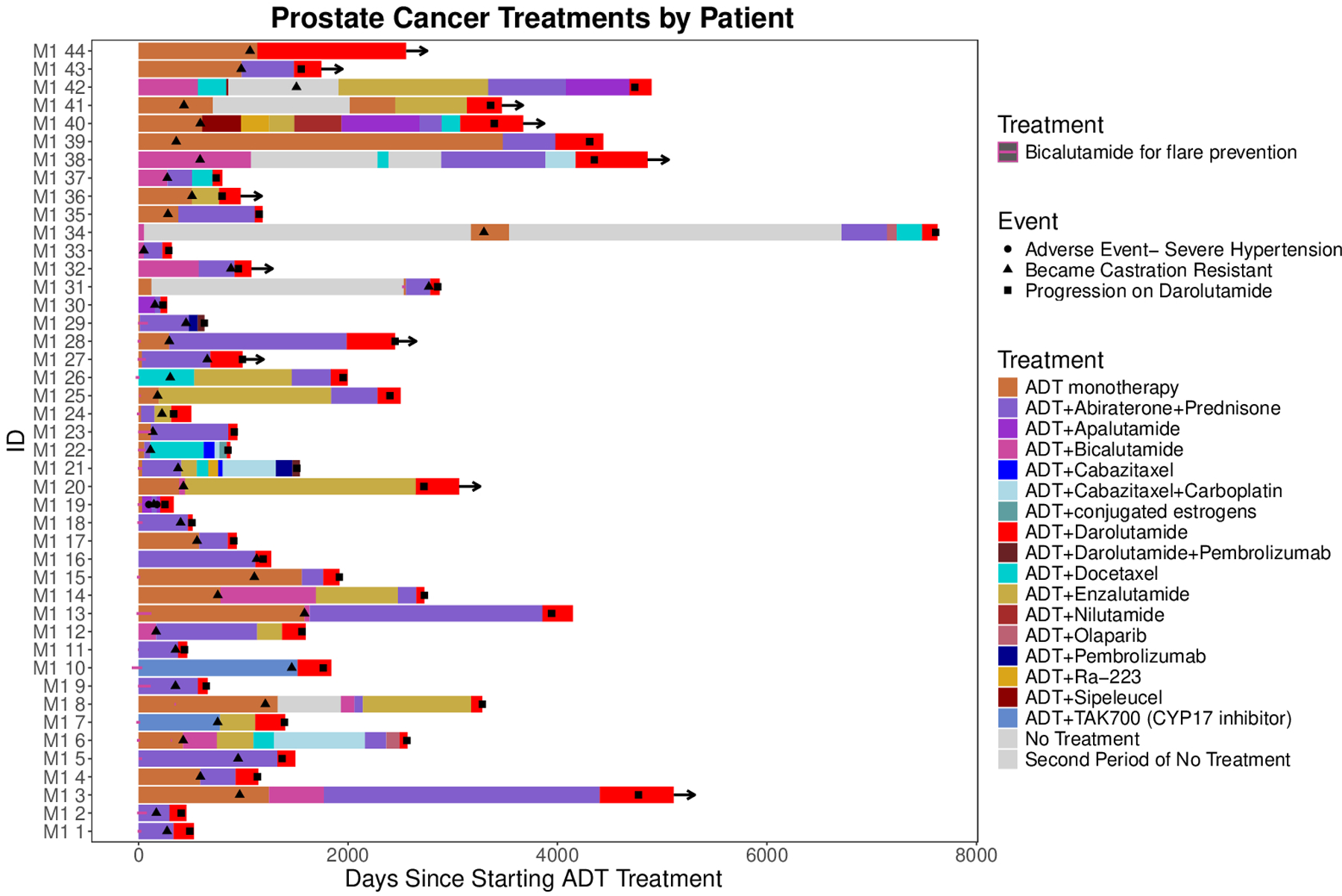
Swimmer plot presenting past treatment history for all M1-CRPC patients. Each bar on the Y-axis represents the clinical course of one patient, and the X-axis represents the number of days since initiating treatment with ADT. Each color in the bar represents a different treatment, as labeled in the Legend. Events are marked by symbols as indicated, and concurrent treatment with bicalutamide is marked by pink lines. Bars with arrows at the end signify that the patient continues to be treated with darolutamide. Abbreviations: ADT- androgen deprivation therapy, Ra-223- Radium-223
Figure 3.
Figure 3.
Kaplan-Meier survival graph comparing PFS between M0-CRPC (blue line) and M1-CRPC (red line) patients. The log-rank test was used to compare PFS between groups, with the P-value for significance set at 0.05. Abbreviations: M0-CRPC, non-metastatic castration-resistant prostate cancer; M1-CRPC, metastatic castration-resistant prostate cancer.
Figure 4.
Figure 4.
Kaplan-Meier graph comparing PFS between M1-CRPC patients refractory only to CYP17 inhibitors (red line) (with no prior resistance to 2GARAs, n = 26) and M1-CRPC patients refractory to 2GARAs (blue line) (n = 17). One M1-CRPC who had not previously received any ARSI is excluded from this graph. The log-rank test was used to compare PFS between groups, with the P-value for significance set at 0.05. Abbreviations: M1-CRPC, metastatic castration-resistant prostate cancer; CYP17I, CYP17 inhibitor; 2GARA, second-generation AR antagonist.
Figure 5.
Figure 5.
Spider plots displaying PSA changes over time for (a) patients previously treated with CYP17Is only and (b) patients previously treated with 2GARAs. Percent PSA change from baseline before darolutamide treatment is displayed on the y-axis, and the number of days since baseline measurement is displayed on the x-axis. Each line represents a single patient, and lines are solid before the point of progression and dashed afterward. Darolutamide suppressed PSA by at least 50% in four of 26 patients previously treated with CYP17Is only (a). None of the 17 patients with prior 2GARA resistance had a 50% decline in PSA (b). One M1-CRPC who had not previously received any ARSI is excluded from these plots. Abbreviations: CYP17I- CYP17 inhibitor, 2GARA- 2nd-generation androgen receptor antagonist, PSA- prostate-specific antigen
Figure 6.
Figure 6.
Bar graph comparing the best % change in PSA (deltaPSA) from baseline by prior treatment status (M1-CRPC patients with prior resistance to only CYP17Is vs patients resistant to 2GARAs. The t-test was used to compare deltaPSAs between the two subgroups, with the p-value for significance set at 0.05. Error bars: 95% CI. Abbreviations: CYP17I- CYP17 inhibitor, 2GARA- 2nd-generation androgen receptor antagonist, PSA- prostate-specific antigen
Figure 7.
Figure 7.
This graph shows the emergence of a D891H mutation during the course of treatment of Patient M1 #6 with darolutamide, and its disappearance after stopping darolutamide. This pattern may suggest that the D891H mutation confers resistance to darolutamide, with the D891H mutation disappearing when darolutamide was stopped because the selective pressure favoring the D891H mutation also ceased. Abbreviations: PSA- prostate-specific antigen, ctDNA- circulating tumor DNA, AR- androgen receptor

References

    1. ALBALA DM 2017. Imaging and treatment recommendations in patients with castrate-resistant prostate cancer. Rev Urol, 19, 200–202. - PMC - PubMed
    1. ANNALA M, VANDEKERKHOVE G, KHALAF D, TAAVITSAINEN S, BEJA K, WARNER EW, SUNDERLAND K, KOLLMANNSBERGER C, EIGL BJ, FINCH D, OJA CD, VERGIDIS J, ZULFIQAR M, AZAD AA, NYKTER M, GLEAVE ME, WYATT AW & CHI KN 2018. Circulating Tumor DNA Genomics Correlate with Resistance to Abiraterone and Enzalutamide in Prostate Cancer. Cancer Discov, 8, 444–457. - PubMed
    1. ANTONARAKIS ES, ZHANG N, SAHA J, NEVALAITA L, IKONEN T, TSAI LJ, GARRATT C & FIZAZI K 2024. Prevalence and Spectrum of AR Ligand-Binding Domain Mutations Detected in Circulating-Tumor DNA Across Disease States in Men With Metastatic Castration-Resistant Prostate Cancer. JCO Precis Oncol, 8, e2300330. - PMC - PubMed
    1. ARMSTRONG AJ, SZMULEWITZ RZ, PETRYLAK DP, HOLZBEIERLEIN J, VILLERS A, AZAD A, ALCARAZ A, ALEKSEEV B, IGUCHI T, SHORE ND, ROSBROOK B, SUGG J, BARON B, CHEN L & STENZL A 2019. ARCHES: A Randomized, Phase III Study of Androgen Deprivation Therapy With Enzalutamide or Placebo in Men With Metastatic Hormone-Sensitive Prostate Cancer. Journal of Clinical Oncology, 37, 2974–2986. - PMC - PubMed
    1. ATTARD G, BORRE M, GURNEY H, LORIOT Y, ANDRESEN-DANIIL C, KALLEDA R, PHAM T & TAPLIN ME 2018. Abiraterone Alone or in Combination With Enzalutamide in Metastatic Castration-Resistant Prostate Cancer With Rising Prostate-Specific Antigen During Enzalutamide Treatment. J Clin Oncol, 36, 2639–2646. - PMC - PubMed

MeSH terms

LinkOut - more resources