


Recent trends in cosmic radiation exposure onboard aircraft: effects of the COVID-19 pandemic on Japanese in-flight doses
- PMID: 40313500
- PMCID: PMC12043470
- DOI: 10.3389/fpubh.2025.1554332
Recent trends in cosmic radiation exposure onboard aircraft: effects of the COVID-19 pandemic on Japanese in-flight doses
Abstract
Background: Galactic cosmic radiation (GCR) is a naturally occurring environmental radiation that originates from outer space. GCR is modulated by solar activity, and its intensity increases with increasing geomagnetic latitude and altitude, reaching a peak of up to approximately 20 km in the atmosphere. Therefore, commercial flight passengers (flyers) are exposed to elevated levels of cosmic radiation while flying onboard commercial aircraft. Although the recent COVID-19 pandemic, which began in early 2020, is believed to have significantly affected public exposure to cosmic radiation, this impact is yet to be quantified.
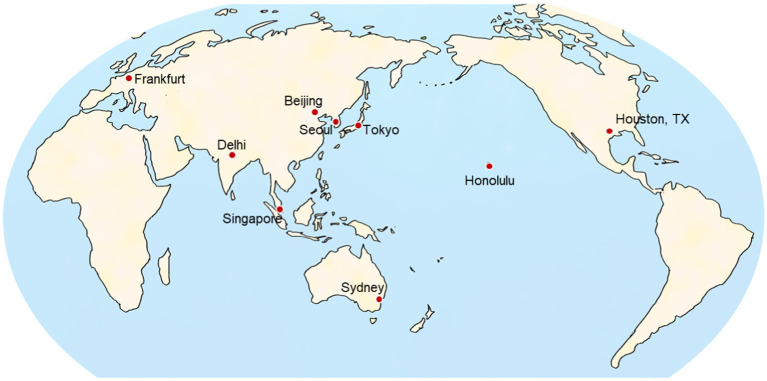
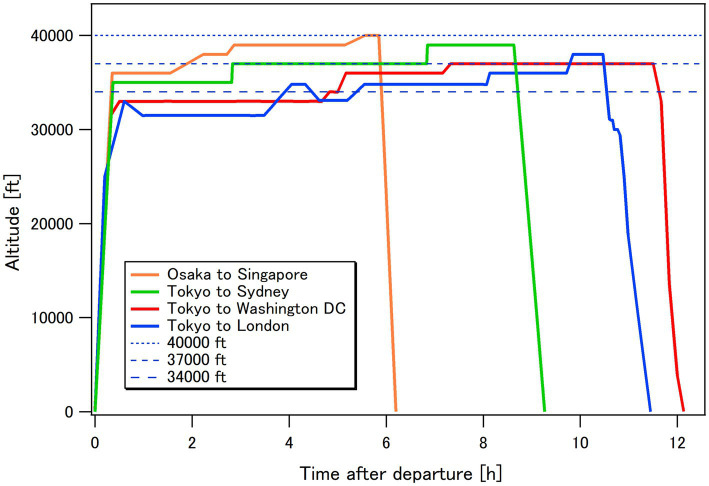
Methods: Based on the official records of Japanese flyers, their annual per-capita doses (APCDs) of cosmic radiation exposure on international and domestic flights were calculated using the established code JISCARD EX over a 7-year period from 2014 to 2020 (including the first year of the pandemic). For estimating the APCDs on international flights, the world was divided into eight regions. The aviation route dose to a representative city in each region was determined at three cruising altitudes: 34,000 ft. (10.4 km), 37,000 ft. (11.3 km), and 40,000 ft. (12.2 km).
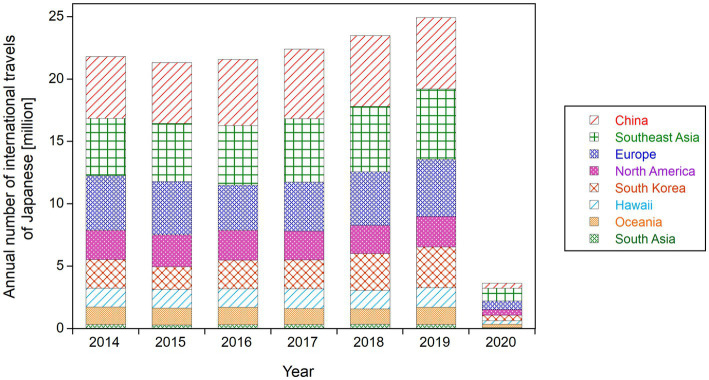
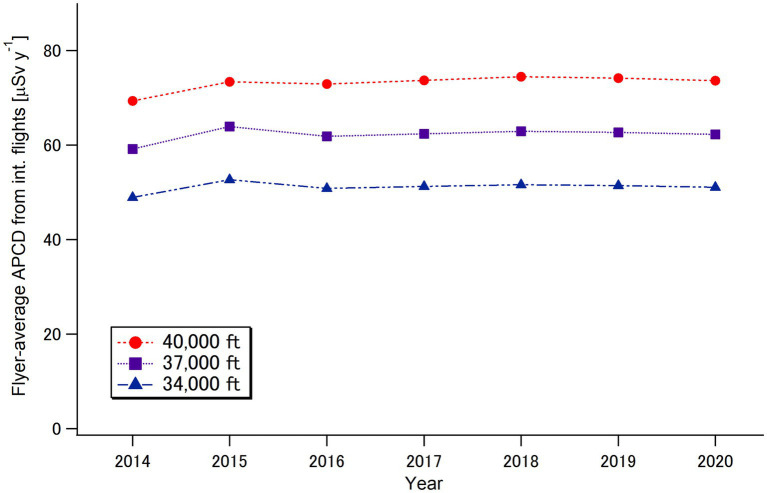
Results: At a typical cruising altitude of 37,000 ft., the flyer-average APCD from international flights was estimated to be approximately 60 μSv y-1, while the APCD from domestic flights was approximately 2 μSv y-1 over the target period, including the pandemic year (2020). These results indicate that the distribution of Japanese travel destinations did not change significantly during the pandemic period. In contrast, the population-average APCD significantly decreased from approximately 10 μSv y-1 in the pre-pandemic period (2014-2019) to 2 μSv y-1 in 2020, representing a reduction of more than 80%, which corresponds to a decline in the number of travelers.
Conclusion: The results of this study indicate that the population-average APCD of Japanese flyers decreased significantly during the COVID-19 pandemic, while the flyer-average APCD remained largely unchanged. Further studies will be performed to determine APCDs for the subsequent period and to assess the overall effect of the pandemic on public health.
Keywords: COVID-19 pandemic; Japanese; aviation dose; commercial flight; cosmic radiation; per-capita.
Copyright © 2025 Yasuda, Motoyama and Yajima.
Conflict of interest statement
The authors declare that the research was conducted in the absence of any commercial or financial relationships that could be construed as a potential conflict of interest.
Figures

References
MeSH terms
LinkOut - more resources
Full Text Sources
Medical
Research Materials
