


Isothermal Disorder-to-Order Transitions of DNA Origami Structures Induced by Alternative Component Subsets
- PMID: 40313835
- PMCID: PMC12041949
- DOI: 10.1021/jacsau.5c00195
Isothermal Disorder-to-Order Transitions of DNA Origami Structures Induced by Alternative Component Subsets
Abstract
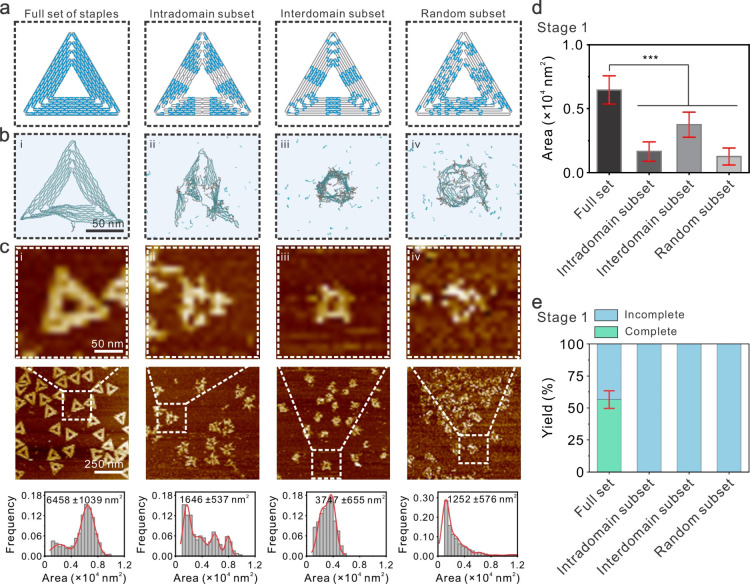
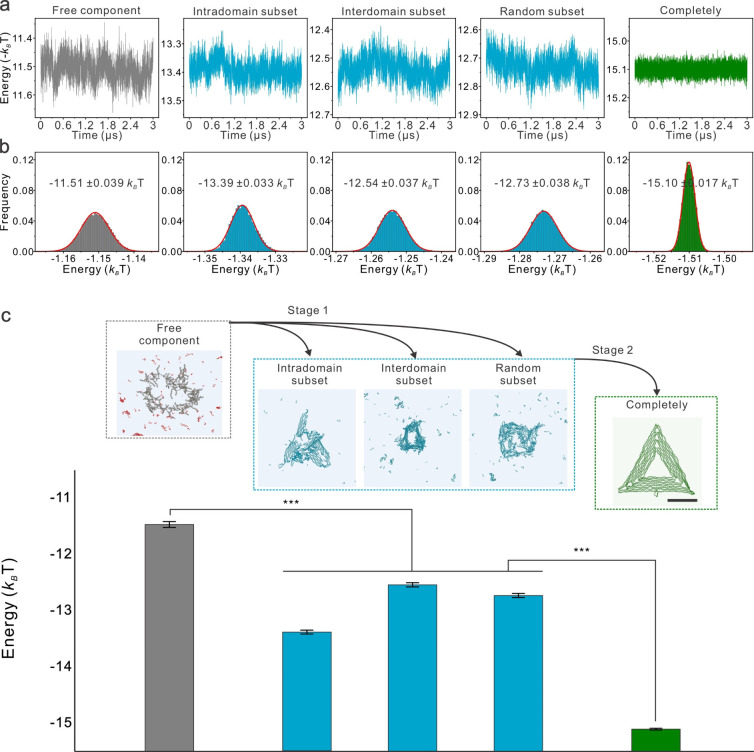
DNA origami technology has shown potential across various applications, including the construction of molecular machines. Among these, mimicking the complex structural transitions of natural biomolecules in physiological environments remains a long-standing pursuit. Here, inspired by intrinsically disordered proteins, we propose a strategy for inducing disorder-to-order transitions in DNA origami structures at room temperature using alternative component subsets. In a triangular DNA origami model, we define three subsets of its constitutional DNA staples based on their spatial distributions along the scaffold. Atomic force microscopy and molecular dynamics simulations show that the individual subsets result in metastable assemblies with disordered morphologies and elevated free-energy fluctuations compared with those generated by the complete set of staples. Notably, after the addition of the remaining staples, the irregular structures transform into ordered triangular architectures within 2 h at room temperature, achieving yields of up to ∼60%. These findings suggest that these controlled folding pathways in DNA origami can robustly converge on the global energy minimum at room temperature, thereby providing a promising alternative strategy for engineering biomimetic DNA molecular machines.
© 2025 The Authors. Published by American Chemical Society.
Conflict of interest statement
The authors declare no competing financial interest.
Figures


References
-
- Dey S.; Fan C.; Gothelf K. V.; Li J.; Lin C.; Liu L.; Liu N.; Nijenhuis M. A. D.; Saccà B.; Simmel F. C.; Yan H.; Zhan P. DNA Origami. Nat. Rev. Methods Primers 2021, 1 (1), 13. 10.1038/s43586-020-00009-8. - DOI
LinkOut - more resources
Full Text Sources