


Age-dependent mechanisms of exercise in the treatment of depression: a comprehensive review of physiological and psychological pathways
- PMID: 40313907
- PMCID: PMC12043869
- DOI: 10.3389/fpsyg.2025.1562434
Age-dependent mechanisms of exercise in the treatment of depression: a comprehensive review of physiological and psychological pathways
Abstract
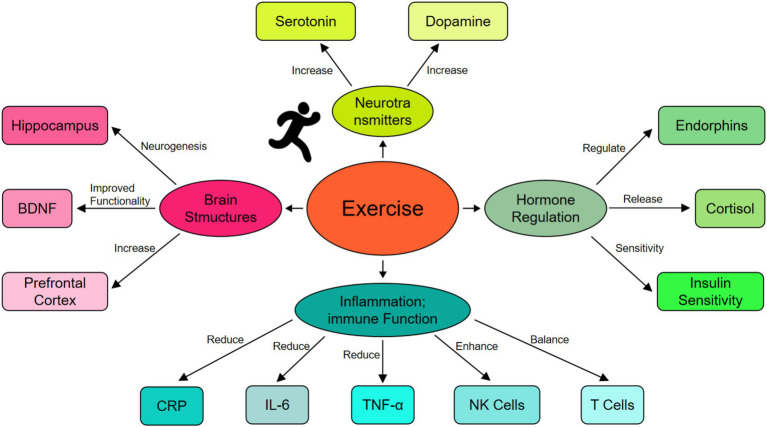
Depression has become one of the most common mental disorders in the world. The rising incidence rate and disability rate pose a serious challenge to public health and socio-economic development. Traditional medication and psychotherapy are positive, but they often come with limitations such as side effects, poor compliance, and resource constraints, which highlights the urgent need for more proactive and sustainable non pharmacological interventions. We mainly explored the physiological and psychological mechanisms of exercise in alleviating depression in different age groups. In particular, we evaluated the characteristics and influencing factors of depression in each age group and compared the pathways through which exercise works, aiming to provide scientific basis for clinical practice and public health policies, and strengthen the application of non pharmacological treatment in depression management. It is worth noting that, in the context of a comprehensive search and analysis of recent literature, we have covered the epidemiology of depression, the impact of exercise on mental health, the characteristics of depression in different age groups, and the specific ways in which exercise alleviates depression through physiological and psychological mechanisms. Exercise alleviates symptoms of depression by regulating neurotransmitters, enhancing neuroplasticity, regulating hormone levels, reducing inflammatory responses through physiological pathways, as well as enhancing cognitive function, strengthening emotional regulation, triggering social interactions, and improving self-efficacy through psychological pathways. The differences in physiological and psychological mechanisms among different age groups determine the age dependent characteristics of exercise in mitigating depression. Teenagers, middle-aged people, and elderly people can improve depressive symptoms by enhancing neural progression, regulating stress responses, and strengthening social support, respectively.
Keywords: age-dependency; depression; exercise; mechanisms; treatment.
Copyright © 2025 Xue, Du and Kong.
Conflict of interest statement
The authors declare that the research was conducted in the absence of any commercial or financial relationships that could be construed as a potential conflict of interest.
Figures
References
-
- Abbatecola A. M., Arosio B., Cerasuolo M., Auriemma M. C., di Meo I., Langiano E., et al. (2024). Common neurodegenerative pathways in brain aging, cognitive decline, type 2 diabetes & metabolic syndrome. J. Gerontol. Geriatr. 72, 43–49. doi: 10.36150/2499-6564-N691, PMID: - DOI
-
- Alomary A. A., Belhadj S. (2007). Determination of heavy metals (cd, Cr, cu, Fe, Ni, Pb, Zn) by ICP-OES and their speciation in Algerian Mediterranean Sea sediments after a five-stage sequential extraction procedure. Environ. Monit. Assess. 135, 265–280. doi: 10.1007/s10661-007-9648-8, PMID: - DOI - PubMed
-
- American Psychiatric Association . (2013). Diagnostic and statistical manual of mental disorders. Text revision. American Psychiatric Association.
Publication types
LinkOut - more resources
Full Text Sources
