


The impact of brand advertising on children's food preferences and behavioural intentions: an experimental study
- PMID: 40314110
- PMCID: PMC12100560
- DOI: 10.1017/S1368980025000369
The impact of brand advertising on children's food preferences and behavioural intentions: an experimental study
Abstract
Objective: Despite strong evidence linking exposure to food and beverage marketing with poor diet quality and negative health impacts in children, the effect of brand marketing (i.e. marketing featuring branded content, but no food products) is uncertain. This study evaluated the impact of brand marketing v. product-based advertising on children's food preferences and behavioural intentions.
Design: An online survey was administered to participants randomised to one of four ad conditions; familiar product (i.e. from popular Canadian brands); familiar brand (i.e. no food product, Canadian brand); unfamiliar product (i.e. foreign products); and unfamiliar brand ad (i.e. foreign brand). Participants viewed three ads displaying features of that condition and answered three 5-point Likert-scale questions related to the study outcomes: food preference, purchase intent and pester power. The average of all outcomes determined the total impact. An ANOVA with Bonferroni post hoc tests evaluated differences in impact between conditions.
Setting: Canada participants: n 1341 Canadian children (9-12 years).
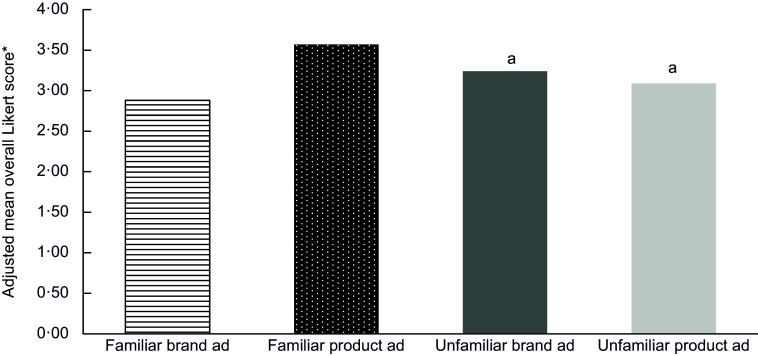
Results: Familiar product ads had a higher total impact on children (mean score 3·57) compared with familiar brand ads (2·88), unfamiliar brand ads (3·24) or unfamiliar product ads (3·09; P < 0·001 for all pairwise comparisons). Total impact was lower for familiar brand ads than for unfamiliar brand ads or unfamiliar product ads (P < 0·001 for all pairwise comparisons). The impact of an unfamiliar brand and product did not differ (P = 0·53).
Conclusions: Results suggest that familiar product ads seem to have a stronger impact on children's food preferences and behavioural intentions than familiar brand ads, unfamiliar brand ads and unfamiliar product ads.
Keywords: Brand marketing; Children; Food and beverage brands; Food marketing; Food policy; Marketing restrictions; Youth.
Conflict of interest statement
There are no conflicts of interest.
Figures
References
-
- World Health Organization (2022) Protecting Children from the Harmful Impact of Food Marketing: Policy Brief. https://www.who.int/publications/i/item/9789240051348 (accessed March 2024).
-
- World Health Organization (2022) Food Marketing Exposure and Power and Their Associations with Food-Related Attitudes, Beliefs, and Behaviours: A Narrative Review. https://www.who.int/publications/i/item/9789240041783 (accessed March 2024).
-
- World Health Organization (2022) WHO Guideline on Policies to Protect Children from the Harmful Impact of Food Marketing: Draft WHO Guideline for Public Consultation. https://www.who.int/news-room/articles-detail/Online-public-consultation... (accessed March 2024). - PubMed
-
- Sadeghirad B, Duhaney T, Motaghipisheh S, et al. (2016) Influence of unhealthy food and beverage marketing on children’s dietary intake and preference: a systematic review and meta-analysis of randomized trials. Obes Rev: Offic J Int Assoc Study Obes 17, 945–959. - PubMed
Publication types
MeSH terms
LinkOut - more resources
Full Text Sources
