


Plasma biomarkers of amyloid, tau & neuroinflammation in Alzheimer's disease and corticobasal syndrome
- PMID: 40314736
- PMCID: PMC12638345
- DOI: 10.1007/s00406-025-02013-z
Plasma biomarkers of amyloid, tau & neuroinflammation in Alzheimer's disease and corticobasal syndrome
Abstract
Background: Blood-based biomarkers (BBBMs) could significantly facilitate the diagnosis of Alzheimer's disease (AD) and non-AD dementia by providing less invasive alternatives to cerebrospinal fluid (CSF) and positron emission tomography (PET) imaging.
Objective: This study investigated how well the BBBMs-amyloid-β (Aβ) 1-42/1-40 ratio, phosphorylated tau181 (pTau181), apolipoprotein E4 (ApoE4), glial fibrillary acidic protein (GFAP), and neurofilament light chain (NfL)-reflect thorough clinical work-up validated by PET and CSF biomarkers in participants with AD (n = 27), Aβ-negative CBS (n = 26), and agematched healthy controls (HC) (n = 17).
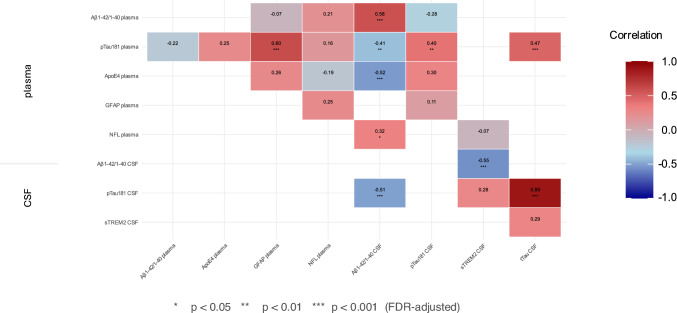
Methods: Factor and correlation explored biomarker associations. Bayesian regression, backward selection regression, and ROC curve analysis were applied to identify optimal biomarker combinations and diagnostic cut-offs.
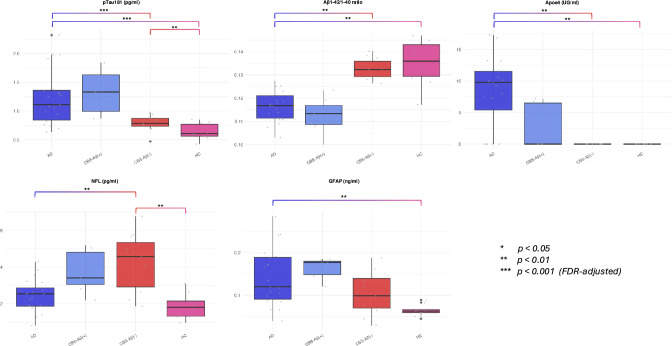
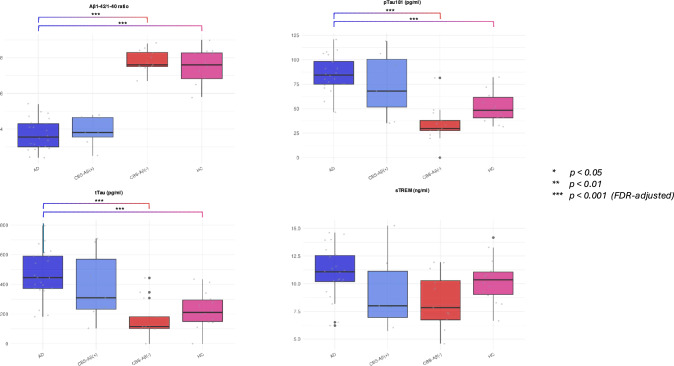
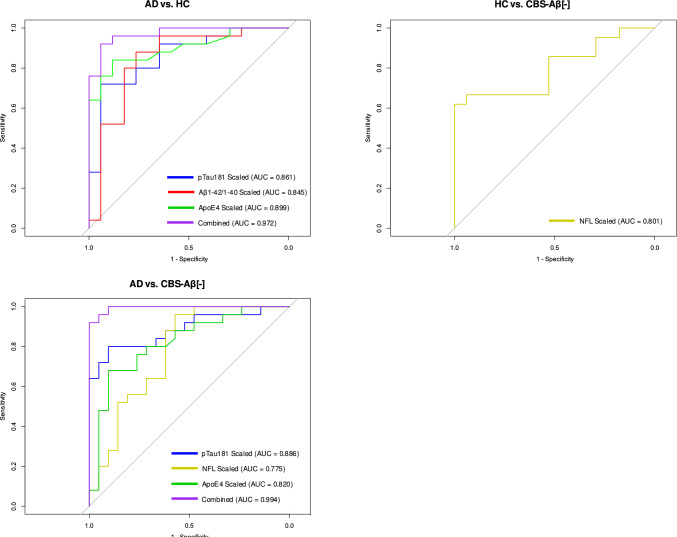
Results: In AD cases, pTau181 and ApoE4 levels were elevated, and the Aβ1-42/1-40 ratio was reduced. ROC analysis showed high accuracy for pTau181, ApoE4 and Aβ1-42/1-40 in discriminating AD from HC, with a combination significantly improving performance. However, limited fold change, and high variability reduced the diagnostic applicability of Aβ1-42/1-40 ratio. Elevated NfL levels were the most reliable biomarker for CBS-Aβ(-) cases. GFAP showed limited discriminatory power due to overlapping levels, suggesting that it may not serve as a disease-specific biomarker but may be indicative of general neurodegeneration.
Conclusions: This study highlights the diagnostic utility of pTau181, ApoE4 and the Aβ1-42/1-40 ratio for AD and NfL in the CBS-Aβ(-) cases and emphasizes the added value of combined biomarker models for group differentiation. Prospective studies will help validate these findings and refine clinical thresholds.
Keywords: Apolipoprotein E (ApoE4); Beta-amyloid 1-40 (Aβ1-40); Beta-amyloid 1-42 (Aβ1-42); Glial fibrillary acidic protein (GFAP); Neurofilament light chain (NfL); Non-Alzheimer's disease dementia; beta; Phosphorylated tau (pTau).
© 2025. The Author(s).
Conflict of interest statement
Declarations. Conflict of interest: S.H., A.J. are full-time employees of Roche Diagnostics GmbH, Penzberg, Germany, I.S. M.C. are full-time employee of Roche Diagnostics International Ltd, Rotkreuz, Switzerland and T.B. is full-time employee and stakeholder of F. Hoffmann-La Roche Ltd, Basel, Switzerland, which manufactured the blood biomarkers that were investigated in this study. C.K. has received speaker honoraria from Roche Diagnostics International Ltd, Rotkreuz, Switzerland. R.P. has received consultancy fees and speaker honoraria from Roche. G. H. serves as a consultant for Abbvie, Alzprotect, Amylyx, Aprinoia, Asceneuron, Bayer, Bial, Biogen, Biohaven, Epidarex, Ferrer, Kyowa Kirin, Lundbeck, Novartis, Retrotope, Roche, Sanofi, Servier, Takeda, Teva, UCB; received honoraria for scientific presentations from Abbvie, Bayer, Bial, Biogen, Bristol Myers Squibb, Kyowa Kirin, Pfizer, Roche, Teva, UCB, Zambon. All other authors report no biomedical financial interests or potential conflicts of interest.
Figures

References
MeSH terms
Substances
Grants and funding
LinkOut - more resources
Full Text Sources
Medical
Miscellaneous
