


Freehand vs. computer-aided implant surgery: a systematic review and meta-analysis-part 1: accuracy of planned and placed implant position
- PMID: 40314873
- PMCID: PMC12048383
- DOI: 10.1186/s40729-025-00622-w
Freehand vs. computer-aided implant surgery: a systematic review and meta-analysis-part 1: accuracy of planned and placed implant position
Abstract
Objectives: This systematic review aimed to investigate and compare the accuracy of free-hand and computer-aided implant surgery (CAIS) approaches in dental implant placement.
Material and methods: The PICO question as follows: In patients receiving dental implants, does computer-aided implant surgery superior in accuracy compared to non-computer-aided implant surgery? The primary outcome was angular deviation between the planned and placed position of the implant. An electronic search was made to identify all relevant studies reporting the accuracy of CAIS approaches and freehand for dental implant placement. The data were extracted in the descriptive description, and a meta-analysis of single means was performed to estimate the deviations for each variable using a random-effects model.
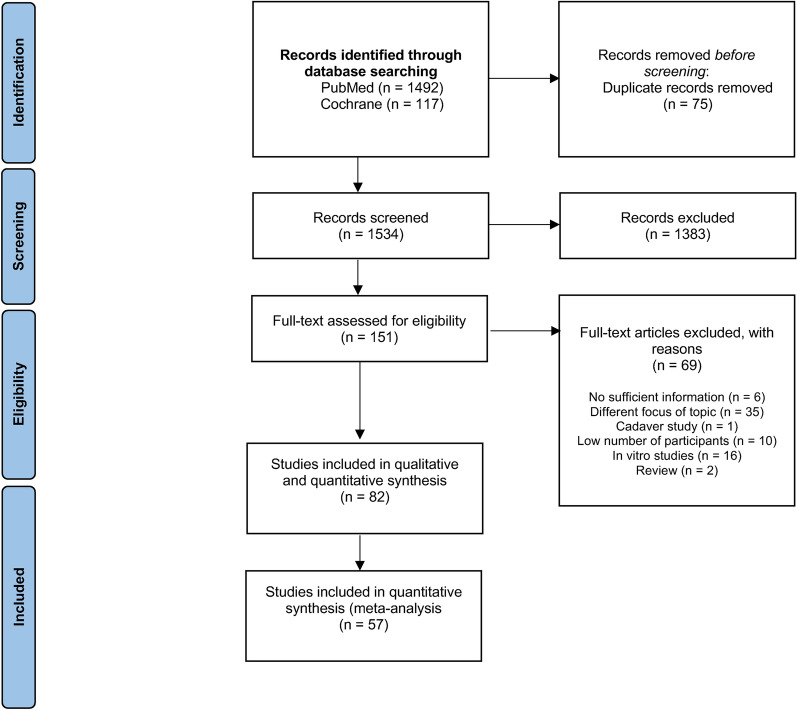
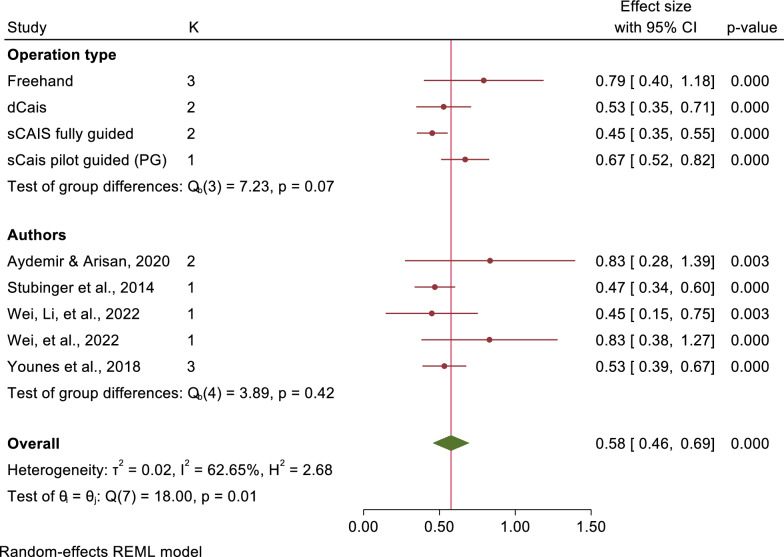
Results: Out of 1609 initial articles, 55 were selected for data extraction. The mean value of angular, entry, and apex deviations were 7.46°, 1.56 mm, and 2.22 mm for freehand, 5.94°, 1.13 mm, and 1.43 mm for pilot drill-sCAIS, 2.57°, 0.72 mm, 0.88 mm for fully guided-sCAIS (fg-sCAIS), and 3.67°, 1.01 mm, and 1.36 for dynamic CAIS (dCAIS), respectively. Significant differences were found between the freehand and CAIS approaches (p < 0.04). Fg-sCAIS was significantly more accurate than dCAIS systems at the entry (p < 0.001).
Conclusions: Compared to the freehand approach, both sCAIS and dCAIS improve implant placement accuracy, with angular deviations ranging from 2° to 6°. Detailed planning is crucial for CAIS, particularly for fg-sCAIS, which demonstrated the highest accuracy than others. As apex deviations of 1 to 2 mm have been observed in CAIS approaches, a 2-mm safety margin should be implemented to minimize surgical risks.
© 2025. The Author(s).
Conflict of interest statement
Declarations. Competing interests: The authors declare no competing interests.
Figures



References
-
- Moraschini V, Poubel LA, Ferreira VF, Barboza ES. Evaluation of survival and success rates of dental implants reported in longitudinal studies with a follow-up period of at least 10 years: a systematic review. Int J Oral Maxillofac Surg. 2015;44(3):377–88. - PubMed
-
- Buser D, Martin W, Belser UC. Optimizing esthetics for implant restorations in the anterior maxilla: anatomic and surgical considerations. Int J Oral Maxillofac Implants. 2004;19(Suppl):43–61. - PubMed
-
- Greenstein G, Cavallaro J, Romanos G, Tarnow D. Clinical recommendations for avoiding and managing surgical complications associated with implant dentistry: a review. J Periodontol. 2008;79(8):1317–29. - PubMed
-
- Vercruyssen M, Fortin T, Widmann G, Jacobs R, Quirynen M. Different techniques of static/dynamic guided implant surgery: modalities and indications. Periodontol 2000. 2014;66(1):214–27. - PubMed
-
- Varga E Jr, Antal M, Major L, Kiscsatari R, Braunitzer G, Piffko J. Guidance means accuracy: a randomized clinical trial on freehand versus guided dental implantation. Clin Oral Implants Res. 2020;31(5):417–30. - PubMed
Publication types
MeSH terms
Substances
LinkOut - more resources
Full Text Sources
Research Materials
Miscellaneous
