


The effect of prenatal education on exclusive breastfeeding among women in Quito: prospective cohort study
- PMID: 40316934
- PMCID: PMC12046691
- DOI: 10.1186/s12884-025-07651-8
The effect of prenatal education on exclusive breastfeeding among women in Quito: prospective cohort study
Abstract
Background: Breast milk is the optimal food for humans, however, many mothers face challenges in sustaining exclusive breastfeeding (EBF). Prenatal education (PE) has been suggested as a strategy to promote EBF, but there is evidence that its impact on EBF duration remains inconclusive. This study aimed to evaluate the effect of PE on EBF continuation among mothers who gave birth in private and public hospitals in Quito, Ecuador, and to identify modifiable risk factors associated with EBF discontinuation.
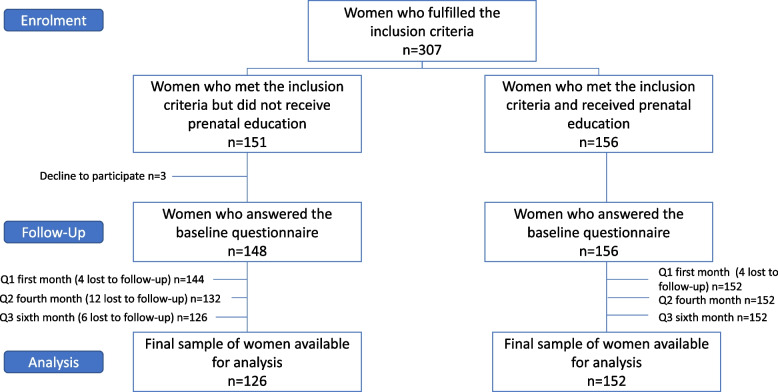
Methods: A prospective cohort study was conducted, recruiting 278 mothers, of whom 152 received PE and 126 did not. Participants were followed from birth to six months postpartum. Data collection included a structured survey, with baseline clinical information obtained through face-to-face interviews before hospital discharge and follow-up telephone interviews at one, four, and six months postpartum.
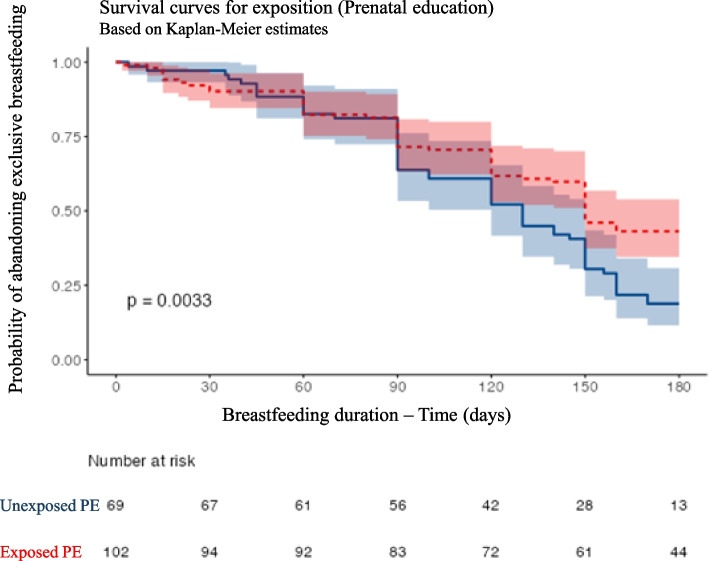
Results: Comparisons between the PE and non-PE groups revealed significant differences in education level, health insurance, antenatal care visits, rooming-in rates, parity, and maternal breastfeeding (BF) intentions. Participants who received PE had a significantly longer mean EBF duration (89.4 ± 77.2 days vs. 66.1 ± 70.2 days, p = 0.004). The incidence rate of EBF abandonment was 11.81 per 100 person-months in the PE group and 14.91 per 100 person-months in the non-PE group. Cox survival analysis indicated a lower risk of EBF cessation among mothers who received PE (adjusted hazard ratio [aHR] = 0.58, 95% CI = 0.40-0.84, p = 0.004). Other factors associated with EBF discontinuation included delivery at a public health facility, postpartum depression, insufficient milk supply, return to work, healthcare provider recommendations, family advice, and negative BF experiences.
Conclusion: Standardized PE programs have a significant and independent positive impact on EBF duration among mothers in Quito, Ecuador. Integrating PE into routine prenatal care and providing comprehensive postpartum support is essential to promoting BF continuation. Targeted interventions should address modifiable risk factors, such as postpartum mental health, return-to-work policies, and healthcare provider recommendations regarding BF.
Keywords: Exclusive breastfeeding; Maternal health; Postpartum depression; Prenatal education; Public health practice.
© 2025. The Author(s).
Conflict of interest statement
Declarations. Ethics approval and consent to participate: The research protocol was approved by the Institutional Research Ethics Committee (CIEI-Human) of the Universidad Peruana Cayetano Heredia (Certificate 093-05-17 dated February 17, 2017) and by the Ethics Committee for Research in Human Subjects of the Pontifical Catholic University of Ecuador (Letter CEISH-736-2019 dated April 30, 2019). Informed consent was obtained from all participants before enrollment under the Declaration of Helsinki. Measures were taken to ensure participant confidentiality and privacy throughout the study. Consent for publication: Not applicable. Competing interests: The authors declare no competing interests.
Figures
References
-
- Rollins NC, Bhandari N, Hajeebhoy N, Horton S, Lutter CK, Martines JC, et al. Why invest, and what it will take to improve breastfeeding practices? Lancet. 2016;387:491–504. - PubMed
MeSH terms
LinkOut - more resources
Full Text Sources
Medical
Miscellaneous
