


Prevention of Heart Failure Induced by Doxorubicin with Early Administration of Dexrazoxane (PHOENIX Study): dose response and time course of dexrazoxane-induced degradation of topoisomerase 2b
- PMID: 40317097
- PMCID: PMC12046681
- DOI: 10.1186/s40959-025-00339-0
Prevention of Heart Failure Induced by Doxorubicin with Early Administration of Dexrazoxane (PHOENIX Study): dose response and time course of dexrazoxane-induced degradation of topoisomerase 2b
Abstract
Background: Dexrazoxane, a putative iron chelator, is effective in preventing doxorubicin-induced cardiotoxicity. However, dexrazoxane is also a catalytic inhibitor of topoisomerase 2b (Top2b), a key mediator of doxorubicin toxicity. Preclinical studies have shown that dexrazoxane induces Top2b degradation, and early administration (8 h before doxorubicin) can prevent doxorubicin-induced cardiotoxicity. In this study, we investigated the dose-response relationship and time course of dexrazoxane-induced Top2b degradation in human volunteers.
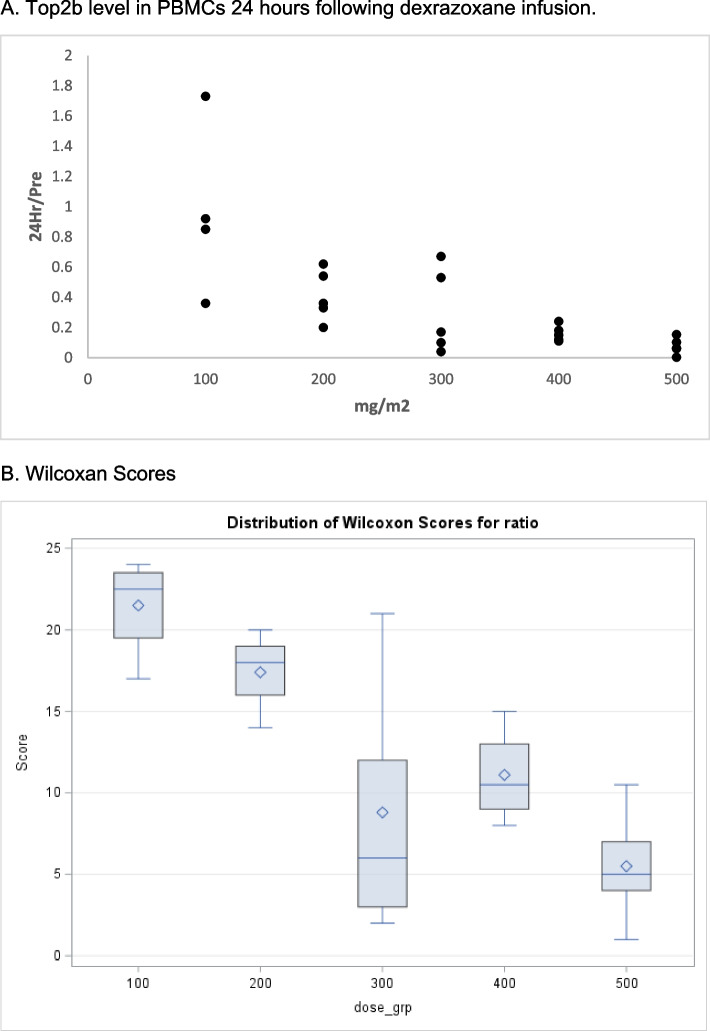
Methods: Twenty-five healthy female volunteers received an intravenous infusion of dexrazoxane at doses ranging from 100 mg/m2 to 500 mg/m2. Blood samples were collected hourly from time zero to 12 h, as well as at 24- and 48-h post-infusion. Peripheral blood mononuclear cells (PBMCs) were isolated, nuclear fractions were extracted, and Top2b expression was analyzed by western blot using Lamin B1 as a control. A linear mixed-effects model was used to assess differences among the five dose groups.
Results: Dexrazoxane infusion led to a rapid and sustained reduction of Top2b in PBMCs, lasting up to 12 h. Statistical analysis revealed a significant difference in Top2b levels among the five dose groups (p = 0.0002). Subgroup analysis identified a significant difference between the 100 mg/m2 and 500 mg/m2 groups (p = 0.005). However, topoisomerase 2a (Top2a), the molecular target of doxorubicin's tumor-killing effect, remained unchanged following dexrazoxane infusion.
Conclusions: Findings from this dose-response and time-course study can inform the design of future clinical trials investigating the efficacy of early dexrazoxane administration in preventing doxorubicin-induced cardiotoxicity while minimizing the risk of tumor protection.
Trial registration: (Funded by the National Institute of Health, RO1HL151993; PHOENIX trials, ClinicalTrials.gov number, NCT03930680.).
Keywords: Cardiotoxicity; Dexrazoxane; Doxorubicin; PHOENIX study; Targeted-degradation; Topoisomerase 2a; Topoisomerase 2b.
© 2025. The Author(s).
Conflict of interest statement
Declarations. Ethics approval and consent to participate: The study protocol (IRB#262180) is approved by the Institutional Review Board of the University of Arkansas for Medical Sciences. Consent for publication: Not applicable. Competing interests: The authors declare no competing interests.
Figures



References
-
- Dubost M, Ganter P, Maral R, Ninet L, Pinnert S, Preudhomme J. A new antibotic with cytostatic properties: rubidomycin. CR Hebd Seances Acad Sci. 1963;257:1813–5. - PubMed
Associated data
Grants and funding
LinkOut - more resources
Full Text Sources
Medical
Research Materials
Miscellaneous