


Dual trajectories of serum brain-derived neurotrophic factor and cognitive function in people living with HIV
- PMID: 40319152
- PMCID: PMC12049541
- DOI: 10.1038/s41598-025-99569-6
Dual trajectories of serum brain-derived neurotrophic factor and cognitive function in people living with HIV
Abstract
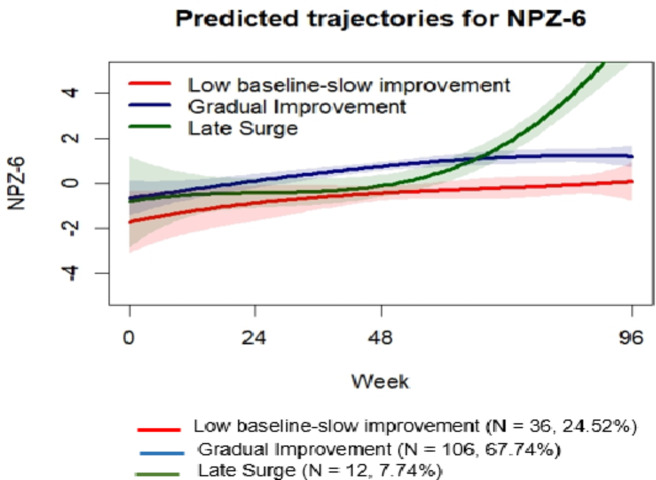
This study aimed to identify the interrelationships between mature BDNF (mBDNF), precursor BDNF (proBDNF) trajectories, and cognitive performance in individuals with HIV from sub-Saharan Africa over 96 weeks following antiretroviral therapy (ART) initiation. Using data from 154 participants in the ACTG 5199 study (ClinicalTrials.gov NCT00096824, 2005-06-23) in Johannesburg and Harare (2006-2009), we measured serum mBDNF and proBDNF levels via ELISA and assessed cognitive performance with neuropsychological tests. Group-based trajectory modelling indicated two mBDNF trajectories-"Stable Ascent" (83.9%) and "Peak with Gradual Decline" (16.1%)-and two proBDNF trajectories-"Gradual Increase" (85.7%) and "Gradual Decline" (14.3%). These were linked to three cognitive trajectories: "Low Baseline-Slow Improvement," "Gradual Improvement," and "Late Surge." The "Stable Ascent" mBDNF group showed a significant probability of "Gradual Improvement" (68%) in cognitive performance and a "Late Surge" (9.5%). In contrast, the "Peak with Gradual Decline" mBDNF trajectory saw no "Late Surge." A "Gradual Increase" in proBDNF corresponded to a 67.7% chance of "Gradual Improvement" in cognition. Findings suggest BDNF isoforms as potential biomarkers for cognitive interventions in HIV, emphasizing that stable or increasing BDNF levels post-ART are linked to favourable cognitive outcomes. Further research is needed to develop BDNF-based cognitive health strategies to improve outcomes for people with HIV.
Keywords: Brain-derived neurotrophic factor; Cognition; Group-based trajectory modelling; HIV/AIDS; sub-Saharan Africa.
© 2025. The Author(s).
Conflict of interest statement
Declarations. Competing interests: The authors declare no competing interests. Ethics approval: This study was performed in line with the principles of the Declaration of Helsinki. Approval was granted by the Ethics Committee of University of Kwazulu-Natl, Durban South Africa (August 18, 2022/Number BREC/00003101/2021), University of the Witwatersrand, Johannesburg, South Africa (July 28, 2021/04081), and Medical Research Council of Zimbabwe, Harare, Zimbabwe (September 10, 2021/MRCZ/E/299). Consent to participate: Informed consent was obtained from all individual participants included in the study. Consent to publish: The authors confirm that participants provided consent for publication. The data analyzed was anonymized and presented collectively.
Figures


Update of
-
Dual Trajectories of Serum Brain-Derived Neurotrophic Factor and Cognitive Function in People Living with HIV.Res Sq [Preprint]. 2025 Apr 14:rs.3.rs-4307577. doi: 10.21203/rs.3.rs-4307577/v1. Res Sq. 2025. Update in: Sci Rep. 2025 May 3;15(1):15520. doi: 10.1038/s41598-025-99569-6. PMID: 40321763 Free PMC article. Updated. Preprint.
References
-
- UNAIDS & Global, H. I. V. & AIDS statistics — Fact sheet, UNAIDS 2023 Epidemiol. Estim. (2023). https://www.unaids.org/en/resources/fact-sheet (accessed March 5, 2024).
Publication types
MeSH terms
Substances
Associated data
Grants and funding
LinkOut - more resources
Full Text Sources
Medical
