Paediatric anaemia prevalence trends in the Eastern Mediterranean Region: a 20-year analysis by income level
- PMID: 40320867
- PMCID: PMC12050902
- DOI: 10.7189/jogh.15.04160
Paediatric anaemia prevalence trends in the Eastern Mediterranean Region: a 20-year analysis by income level
Abstract
Background: Anaemia is a significant global public health issue, especially in low-income countries, where it influences children's mental and physical development. Anaemia is a common public health problem in the Eastern Mediterranean Region (EMR), although long-term, income-stratified analyses at the regional level are scarce. This study investigated trends in anaemia prevalence among children aged 6-59 months from 21 countries in the EMR between 2000 and 2019, correlating differences in these trends with each country's national income.
Methods: We analysed data collected by the World Health Organization (WHO) on the prevalence of anaemia in children aged 6-59 months between 2000 and 2019 in 21 EMR countries at five-year intervals. Data on national income classifications were taken from the World Bank. The data were subject to statistical analysis using SPSS, Excel and GraphPad Prism to determine the associations between anaemia prevalence and income groups.
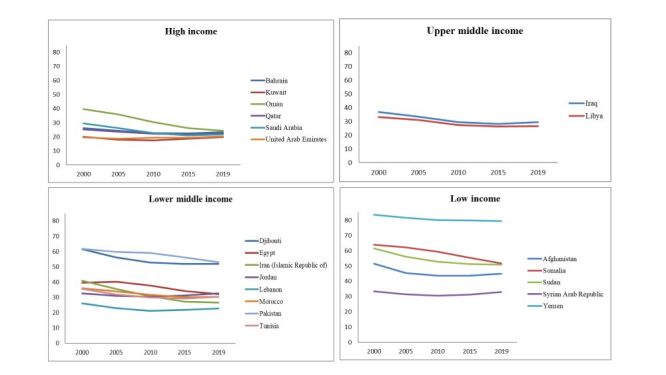
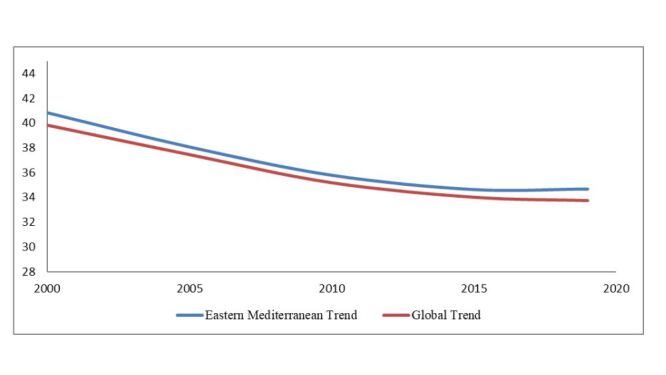
Results: The average anaemia prevalence among children in the EMR decreased from 40.56% in 2000 to 34.25% in 2019 - an absolute change of -6.3%. The number of countries with a prevalence above 40% fell from seven in 2000 to six in 2019. Oman, Yemen and Sudan had some of the highest prevalences, and the UAE witnessed a slight increase, despite being a high-income country. Anaemia prevalence was significantly associated with national income (P < 0.001), but outliers suggest that income alone does not fully explain the observed trends. In 2019, the prevalence of anaemia in the EMR remained greater than the global average.
Conclusions: Between 2000 and 2019, the prevalence of anaemia in children aged 6-59 months decreased significantly in the EMR. Despite this progress, there are still disparities between the prevalence of anaemia in low-income and high-income countries. Therefore, income is not the only factor associated with declines in anaemia prevalence. The fact that reduction rates plateaued after 2015 reinforces the significance of implementing new, innovative health programmes to minimise anaemia.
Copyright © 2025 by the Journal of Global Health. All rights reserved.
Conflict of interest statement
Disclosure of interest: The authors completed the ICMJE Disclosure of Interest Form (available upon request from the corresponding author) and disclose no relevant interests.
Figures
References
-
- Anaemia. Available: https://www.who.int/news-room/fact-sheets/detail/anaemia. Accessed: 25 March 2025.
-
- Rhodes CE, Denault D, Varacallo MA, editors. Physiology, Oxygen Transport. Treasure Island, FL, USA: StatPearls Publishing; 2025. Available: http://www.ncbi.nlm.nih.gov/books/NBK538336/. Accessed: 25 March 2025. - PubMed
-
- Prevalence of anaemia in children aged 6–59 months (%). Available: https://www.who.int/data/gho/data/indicators/indicator-details/GHO/preva.... Accessed: 25 March 2025.
MeSH terms
LinkOut - more resources
Full Text Sources
Medical