


Factors impacting chronic disease medication adherence in the UAE: a prospective cohort study, 2021-2022
- PMID: 40321131
- PMCID: PMC12142380
- DOI: 10.57264/cer-2025-0020
Factors impacting chronic disease medication adherence in the UAE: a prospective cohort study, 2021-2022
Abstract
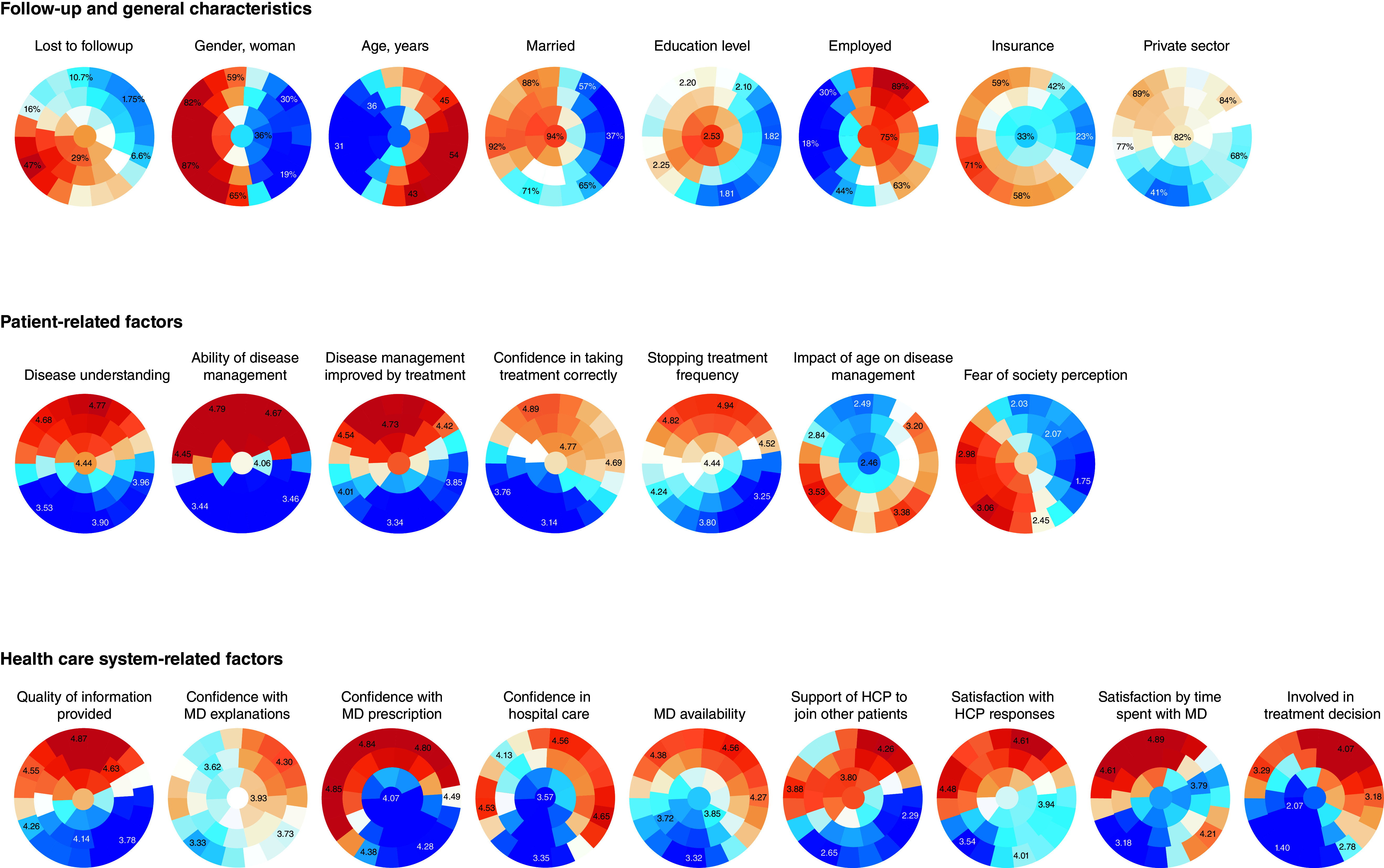
Aim: To assess the evolution of chronic disease medication adherence factors and identify factors predictive of long-term adherence in the UAE. Materials & methods: Patients ≥18 years old; newly diagnosed with one of the following diseases: ankylosing spondylitis, heart failure, multiple sclerosis, psoriasis, or asthma and prescribed long-term medication were followed ≥12 months (M12), then categorized as followed (continued treatment by prescribing physician) or lost to follow-up. Adherence was assessed using the Patient Needs Assessment Tool (PNAT), which is based on the WHO's five dimensional framework. Results: A total of 111 patients were included, 17 (15.3%) were lost of follow-up at M12. Time spent in consultation by medical doctor (MD) (adjusted odds ratio = 6.89, 95% CI = 2.07-12.76) and anxiety and stress level (adjusted odds ratio = 0.18, 95% CI = 0.11-0.67) were significant predictive factors associated with remaining on treatment at M12. Self organizing map methodology identified predictive factors associated with remaining on treatment at M12 as: patient satisfaction with time spent with prescribing MD, patient involvement in treatment decision, disease management ability, satisfaction with support from family/friends, low dependence on others for daily life activities, difficulties joining community activities, and acknowledgement of an influential role of cultural habits/spiritual beliefs. The highest means score differences from M0 to M12 were for difficulties joining community activities (difference [diff] M12-M0 = 1.32, p < 10-4), role of cultural habits (diff = 1.05, p < 10-4), role of spiritual beliefs (diff = 1.02, p < 10-4), patient involved in treatment decision (diff = 0.67, p = 0.007), and memory difficulties (diff = 0.62, p < 10-4). Conclusion: Socio-economic factors changed most significantly over 12 months. The identified factors may be used to develop strategies to improve patient satisfaction with the time they spend with the prescribing MD as well as reduce stress, each of which may improve medication adherence. Understanding patient behavior and accurately quantifying adherence are essential for improving outcomes for patients prescribed chronic disease medication in Gulf Arabic countries.
Keywords: Arabic Gulf country; chronic disease; follow-up; medication adherence; patient compliance; self-management.
Conflict of interest statement
Competing interests disclosure
The authors have no competing interests or relevant affiliations with any organization or entity with the subject matter or materials discussed in the manuscript. This includes employment, consultancies, honoraria, stock ownership or options, expert testimony, grants or patents received or pending, or royalties.
The authors have no competing interests or relevant affiliations with any organization or entity with the subject matter or materials discussed in the manuscript.
Figures
Similar articles
-
Factors impacting self-management ability in patients with chronic diseases in the United Arab Emirates, 2019.J Comp Eff Res. 2022 Feb;11(3):179-192. doi: 10.2217/cer-2021-0177. Epub 2021 Nov 22. J Comp Eff Res. 2022. PMID: 34806911
-
The influence of behavioural and psychological factors on medication adherence over time in rheumatoid arthritis patients: a study in the biologics era.Rheumatology (Oxford). 2015 Oct;54(10):1780-91. doi: 10.1093/rheumatology/kev105. Epub 2015 May 13. Rheumatology (Oxford). 2015. PMID: 25972390 Free PMC article.
-
The Relation Between Patients' Beliefs About Pain Medication, Medication Adherence, and Treatment Outcome in Chronic Pain Patients: A Prospective Study.Clin J Pain. 2019 Dec;35(12):941-947. doi: 10.1097/AJP.0000000000000760. Clin J Pain. 2019. PMID: 31513057
-
Mobile phone-based interventions for improving adherence to medication prescribed for the primary prevention of cardiovascular disease in adults.Cochrane Database Syst Rev. 2021 Mar 26;3(3):CD012675. doi: 10.1002/14651858.CD012675.pub3. Cochrane Database Syst Rev. 2021. PMID: 33769555 Free PMC article.
-
Folic acid supplementation and malaria susceptibility and severity among people taking antifolate antimalarial drugs in endemic areas.Cochrane Database Syst Rev. 2022 Feb 1;2(2022):CD014217. doi: 10.1002/14651858.CD014217. Cochrane Database Syst Rev. 2022. PMID: 36321557 Free PMC article.
References
-
- Sabate E. WHO. Adherence to Long Term Therapies: Evidence for Action. WHO, Switzerland: (2003).
-
• Adherence to long-term therapies is a must read for all policy makers and health managers and is also very beneficial for clinicians as they are the direct care givers.
-
- World Health Statistics 2023: Monitoring Health for the SDGs, Sustainable Development Goals. WHO, Switzerland: (2023). Available at: https://cdn.who.int/media/docs/default-source/gho-documents/world-health...
-
- Lee EKP, Poon P, Yip BHK et al. Global burden, regional differences, trends, and health consequences of medication nonadherence for hypertension during 2010 to 2020: a meta-analysis involving 27 million patients. J. Am. Heart Assoc. 11(17), e026582 (2022). - PMC - PubMed
-
• Higher prevalence of antihypertensive medication nonadherence was reported worldwide, but higher prevalence was detected in low- to middle-income countries.
-
- Dagnew SB, Wondm SA, Dagnew FN, Yimer YS, Wondmkun YT, Moges TA. Level of medication adherence and its determinants of cardiovascular disease patients attending at a specialized teaching hospitals of Amhara regional state, Ethiopia: a multicenter cross-sectional study. Front. Pharmacol. 15, 1422703 (2024). - PMC - PubMed
MeSH terms
LinkOut - more resources
Full Text Sources
Research Materials
