


Study on the Law of Pressure and Flame Propagation during Gas Explosion in the Gas Cabin of the Utility Tunnel
- PMID: 40321539
- PMCID: PMC12044464
- DOI: 10.1021/acsomega.4c10174
Study on the Law of Pressure and Flame Propagation during Gas Explosion in the Gas Cabin of the Utility Tunnel
Abstract
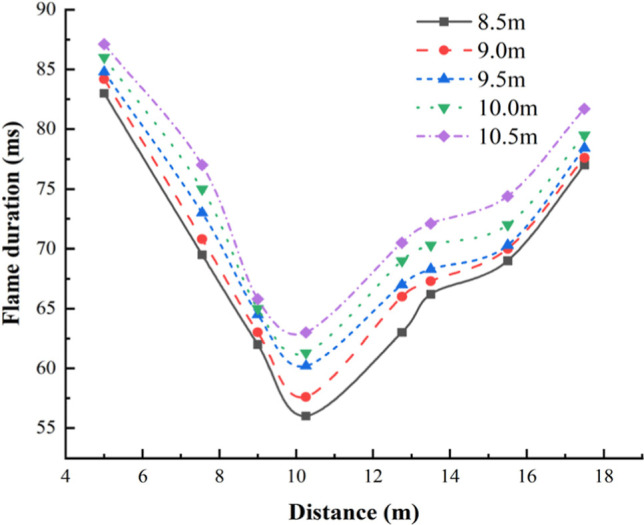
To explore the gas explosion propagation law in the gas cabin of the utility tunnel, a gas explosion pipeline experimental system with 20 m length and 180 × 180 mm cross-section was built, and the evolution characteristics of overpressure and flame after gas explosion with different gas accumulation lengths were analyzed. Results show that when the gas accumulation length is certain, as the propagation distance increases, the explosion peak overpressure and flame propagation speed increase first and then decrease; the flame duration decreases first and then increases; and the peak overpressure attenuation and flame speed attenuation accelerate. In an explosion, the maximum peak overpressure is positively correlated with the gas accumulation length, and the maximum flame propagation speed can reach 373.13 m/s. When the gas accumulation length increases, the peak overpressure attenuation accelerates, and the flame speed attenuation slows down. Explosion overpressure and flame have a positive feedback effect of mutual promotion and mutual restraint. The research results can provide a scientific basis for the safety design and protective measures of the utility tunnel and a reference for the formulation of emergency response and rescue measures and improve the ability to respond to gas explosion accidents.
© 2025 The Authors. Published by American Chemical Society.
Conflict of interest statement
The authors declare no competing financial interest.
Figures



References
-
- Su B.; Luo Z.; Wang T.; Zhang J.; Cheng F. Experimental and principal component analysis studies on minimum oxygen concentration of methane explosion. Int. J. Hydrogen Energy 2020, 45, 12225–12235. 10.1016/j.ijhydene.2020.02.133. - DOI
-
- Su B.; Tan Y.; Zhang L.; Hao R.; Liu L.; Luo Z.; Wang T. Prediction models for flammability limits of syngas/air mixtures based on machine learning approach. Int. J. Hydrogen Energy 2025, 98, 1356–1365. 10.1016/j.ijhydene.2024.12.040. - DOI
-
- Xu Z.; Liu X.; Xu W.; Sun B.; Liu X.; Xu D. Analysis on the disaster chain evolution from gas leak to explosion in urban utility tunnels. Eng. Fail. Anal. 2022, 140, 106609. 10.1016/j.engfailanal.2022.106609. - DOI
-
- Duan Y.; Liu L.; Yang J.; Long J.; He G.; Lei S.; Duan X. Effects of explosion-venting interlayer within utility tunnels on the characteristics of natural gas explosions. Fuel 2024, 377, 132766. 10.1016/j.fuel.2024.132766. - DOI
-
- Xue Y.; Chen G.; Zhang Q.; Xie M.; Ma J. Simulation of the dynamic response of an urban utility tunnel under a natural gas explosion. Tunn. Undergr. Space Technol. 2021, 108, 103713. 10.1016/j.tust.2020.103713. - DOI
LinkOut - more resources
Full Text Sources