


Global Patterns of Clostridioides difficile Infection in Patients with Inflammatory Bowel Disease: A Systematic Review and Meta-Analysis of Prevalence, Epidemiology, and Risk Factors
- PMID: 40321839
- PMCID: PMC12048841
- DOI: 10.1093/crocol/otaf024
Global Patterns of Clostridioides difficile Infection in Patients with Inflammatory Bowel Disease: A Systematic Review and Meta-Analysis of Prevalence, Epidemiology, and Risk Factors
Abstract
Background: Clostridioides difficile infection (CDI) is a well-recognized complication of inflammatory bowel disease (IBD) that has been associated with poor clinical outcomes. The objective of this study is to characterize the global incidence, risk factors and outcomes of CDI in patients with IBD.
Methods: A search of MEDLINE/PubMed, Scopus, and Cochrane Database of Systematic Reviews was conducted for studies published between January 1960, and March 2024. Random-effect models were employed to estimate the incidence of CDI in the IBD population. Risk factors and outcomes were estimated using random effects meta-regression and subgroup analysis.
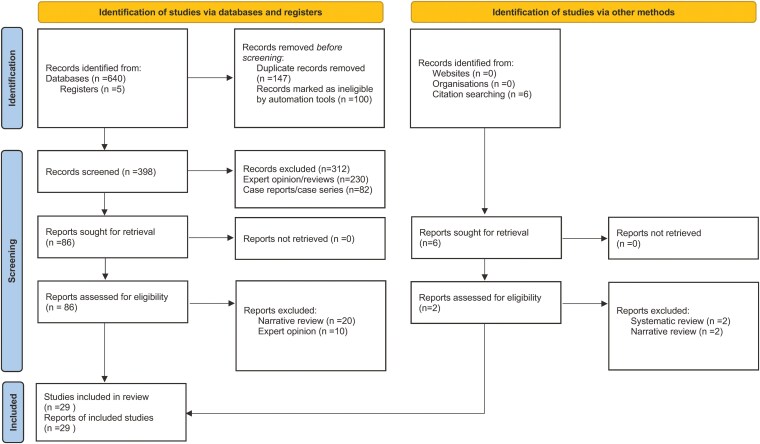
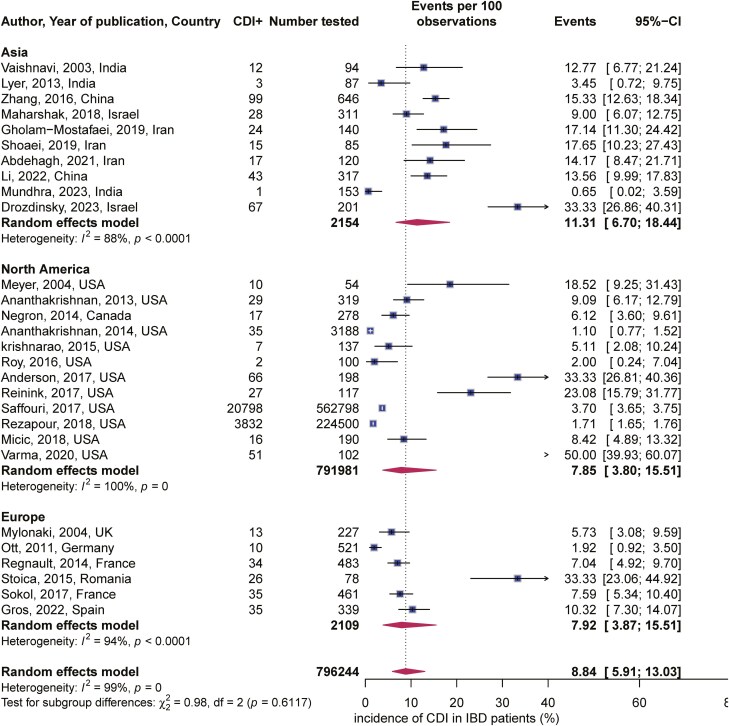
Results: Twenty-eight articles from 11 countries on 3 continents, comprising 796, 244 patients with IBD were included. The overall CDI rate was 8.84% (95% CI, 5.91%-13.03%). The rate of CDI was slightly higher in Asia at 11% (95% CI, 6.7%-18.44%) compared to the North America (USA and Canada) at 7.85% (95% CI, 3.80%-15.51%) and Europe, where the incidence, was 7.92% (95% CI, 3.87%-15.51%). A univariable random-effects meta-regression model demonstrated that male gender (odds ratio [OR], 1.18; 95% CI, 1.00-1.40) and older age (OR, 1.06; 95% CI, 0.99-1.15, per one-year increase in age) were factors associated with higher CDI incidence in the IBD population. CDI testing by PCR compared to enzyme immunoassay was associated with higher rates of CDI (OR, 4.70; 95% CI, 01.39-15.90). No association was observed between length of hospital stay and CDI.
Conclusions: One in 10 patients with IBD were positive for CDI. Increasing age and male population were associated with higher risk of CDI.
Keywords: Clostridioides difficile infection; epidemiology; inflammatory bowel disease; meta-analysis; risk factors.
© The Author(s) 2025. Published by Oxford University Press on behalf of Crohn's & Colitis Foundation.
Conflict of interest statement
KC holds the position of Associate Editor for Crohn’s & Colitis 360 and has been recused from reviewing or making decisions about the manuscript.
Figures





References
-
- Burke KE, Lamont JT.. Clostridium difficile infection: a worldwide disease. Gut Liver. 2014;8(1):1-6. doi: https://doi.org/10.5009/gnl.2014.8.1.1 - DOI - PMC - PubMed
-
- Tortora A, Purchiaroni F, Scarpellini E, et al.Colitides. Eur Rev Med Pharmacol Sci. 2012;16(13):1795-1805. https://www.europeanreview.org/article/1176 - PubMed
-
- Dahlhamer JM, Zammitti EP, Ward BW, Wheaton AG, Croft JB.. Prevalence of inflammatory bowel disease among adults aged ≥18 years - United States, 2015. MMWR Morb Mortal Wkly Rep. 2016;65(42):1166-1169. doi: https://doi.org/10.15585/mmwr.mm6542a3 - DOI - PubMed
-
- Rao K, Higgins PD.. Epidemiology, diagnosis, and management of Clostridium difficile infection in patients with inflammatory bowel disease. Inflamm Bowel Dis. 2016;22(7):1744-1754. doi: https://doi.org/10.1097/MIB.0000000000000793 - DOI - PMC - PubMed
-
- Chen W, Liu Y, Zhang Y, et al.Risk of Clostridioides difficile infection in inflammatory bowel disease patients undergoing vedolizumab treatment: a systematic review and meta-analysis. BMC Gastroenterol. 2024;24(1):377. doi: https://doi.org/10.1186/s12876-024-03460-z - DOI - PMC - PubMed
LinkOut - more resources
Full Text Sources