


Peer Education Initiatives for Promoting Adolescent Health in the South-East Asia Region: Findings From Desk Review and Key Informant Interviews
- PMID: 40322068
- PMCID: PMC12049988
- DOI: 10.1016/j.focus.2025.100325
Peer Education Initiatives for Promoting Adolescent Health in the South-East Asia Region: Findings From Desk Review and Key Informant Interviews
Abstract
Introduction: The aim of the study was to map the national-level peer education initiatives in the South-East Asia Region.
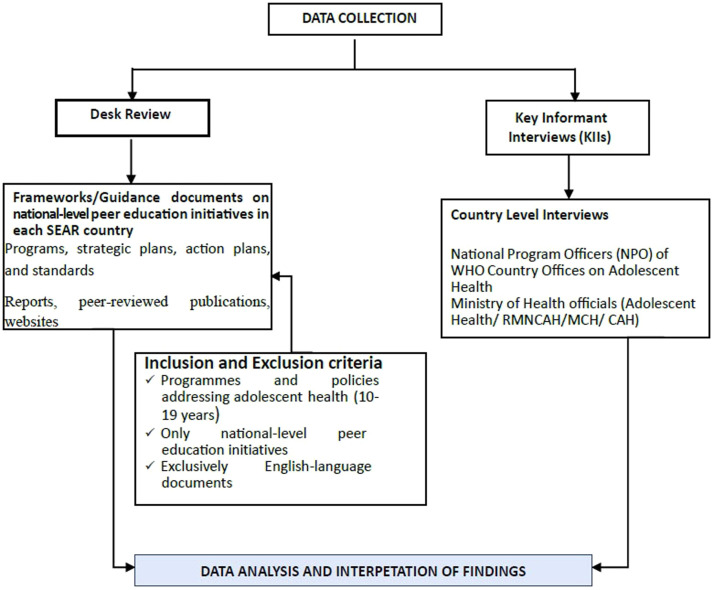
Methods: This was a descriptive study design, employing primary methods (key informant interviews) and secondary data (desk reviews). Semistructured key informant interviews were conducted with Ministry of Health Officials and National Programme Officers of WHO Country Offices.
Results: Almost all countries in the South-East Asia Region have national initiatives addressing adolescent issues and integrating peer education within them. The overarching goal of peer education initiatives was to enhance information dissemination and health services to adolescents. They shared key themes, including sexual and reproductive health, nutrition, mental health, substance misuse, noncommunicable diseases, communicable diseases, and life-skill education. Government-led models were prevalent over nongovernmental organizations-facilitated models. The Ministry of Health takes the lead in most countries, often collaborating with Ministries of Education, Youth and Sports. Peer educators' selection criteria included age, motivation, volunteerism, cultural awareness, communication skills, and educational qualifications. Resources, information, education, and communication materials varied in the form of pamphlets, posters, booklets, animated videos, and comic books. Supportive supervision was mostly provided by health workers or teachers, and incentives and reward mechanisms often relied on volunteerism. Reported barriers to successful program implementation included parental hesitancy, awareness gaps, lack of incentives, inadequate evaluations, and lack of capacity building. Facilitators included adolescent motivation, support from developmental partners, engagement of teachers and local leaders, and new-age media use.
Conclusions: Peer education holds promise as an empowering approach to address crucial adolescent health issues; however, its implementation exhibits variations across South-East Asia Region.
Keywords: Peer education; SEAR; adolescent health; peer educators.
© 2025 The Author(s).
References
-
- WHO . WHO; Geneva, Switzerland: 2024. Adolescent and young adult health.https://www.who.int/news-room/fact-sheets/detail/adolescents-health-risk... Accessed February 4, 2025.
-
- WHO Regional office for South-East Asia . WHO Regional office for South-East Asia; New Delhi, India: 2021. Rapid assessment of the implementation of adolescent health programmes in countries of South-East Asia.https://iris.who.int/handle/10665/342587 Accessed December 13, 2023.
-
- WHO Regional office for South-East Asia . WHO Regional office for South-East Asia; New Delhi, India: 2021. Progressing towards SDG targets. Sexual, reproductive, maternal, newborn, child and adolescent health (SRMNCAH) SEAR 2020.https://iris.who.int/handle/10665/347423 Published 2021 Accessed December 15, 2023.
-
- Adolescent health in the South-East Asia Region. WHO Regional office for South-East Asia. https://www.who.int/southeastasia/health-topics/adolescent-health. Accessed December 3, 2023.
LinkOut - more resources
Full Text Sources
