


Feasibility of applying Bacillus amyloliquefaciens-derived solid state fermentation products into the hatch cabinet environment as a method to mitigate the microbial bloom during the hatching phase
- PMID: 40328041
- PMCID: PMC12124623
- DOI: 10.1016/j.psj.2025.105190
Feasibility of applying Bacillus amyloliquefaciens-derived solid state fermentation products into the hatch cabinet environment as a method to mitigate the microbial bloom during the hatching phase
Abstract
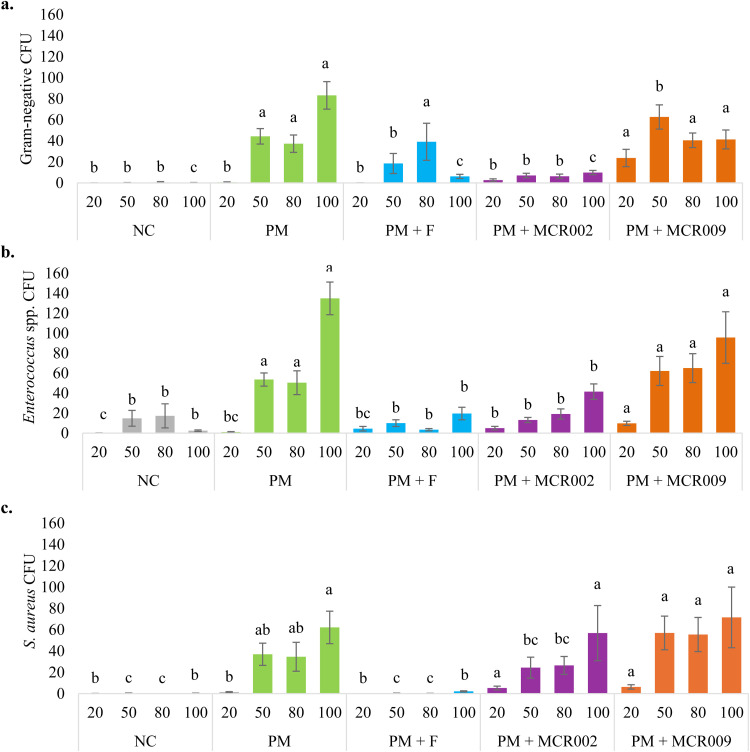
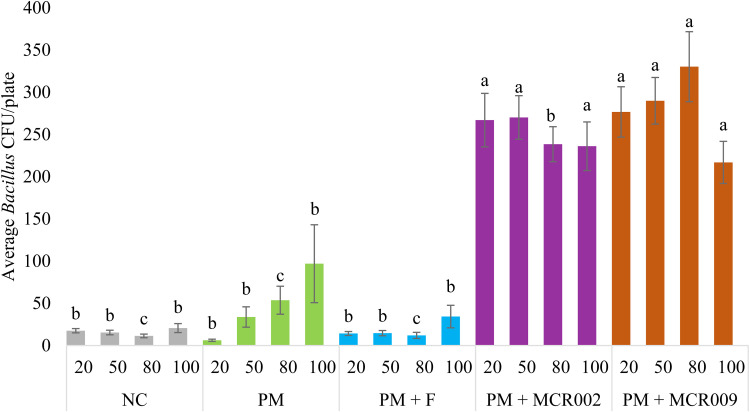
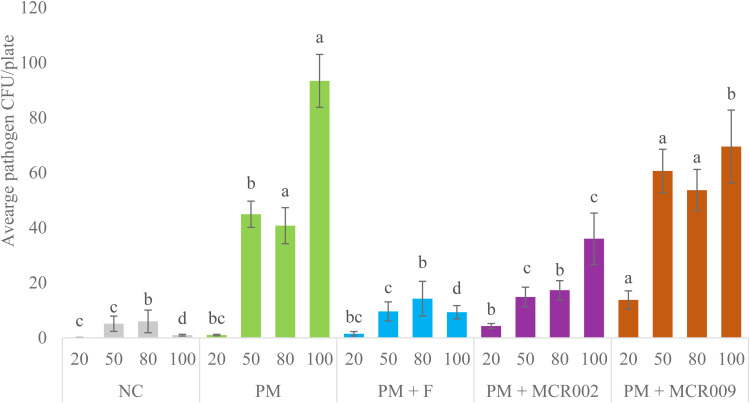
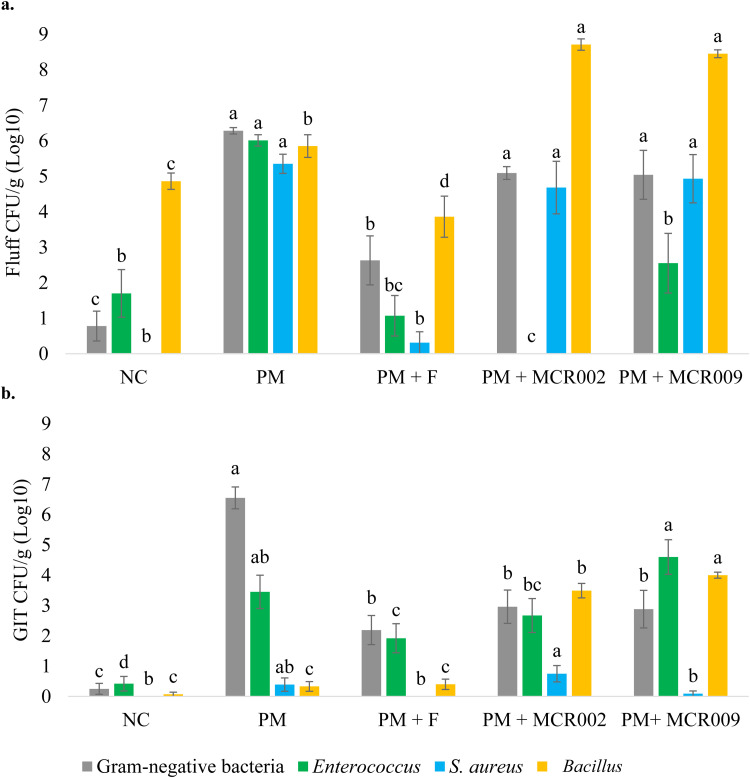
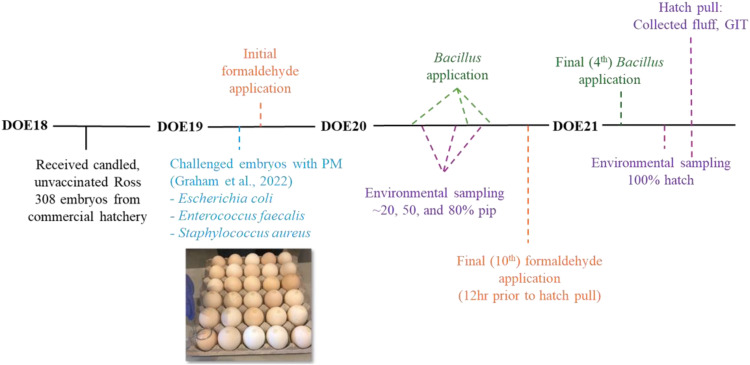
Formaldehyde has been used to control microbial contamination in commercial hatch cabinets. The purpose of the present study was to investigate the effects of spray application of Bacillus amyloliquefaciens solid state fermentation products on the microbial load in the hatch cabinet, pioneer colonization of the gastrointestinal tract (GIT), and early performance compared to formaldehyde fumigation. An environmental challenge model was used to simulate the microbial bloom to compare the application of two B. amyloliquefaciens strains (MCR002, MCR009) to formaldehyde fumigation. Groups included 1) non-challenged control (NC), 2) challenged with pathogen mix (PM) containing Escherichia coli, Enterococcus faecalis, and Staphylococcus aureus at DOE19, 3) PM + formaldehyde treated (PM+F), 4) PM + MCR002 (PM+MCR002), 5) PM + MCR009 (PM+MCR009), and 6) PM+MCR002+MCR009 (PM+Combo). All groups were evaluated in trial 1-3 except PM+Combo. Air samples were collected from the hatch cabinet environment on d20 of embryogenesis (DOE20) at ∼20, 50, 80 % hatch, and immediately prior to hatch pull at DOE21. GIT samples were collected for enumeration of relevant enteric bacteria at hatch (d0). Pen and feed weights were recorded at d0 and d7 for trial 1 and 2 and at d14 for trial 2 to assess BWG and FCR. In summary, there was a significant (P < 0.05) reduction in gram-negative bacterial recovery from the GIT for PM+F, PM+MCR002, and PM+MCR009 compared to PM while the two B. amyloliquefaciens treatments were similar to PM+F. Gram-negative bacteria and Enterococcus recovery from hatch cabinet air samples were significantly reduced in PM+F and PM+MCR002 compared to PM. No significant differences in performance were observed. Spray application of MCR002 or MCR009 alone shifted the microbial load in the hatch cabinet and in the GIT of chicks similar to PM + F without negatively affecting performance at d7 or 14. However, MCR002 was more effective. This suggests that MCR002 could be used to mitigate the microbial bloom during the hatching phase without impacting chick performance.
Keywords: Bacillus amyloliquefaciens; Broiler; Formaldehyde; Hatchery; Microbial bloom.
Copyright © 2025. Published by Elsevier Inc.
Conflict of interest statement
Declaration of competing interest There are no conflicts of interest.
Figures
References
-
- 15th Report on Carcinogens. 2021. National Institute of Environmental Health and Safety. https://ntp.niehs.nih.gov/whatwestudy/assessments/cancer/roc.
-
- Aviagen. 2018. Broiler Management Handbook. Available at https://en.aviagen.com/assets/Tech_Center/Ross_Broiler/Ross-BroilerHandb....
-
- Berrang M.E., Cox N..A., Bailey J.S. Measuring air-borne microbial contamination of broiler hatching cabinets. J. Appl. Poult. Res. 1995;4:83–87.
-
- Depner R.F.R., Pontin K.P., Otutumi L.K., Westenhofen M., Borges K.A., Furian T.Q., Do Nascimento V.P., Lovato M. Antimicrobial activity of poultry hatch baskets containing copper inserts. J. Appl. Poult. Res. 2021;30
-
- Gottselig S.M., Dunn-Horrocks S..L., Woodring K.S., Coufal C.D., Duong T. Advanced oxidation process sanitization of eggshell surfaces. Poult. Sci. 2016;95:1356–1362. - PubMed
MeSH terms
Substances
LinkOut - more resources
Full Text Sources
