


Association between triglyceride glucose weight adjusted waist index and stroke risk in different glucose metabolism status
- PMID: 40328907
- PMCID: PMC12056119
- DOI: 10.1038/s41598-025-99618-0
Association between triglyceride glucose weight adjusted waist index and stroke risk in different glucose metabolism status
Abstract
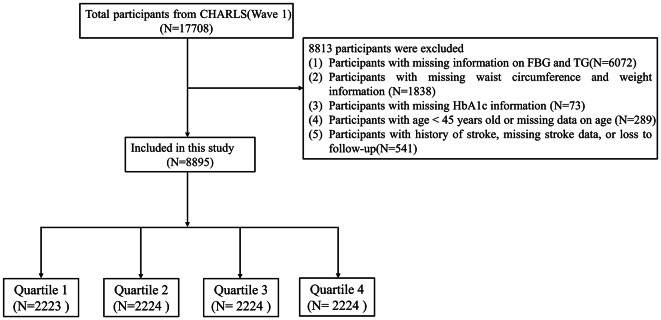
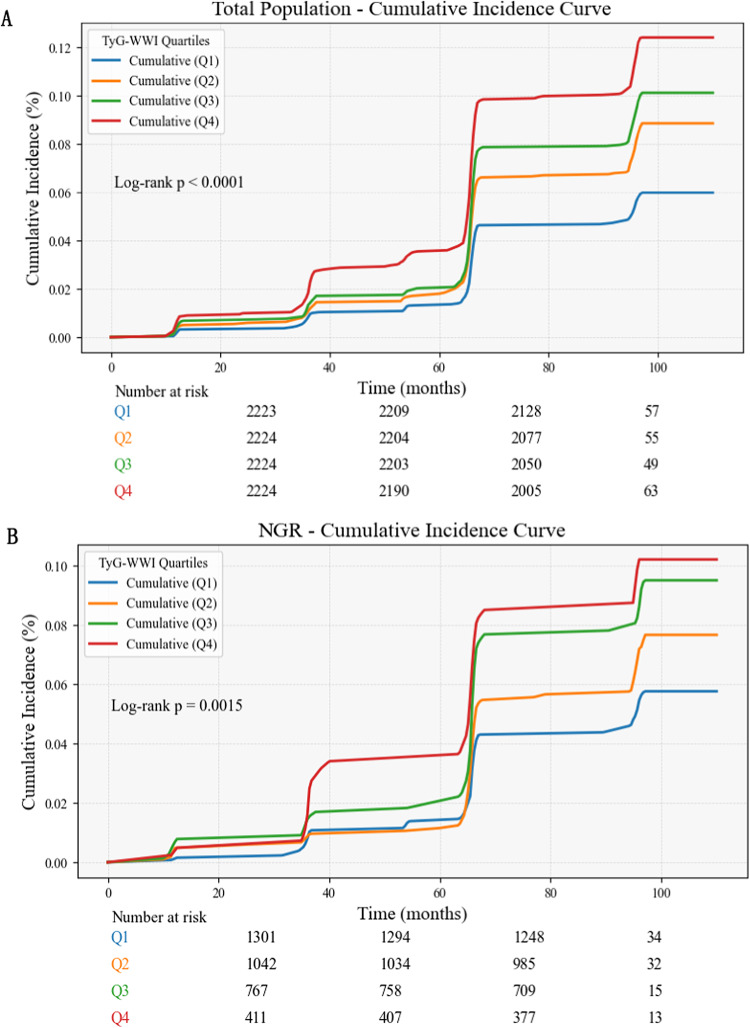
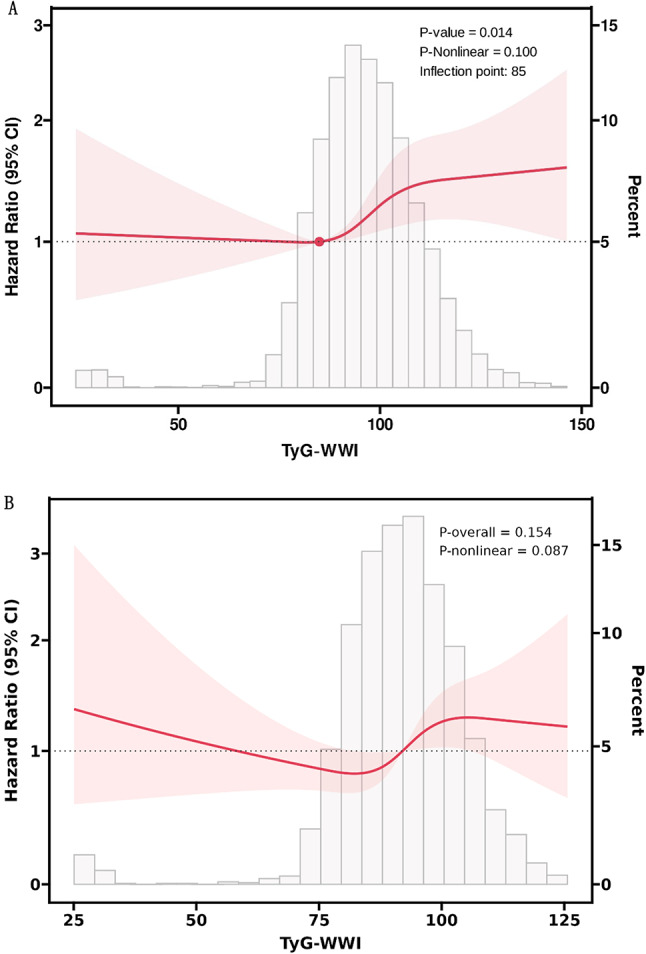
The triglyceride glucose-weight adjusted waist index (TyG-WWI) has emerged as a straightforward and reliable alternative for assessing insulin resistance (IR). However, the relationship between the TyG-WWI index and the incidence of stroke, especially in individuals with different glucose metabolism status, is still unclear. The data for this study was obtained from the China Health and Retirement Longitudinal Study (CHARLS). The primary endpoint was the occurrence of stroke events. We utilized multivariate Cox proportional hazard models and restricted cubic spline (RCS) analysis to examine the relationship between the TyG-WWI index and the risk of stroke in individuals with different glycemic metabolic states. A total of 8895 participants were included in this study, 831 (9.3%) stroke events were recorded during the follow-up period. After fully adjusting for covariates, per SD increase in the TyG-WWI index was associated with a 11% increase in stroke risk (HR: 1.11, 95% CI 1.02, 1.20) in all participants. The TyG-WWI index was further categorized into quartiles, the adjusted HRs (95% CIs) for Q2, Q3, and Q4 compared to Q1 being 1.37 (95% CI 1.09, 1.72), 1.42 (95% CI 1.13, 1.78), and 1.50 (95% CI 1.17, 1.93), respectively. Furthermore, high levels of the TyG-WWI index were found to be linked to an increased risk of stroke in prediabetes mellitus (Pre-DM) participants across Cox models. However, this association was not observed in participants with normal glucose regulation (NGR) and diabetes mellitus (DM) (all P > 0.05). RCS analysis also demonstrated that higher baseline TyG-WWI index levels were associated with higher HRs for stroke in all participants and those with Pre-DM. The TyG-WWI index significantly associates with stroke risk in middle-aged and elderly Chinese populations. Moreover, this relationship exhibits distinct characteristics influenced by the individual's glucose metabolism status.
Keywords: CHARLS; Insulin resistance; Stroke; Triglyceride glucose index; Weight-adjusted waist index.
© 2025. The Author(s).
Conflict of interest statement
Declarations. Competing interests: The authors declare no competing interests. Ethics approval and consent to participate: CHARLS was approved by the Institutional Review Board of Peking University (approval number: IRB00001052-11015 for the household survey and IRB00001052-11014 for blood samples), and all participants provided written informed consent.
Figures


References
-
- Mensah, G. A., Fuster, V., Roth, G. A. A. & Heart-healthy and stroke-free world: Using data to inform Global Action J. Am. Coll. Cardiol.82(25), 2343–2349. (2023). - PubMed
MeSH terms
Substances
Grants and funding
LinkOut - more resources
Full Text Sources
Medical
