


Translation and cultural adaptation of the Chinese version of the International 'Care Of the Dying Evaluation' (CODE™) tool for assessing the quality of care for dying patients from the perspective of bereaved family members
- PMID: 40329248
- PMCID: PMC12054271
- DOI: 10.1186/s12904-025-01772-9
Translation and cultural adaptation of the Chinese version of the International 'Care Of the Dying Evaluation' (CODE™) tool for assessing the quality of care for dying patients from the perspective of bereaved family members
Abstract
Background: Culturally appropriate assessments are needed to improve care during the last days of life. One way of assessment is to use a tool with bereaved family members after death. The aim of this study was to translate and cross-culturally adapt the International 'Care Of the Dying Evaluation' questionnaire (i-CODE) into Mandarin Chinese.
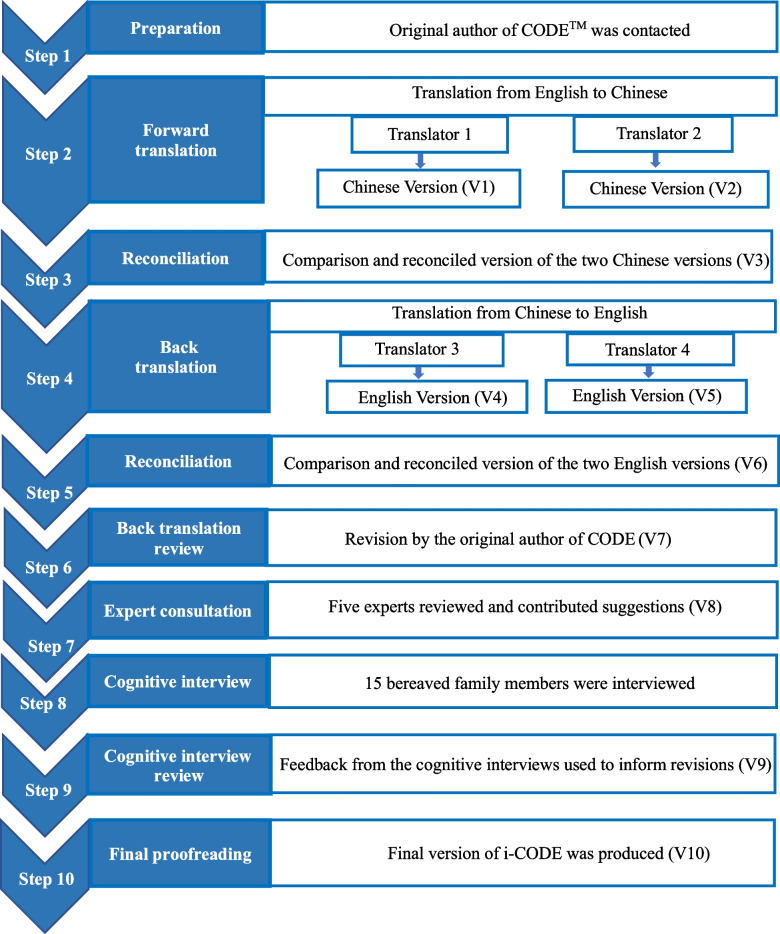
Methods: Translation and cultural adaptation process was performed according to the Brislin Classical Backtranslation Model and the principles of the European Organization for Research and Treatment of Cancer (EORTC) quality-of-life group translation procedure. Fifteen bereaved family members, 5 palliative care experts and 4 translators were involved in the process, which followed 10 steps: a) Preparation; b) Forward translation; c) Reconciliation; d) Backward translation; e) Reconciliation; f) Backward translation review; g) Expert consultation; h) Cognitive interview; i) Cognitive interview review; h) Final proofreading.
Results: The translation and cultural adaptation followed established guidelines. items 1 ("washing"), 2 ("giving medicines"), 14 ("noisy rattle"), 18 ("giving fluids through a 'drip'") emerged divergence and reached a consensus among the research team, translators, and original author. In the cultural adaptation, demographic items were restructured to align with Chinese context. Gender-neutral terminology was employed by using "they/them". Inconsistent subject, terminology "healthcare team" and Items 4 ("had adequate privacy"), 14 ("noisy rattle"), 27 ("in the right place"), and 28 ("at the actual time of his/her death") was modified based on experts' assessments and bereaved families' comments. Linguistic, cultural, and conceptual equivalence was achieved in the process of translation and cultural adaptation.
Conclusion: A questionnaire allowing for international comparisons related to quality of care for dying individuals has been developed in Mandarin Chinese. Key cultural adaptations were required to ensure that the Chinese version of the i-CODE was suitable for use. It has proved content and face validity. Future work will focus on psychometric testing assessing the validity and reliability of questionnaire and its use in assessing and improving care.
Keywords: Bereaved family members; Cultural adaptation; Equivalent translation; Palliative care; Quality of care for the dying.
© 2025. The Author(s).
Conflict of interest statement
Declarations. Ethics approval and consent to participate: The research was conducted in accordance with the Declaration of Helsinki and its later amendments and was approved by the Ethics Committee of the Tohoku University Graduate School of Medicine, Sendai, Japan (ID: 2022–1-1022). Oral informed consent was obtained from all participants (bereaved family members). Consent for publication: Not applicable. Competing interests: The authors declare no competing interests.
Figures
References
-
- State Statistical Bureau. Bulletin of the seventh national census (No. 5)—Population age composition. 2021. http://www.stats.gov.cn/ztjc/zdtjgz/zgrkpc/dqcrkpc/ggl/202105/t20210519_.... Accessed 10 Dec 2022.
-
- Outlook Newsweek. Chronicle of governance. 2021. http://www.news.cn/politics/leaders/2021-10/10/c_1127942702.htm. Accessed 10 Dec 2022.
-
- Information Office of the State Council. Prevention and control of chronic diseases (scio.gov.cn).2020. http://www.scio.gov.cn/xwfbh/xwbfbh/wqfbh/42311/44583/zy44587/Document/1.... Accessed 18 Feb 2023.
-
- World Health Organization. World health statistics 2023: monitoring health for the SDGs, sustainable development goals, Golobal Report. https://www.who.int/publications/i/item/9789240074323 (2023). Assessed 03 Feb 2024.
MeSH terms
LinkOut - more resources
Full Text Sources
Medical
