


Mortality and exacerbations in bronchiectasis patients with carbapenem-resistant Pseudomonas aeruginosa isolation: a long-term retrospective cohort study
- PMID: 40329320
- PMCID: PMC12057110
- DOI: 10.1186/s12941-025-00798-4
Mortality and exacerbations in bronchiectasis patients with carbapenem-resistant Pseudomonas aeruginosa isolation: a long-term retrospective cohort study
Abstract
Background: Few studies have investigated the impact of carbapenem-resistant Pseudomonas aeruginosa (CRPA) on long-term outcomes in bronchiectasis. This study aimed to analyze acute exacerbations and mortality in bronchiectasis patients with CRPA isolation.
Methods: This retrospective study included bronchiectasis patients with PA-positive cultures from January 1, 2014, to July 31, 2023, at West China Hospital of Sichuan University. PA was isolated from sputum or bronchoalveolar lavage fluid (BALF) and classified into CRPA and non-CRPA groups based on antimicrobial susceptibility testing. Multivariate logistic regression was used to assess risk factors for acute exacerbations, while multivariate Cox regression identified independent risk factors for all-cause and cause-specific mortality.
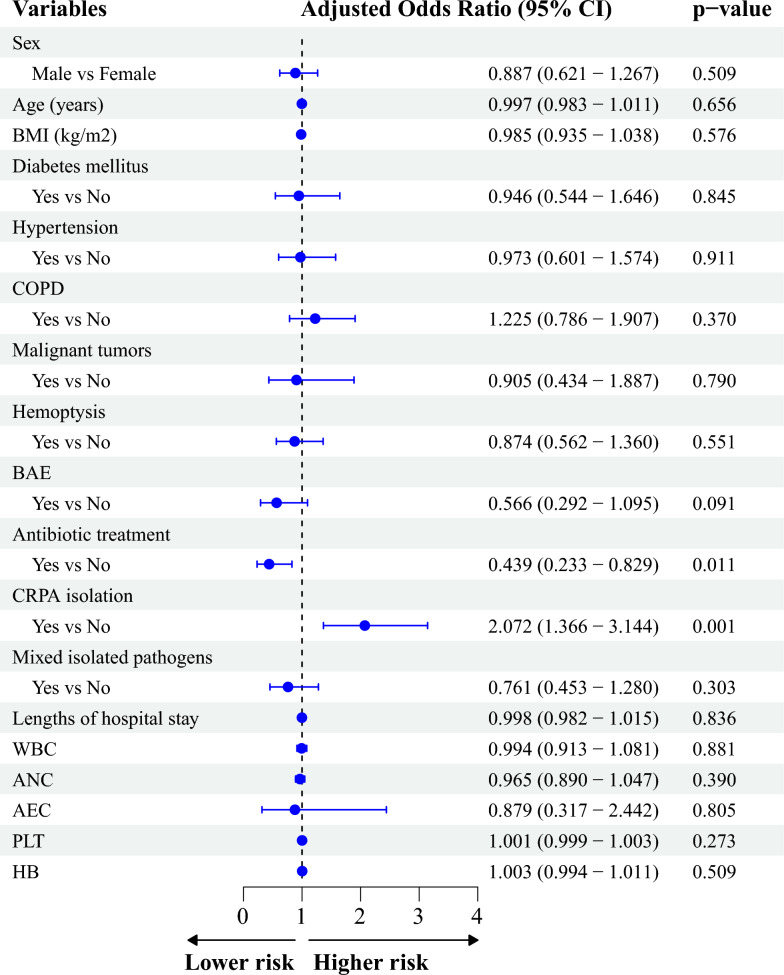
Results: Among 564 patients with PA-positive isolates, 143 (25.36%) harbored CRPA strains. CRPA isolation was associated with an increased risk of acute exacerbations (adjusted odds ratio [aOR] 2.072, p = 0.001), while antibiotic treatment reduced the risk of exacerbations (aOR 0.439, p = 0.011). CRPA isolation was an independent risk factor for all-cause (adjusted hazard ratio [aHR] 1.488, p = 0.031) and cause-specific mortality (aHR 1.882, p = 0.010). The 1-, 3-, 5-, and 7-year cause-specific survival rates in the CRPA group were 88.6%, 79.8%, 73.2%, and 68.0%, respectively, versus 95.4%, 91.0%, 85.6%, and 81.8% in the non-CRPA group (p = 0.001).
Conclusion: CRPA isolation was significantly associated with an increasing risk of acute exacerbations, overall and cause-specific mortality. These findings underscored the urgent need to strengthen antibiotic stewardship to reduce the emergence of CRPA and to implement early detection and targeted management strategies to improve outcomes for patients with CRPA.
Keywords: Bronchiectasis; CRPA; Exacerbations; Mortality.
© 2025. The Author(s).
Conflict of interest statement
Declarations. Ethics approval and consent to participate: This study was approved by the Ethics Committee on Biomedical Research at the West China Hospital of Sichuan University (No. 2022455). Informed consent was also waived by the ethics committee of the West China Hospital. Consent for publication: Not applicable. Competing interests: The authors declare no competing interests.
Figures


References
-
- Chalmers JD, Polverino E, Crichton ML, Ringshausen FC, De Soyza A, Vendrell M, Burgel PR, Haworth CS, Loebinger MR, Dimakou K, et al. Bronchiectasis in Europe: data on disease characteristics from the European Bronchiectasis registry (EMBARC). Lancet Respir Med. 2023;11(7):637–49. - PubMed
-
- Lin JL, Xu JF, Qu JM. Bronchiectasis in China. Ann Am Thorac Soc. 2016;13(5):609–16. - PubMed
-
- Roberts JM, Goyal V, Kularatna S, Chang AB, Kapur N, Chalmers JD, Goeminne PC, Hernandez F, Marchant JM, McPhail SM. The economic burden of bronchiectasis: a systematic review. Chest. 2023;164(6):1396–421. - PubMed
MeSH terms
Substances
Grants and funding
LinkOut - more resources
Full Text Sources
