


Dynamic brain glymphatic changes and cognitive function in COVID-19 recovered patients: a DTI-ALPS prospective cohort study
- PMID: 40330302
- PMCID: PMC12053492
- DOI: 10.3389/fpsyg.2025.1465660
Dynamic brain glymphatic changes and cognitive function in COVID-19 recovered patients: a DTI-ALPS prospective cohort study
Abstract
Objective: This study aimed to evaluate brain glymphatic function in COVID-19 recovered patients using the non-invasive Diffusion Tensor Imaging-Analysis Along the Perivascular Space (DTI-ALPS) technique. The DTI-ALPS technique was employed to investigate changes in brain glymphatic function in these patients and explore correlations with cognitive function and fatigue.
Materials and methods: Follow-up assessments were conducted at 1, 3, and 12 months post-recovery. A total of 31 patients completed follow-ups at all three time points, with 30 healthy controls (HCs) for comparison.
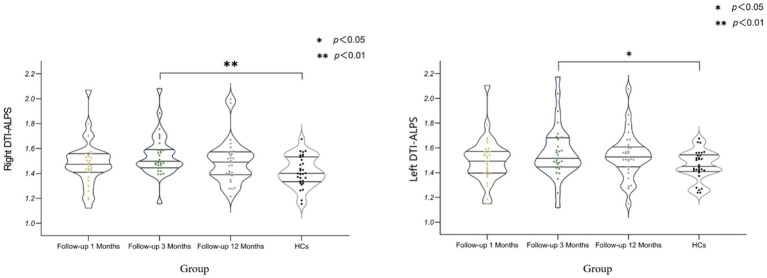
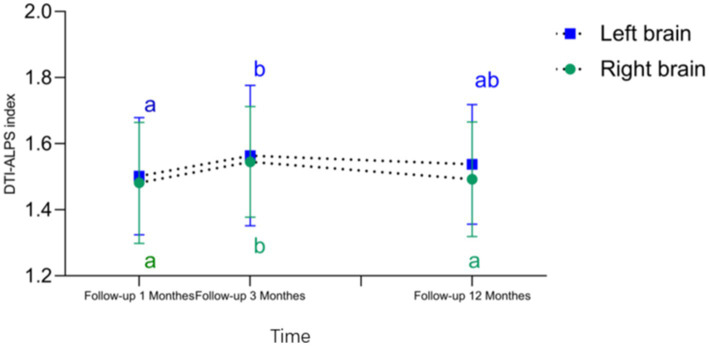
Results: Compared to HCs, COVID-19 recovered patients showed a significant decline in MoCA scores at 3 months post-recovery (p < 0.05), which returned to near-normal levels by 12 months. Mental fatigue, measured by the Fatigue Assessment Scale (FAS), was significantly higher in COVID-19 patients at all follow-up points compared to HCs (p < 0.05). The DTI-ALPS index in both hemispheres showed significant differences at 3 months post-recovery compared to HCs (p < 0.001), indicating increased glymphatic activity. Longitudinal analysis revealed a peak in the DTI-ALPS index at 3 months post-recovery, which then decreased by 12 months. Correlation analysis showed a significant negative correlation between the Bilateral brain hemisphere DTI-ALPS index and MoCA scores (right side: r = -0.373, p = 0.003; left side: r = -0.255, p = 0.047), and a positive correlation with mental fatigue (right side: r = 0.275, p = 0.032; left side: r = 0.317, p = 0.013).
Conclusion: This study demonstrates dynamic changes in brain glymphatic function in COVID-19 recovered patients, with a peak in activity at 3 months post-recovery. These changes are associated with cognitive function and mental fatigue, suggesting potential targets for addressing neurological symptoms of long COVID. The non-invasive DTI-ALPS technique proves to be a valuable tool for assessing brain glymphatic function in this population.
Keywords: COVID-19 recovered patients; DTI-ALPS; brain glymphatic function; cognitive function; fatigue.
Copyright © 2025 He, Xie, Fang, Guo, Shi, Li, Liu, Zhu, Bao, Niu, Wang, Fu, Li and Xie.
Conflict of interest statement
SW was employed by company MR Research Collaboration, Siemens Healthineers. The remaining authors declare that the research was conducted in the absence of any commercial or financial relationships that could be construed as a potential conflict of interest.
Figures

References
-
- Alkodaymi M. S., Omrani O. A., Fawzy N. A., Shaar B. A., Almamlouk R., Riaz M., et al. (2022). Prevalence of post-acute COVID-19 syndrome symptoms at different follow-up periods: a systematic review and meta-analysis. Clin. Microbiol. Infect. 28, 657–666. doi: 10.1016/j.cmi.2022.01.014, PMID: - DOI - PMC - PubMed
LinkOut - more resources
Full Text Sources
Research Materials
Miscellaneous
