


Feasibility, reliability and validity of smartphone administered cognitive ecological momentary assessments in breast cancer survivors
- PMID: 40330870
- PMCID: PMC12052553
- DOI: 10.3389/fdgth.2025.1543846
Feasibility, reliability and validity of smartphone administered cognitive ecological momentary assessments in breast cancer survivors
Abstract
Objective: Breast cancer and its treatment are associated with cancer-related cognitive impairments (CRCI). Cognitive ecological momentary assessments (EMA) allow for the assessment of individual subjective and objective cognitive functioning in real world environments and can be easily administered via smartphones. The objective of this study was to establish the feasibility, reliability, and validity of a cognitive EMA platform, NeuroUX, for assessing CRCI in breast cancer survivors.
Methods: Using a prospective design, clinical cognitive assessments (neuropsychological testing; patient reported outcomes) were collected at baseline, followed by an 8-week EMA smartphone protocol assessing self-reported cognitive concerns and objective cognitive performance via mobile cognitive tests once per day, every other day. Satisfaction and feedback questions were included in follow-up data collection. Feasibility data were analyzed using descriptive methods. Test-retest reliability was examined using intraclass correlation coefficients for each cognitive EMA (tests and self-report questions), and Pearson's correlation was used to evaluate convergent validity between cognitive EMAs and baseline clinical cognitive variables.
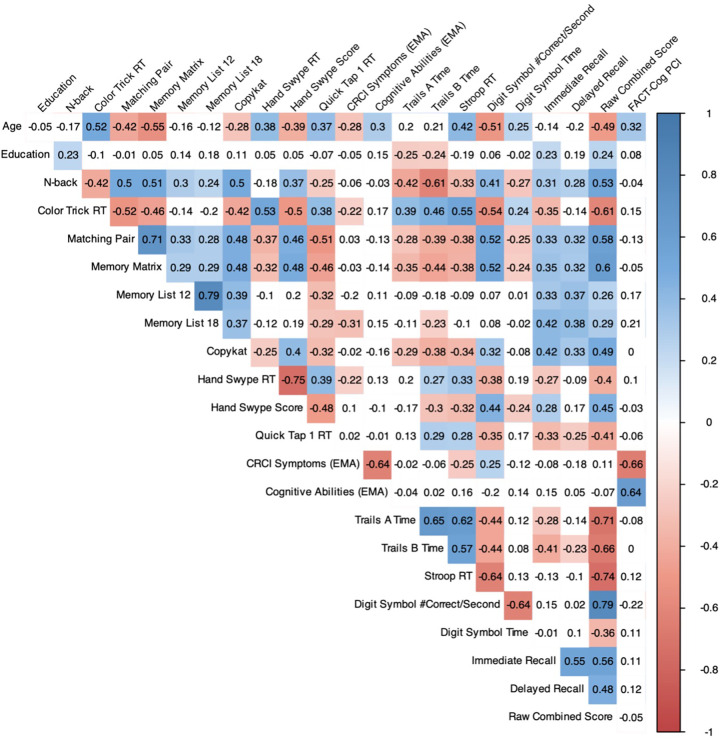
Results: 105 breast cancer survivors completed the EMA protocol with high adherence (87.3%) and high satisfaction (mean 87%). Intraclass correlation coefficients for all cognitive EMAs were strong (>0.73) and correlational findings indicated moderately strong convergent validity (|0.23| < r < |0.61|).
Conclusion: Fully remote, self-administered cognitive testing for 8-weeks on smartphones was feasible in breast cancer survivors who completed adjuvant treatment and the specific cognitive EMAs (cognitive EMA tests and self-report questions) administered demonstrate strong reliability and validity for CRCI.
Keywords: breast cancer survivors; cancer-related cognitive impairment; ecological momentary assessments; feasibility; mobile cognitive testing; reliability; validity.
© 2025 Henneghan, Paolillo, Van Dyk, Franco-Rocha, Patel, Bang and Moore.
Conflict of interest statement
RCM has equity interest in KeyWise AI, Inc. and has equity interest, is a consultant and receives compensation from NeuroUX. The terms of this arrangement have been reviewed and approved by UC San Diego in accordance with its conflict-of-interest policies. AMH was a consultant for Prodeo, Inc. The terms of this arrangement have been reviewed and approved by University of Texas at Austin in accordance with its conflict-of-interest policies. The remaining authors declare that the research was conducted in the absence of any commercial or financial relationships that could be construed as a potential conflict of interest.
Figures
References
-
- Mayo SJ, Lustberg M, Dhillon HM, Nakamura ZM, Allen DH, Von Ah D, et al. Cancer-related cognitive impairment in patients with non-central nervous system malignancies: an overview for oncology providers from the MASCC neurological complications study group. Support Care Cancer. (2021) 29(6):2821–40. 10.1007/s00520-020-05860-9 - DOI - PubMed
Grants and funding
LinkOut - more resources
Full Text Sources
Research Materials
