


The emergence of large language models as tools in literature reviews: a large language model-assisted systematic review
- PMID: 40332983
- PMCID: PMC12089777
- DOI: 10.1093/jamia/ocaf063
The emergence of large language models as tools in literature reviews: a large language model-assisted systematic review
Abstract
Objectives: This study aims to summarize the usage of large language models (LLMs) in the process of creating a scientific review by looking at the methodological papers that describe the use of LLMs in review automation and the review papers that mention they were made with the support of LLMs.
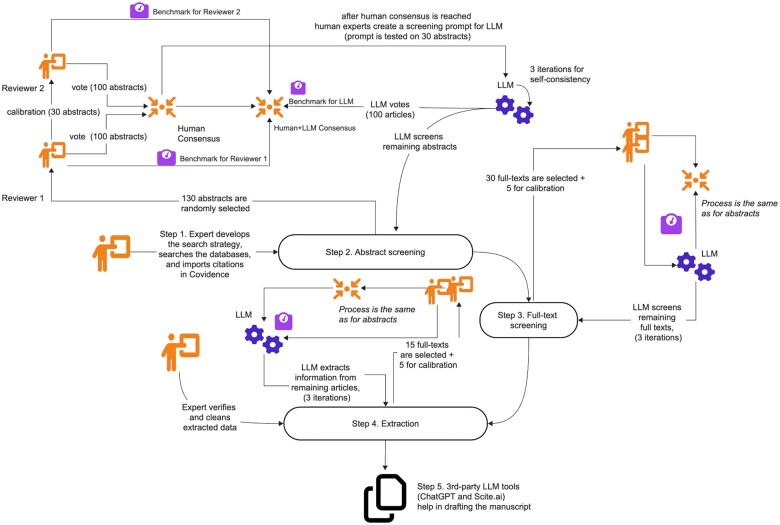
Materials and methods: The search was conducted in June 2024 in PubMed, Scopus, Dimensions, and Google Scholar by human reviewers. Screening and extraction process took place in Covidence with the help of LLM add-on based on the OpenAI GPT-4o model. ChatGPT and Scite.ai were used in cleaning the data, generating the code for figures, and drafting the manuscript.
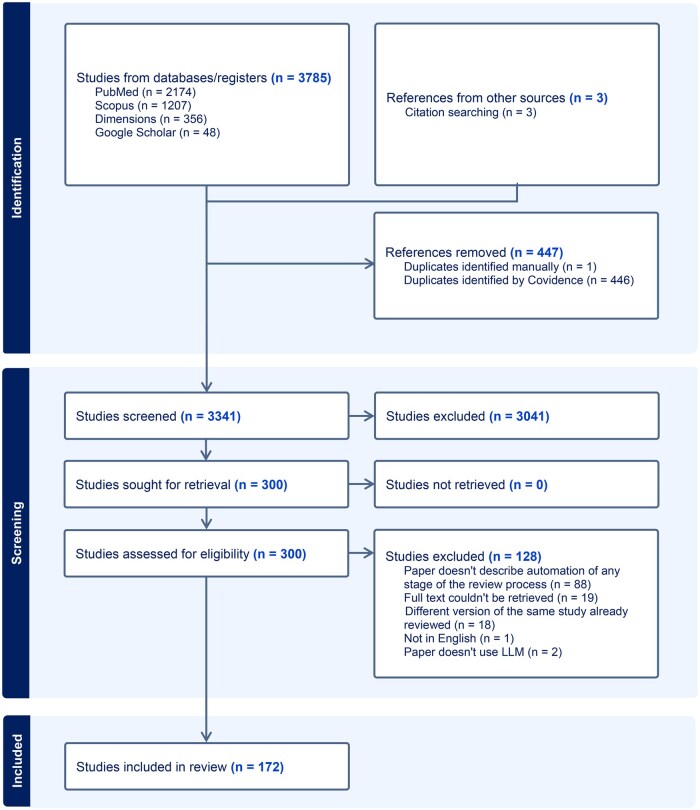
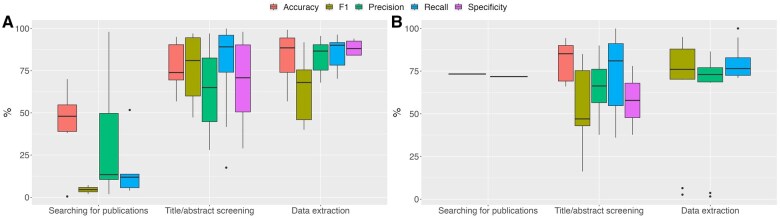
Results: Of the 3788 articles retrieved, 172 studies were deemed eligible for the final review. ChatGPT and GPT-based LLM emerged as the most dominant architecture for review automation (n = 126, 73.2%). A significant number of review automation projects were found, but only a limited number of papers (n = 26, 15.1%) were actual reviews that acknowledged LLM usage. Most citations focused on the automation of a particular stage of review, such as Searching for publications (n = 60, 34.9%) and Data extraction (n = 54, 31.4%). When comparing the pooled performance of GPT-based and BERT-based models, the former was better in data extraction with a mean precision of 83.0% (SD = 10.4) and a recall of 86.0% (SD = 9.8).
Discussion and conclusion: Our LLM-assisted systematic review revealed a significant number of research projects related to review automation using LLMs. Despite limitations, such as lower accuracy of extraction for numeric data, we anticipate that LLMs will soon change the way scientific reviews are conducted.
Keywords: Covidence; large language models; review automation; scoping review; systematic review.
© The Author(s) 2025. Published by Oxford University Press on behalf of the American Medical Informatics Association.
Conflict of interest statement
The authors have no competing interests to declare.
Figures


References
-
- Toh TS, Lee JH. Statistical note: using scoping and systematic reviews. Pediatr Crit Care Med. 2021;22:572-575. - PubMed
-
- Acar IH, Avcılar G, Yazıcı G, Bostancı S. The roles of adolescents’ emotional problems and social media addiction on their self-esteem. Curr Psychol. 2020;41:6838-6847. 10.1007/s12144-020-01174-5 - DOI
Publication types
MeSH terms
Grants and funding
LinkOut - more resources
Full Text Sources
