


Dynamics of SARS-CoV-2 IgG in Nursing Home Residents in Belgium Throughout Three BNT162b2 Vaccination Rounds: 19-Month Follow-Up
- PMID: 40333301
- PMCID: PMC12030799
- DOI: 10.3390/vaccines13040409
Dynamics of SARS-CoV-2 IgG in Nursing Home Residents in Belgium Throughout Three BNT162b2 Vaccination Rounds: 19-Month Follow-Up
Abstract
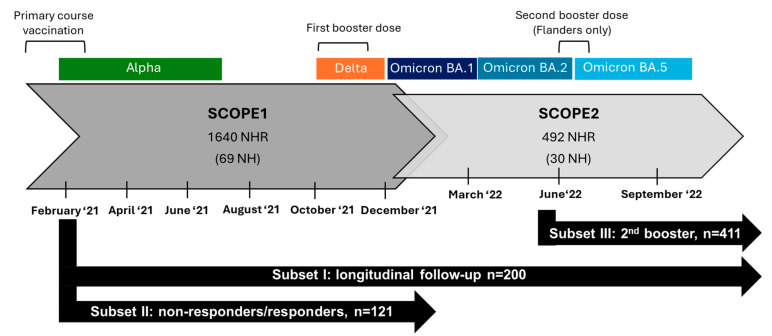
Background/objectives: This study mapped antibody dynamics across three COVID-19 vaccination rounds (primary course, first, and second booster with BNT162b2) in Belgian nursing home residents (NHRs).
Methods: Within a national SARS-CoV-2 serosurveillance study (February 2021-September 2022) across Belgian nursing homes, dried blood spots were collected, on which anti-spike SARS-CoV-2 IgG antibodies were quantified by ELISA in international units/mL (IU/mL). Sociodemographic data were collected at the study start and infection history and vaccination data at each sampling round.
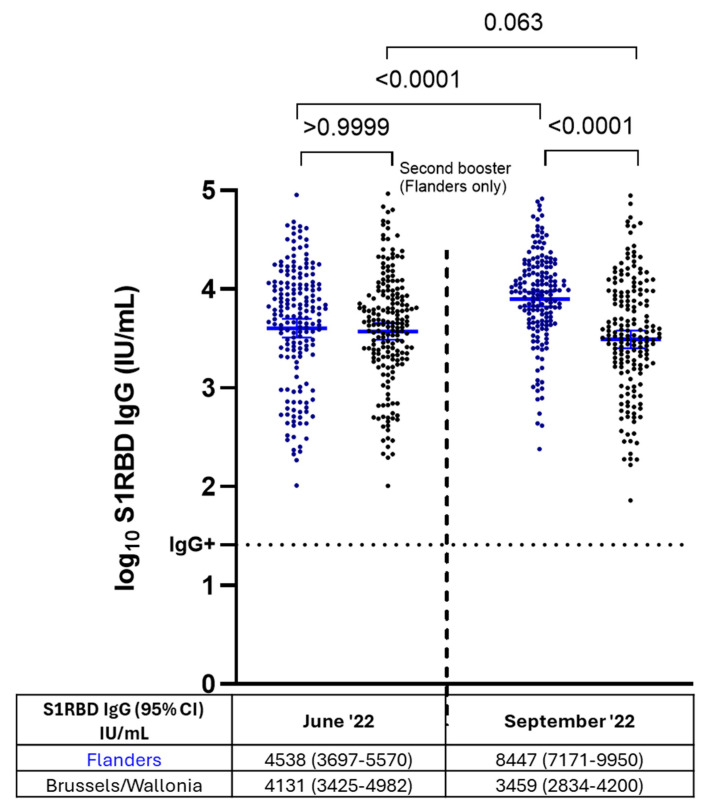
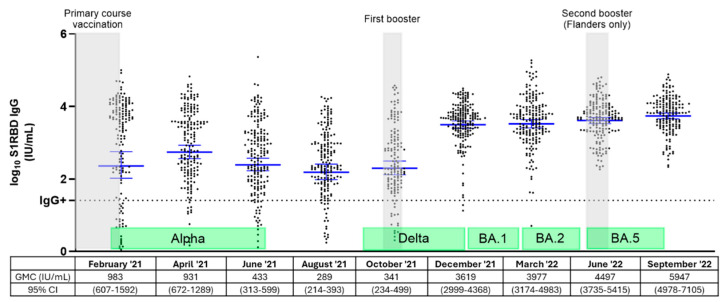
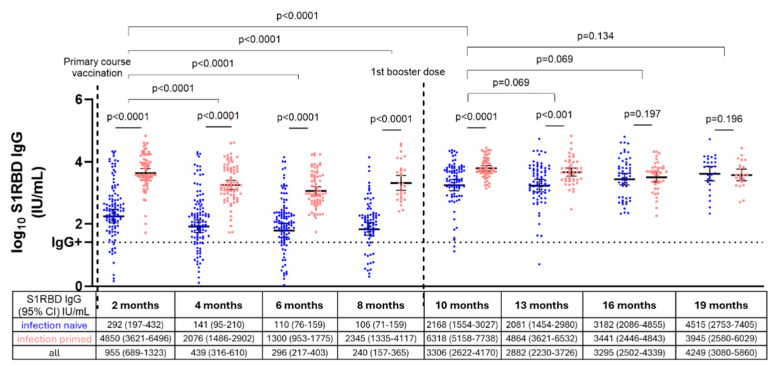
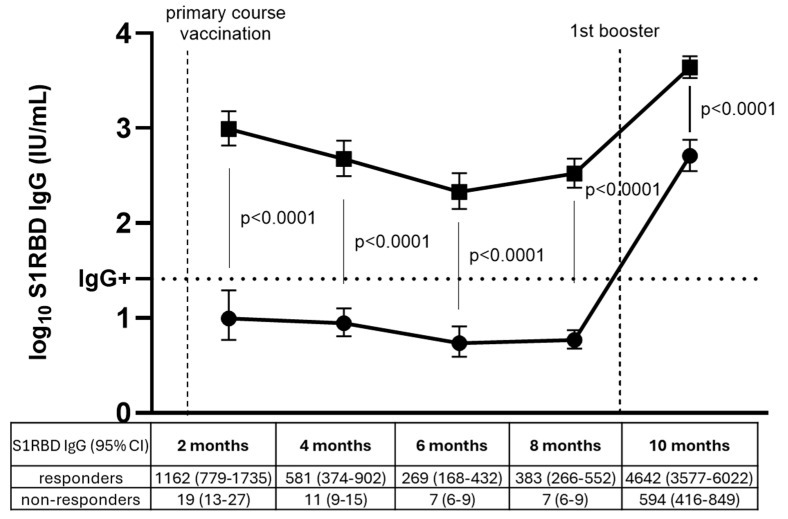
Results: Infection-naïve NHRs had low antibody levels after primary course vaccination (geometric mean concentration (GMC) 292 IU/mL, 95% confidence interval (95% CI): 197-432), but increased tenfold after first booster (GMC 2168 IU/mL, 95% CI: 1554-3027). While antibodies among NHRs significantly declined within six months after primary vaccination (p < 0.0001), they remained stable for nine months post-booster (p > 0.05). Among primary vaccine non-responders, 92% (95% CI: 82-97%) developed antibodies after the first booster (GMC 594 IU/mL, 95% CI: 416-849), though tenfold lower than initial responders (GMC 4642 IU/mL, 95% CI: 3577-6022).
Conclusions: These findings demonstrate that NHRs require tailored vaccination, prioritizing repeated immunization to improve serological outcomes in poor responders such as infection-naive NHRs. Regular immune monitoring could aid in implementing evidence-based vaccine strategies, ensuring optimal protection for vulnerable populations against SARS-CoV-2 and other infectious threats.
Keywords: COVID-19 vaccination; antibody dynamics; booster; nursing home residents.
Conflict of interest statement
The authors have no conflicts of interest to declare.
Figures
References
-
- Leece P., Whelan M., Costa A.P., Daneman N., Johnstone J., McGeer A., Rochon P., Schwartz K.L., Brown K.A. Nursing home crowding and its association with outbreak-associated respiratory infection in Ontario, Canada before the COVID-19 pandemic (2014-19): A retrospective cohort study. Lancet Healthy Longev. 2023;4:e107–e114. doi: 10.1016/S2666-7568(23)00018-1. - DOI - PMC - PubMed
-
- Catteau D.S., Haarhuis L., Vandael F., Stouten E., Litzroth V., Wyndham A., Sciensano T.C. Surveillance van de COVID-19 Vaccinatie in Belgische Woonzorgcentra. Resultaten tot 24 Maart 2021. Sciensano; Brussels, Belgium: 2021.
-
- Meyers E., De Rop L., Engels F., Gioveni C., Coen A., De Burghgraeve T., Digregorio M., Van Ngoc P., De Clercq N., Buret L., et al. Follow-Up of SARS-CoV-2 Antibody Levels in Belgian Nursing Home Residents and Staff Two, Four and Six Months after Primary Course BNT162b2 Vaccination. Vaccines. 2024;12:951. doi: 10.3390/vaccines12080951. - DOI - PMC - PubMed
Grants and funding
LinkOut - more resources
Full Text Sources
Miscellaneous
