


Comparing the Role of Relative and Absolute Humidity in Heat-Related Mortality: A Case Time-Series Study in South Korea
- PMID: 40333434
- PMCID: PMC12169509
- DOI: 10.1289/EHP15827
Comparing the Role of Relative and Absolute Humidity in Heat-Related Mortality: A Case Time-Series Study in South Korea
Abstract
Background: Epidemiology studies have reported inconsistent associations of humidity with heat-related health outcomes, despite strong plausibility of such physiological associations. In this regard, there has been a heated debate on which humidity metric to use in epidemiological research.
Objectives: This study aimed to compare the role of two common humidity metrics, relative and absolute humidity, in heat-related mortality in summer using a nationwide mortality dataset.
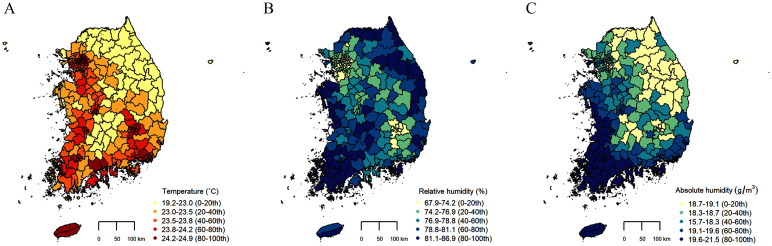
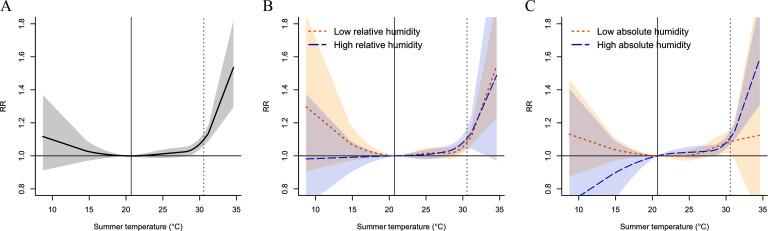
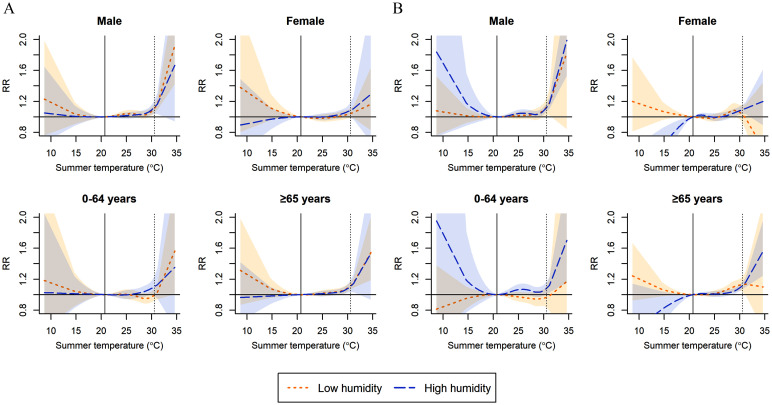
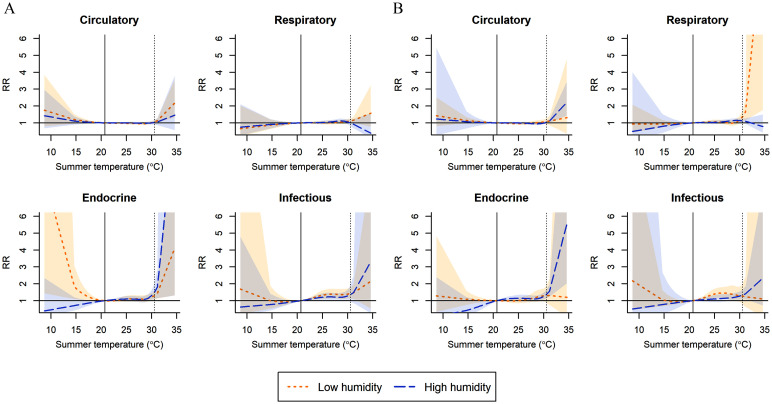
Methods: We applied a case time-series design for summer (June-September) mortality across the entire 229 districts of South Korea from 2011 to 2019. The temperature was fitted using a distributed lag nonlinear model (DLNM) with 10 lag days. A linear interaction between the cross-basis of temperature and humidity was included in each model to examine the different patterns of association between heat and mortality by humidity level (low and high humidity defined by fifth and 95th percentile of each humidity distribution).
Results: A total of 780,102 deaths were recorded in the summer from 2011 to 2019 in South Korea. The association between extreme heat (temperature approximately above the 99th percentile of the temperature distribution) and mortality was modified more by absolute humidity than by relative humidity, although the effect modification of both humidity indicators was not statistically significant. The relative risks at the 99.Ninth percentile temperature in comparison with the minimum mortality temperature were 1.21 [95% confidence interval (CI): 1.11, 1.31] and 1.22 (95% CI: 1.03, 1.44) for low and high relative humidity, respectively, and 1.11 (95% CI: 0.89, 1.37) and 1.25 (95% CI: 1.15, 1.34) for low and high absolute humidity, respectively.
Discussion: Our findings provide epidemiological evidence on the role of relative and absolute humidity in heat-related mortality and suggest that absolute humidity may be a more appropriate metric than relative humidity when assessing health impact. https://doi.org/10.1289/EHP15827.
Figures
References
-
- IPCC (Intergovernmental Panel on Climate Change). 2023. Climate Change 2023: Synthesis Report. https://www.ipcc.ch/report/ar6/syr/downloads/report/IPCC_AR6_SYR_LongerR... [accessed 2 March 2024].
-
- Lutsko NJ. 2021. The relative contributions of temperature and moisture to heat stress changes under warming. J Clim 34(3):901–917, 10.1175/JCLI-D-20-0262.1. - DOI
MeSH terms
LinkOut - more resources
Full Text Sources