


Oral zinc sulphate reduces the recurrence rate and provides significant therapeutic effects for viral warts: A systematic review and meta-analysis of randomized controlled trials
- PMID: 40334186
- PMCID: PMC12058182
- DOI: 10.1371/journal.pone.0323051
Oral zinc sulphate reduces the recurrence rate and provides significant therapeutic effects for viral warts: A systematic review and meta-analysis of randomized controlled trials
Abstract
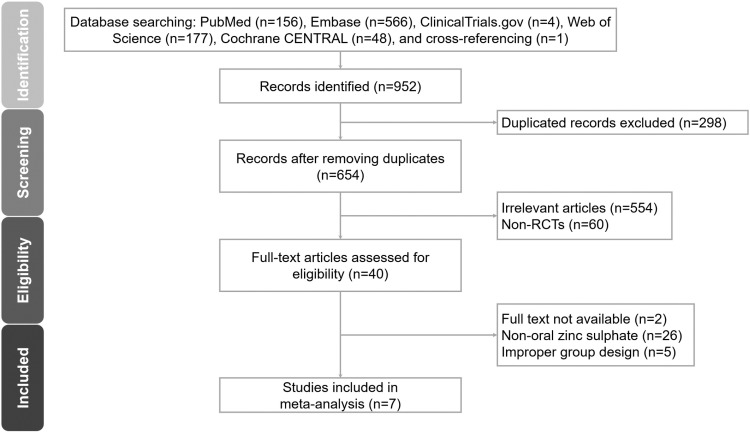
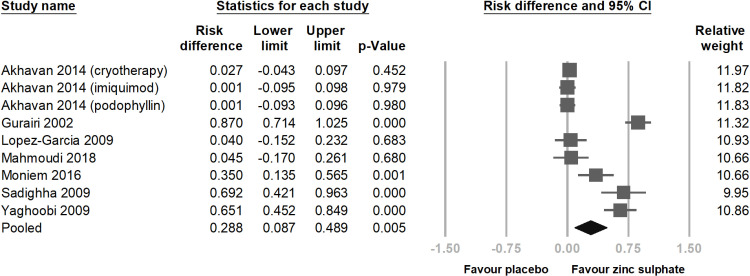
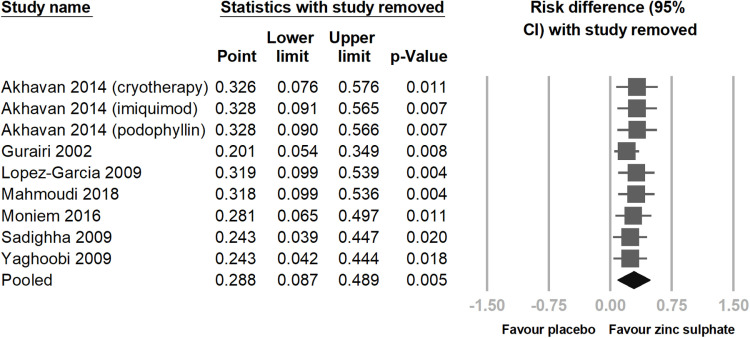
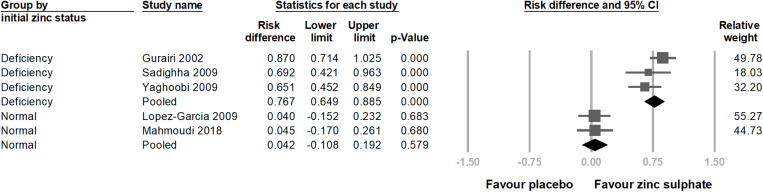
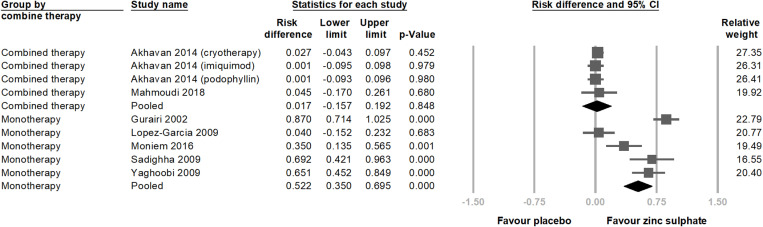
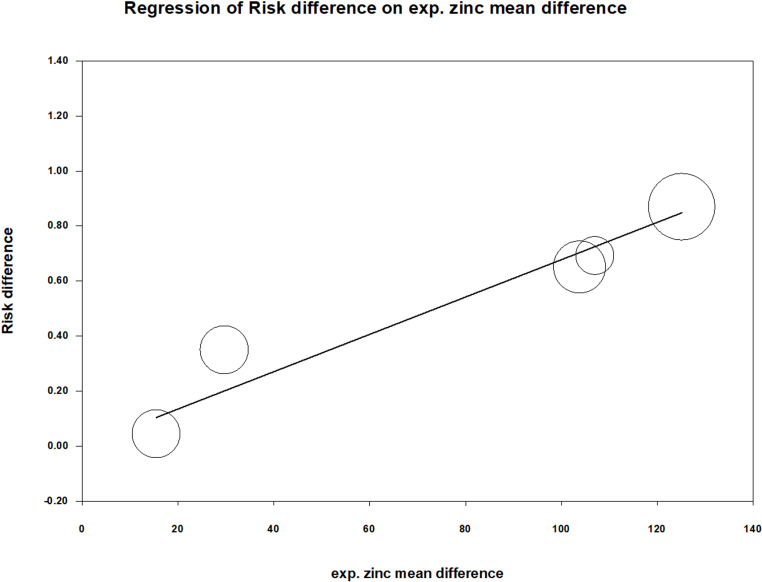
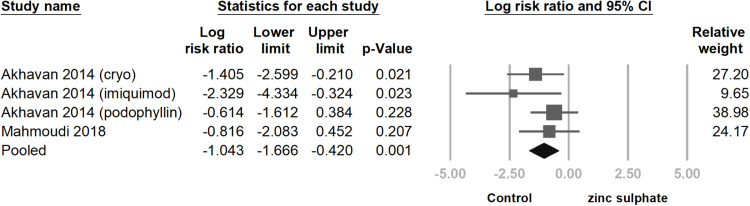
Zinc plays a crucial role in maintaining immune balance in the human body. Zinc is believed to substantially affect cytokine synthesis and signaling; thus potentially combating viral infections, including Human Papillomavirus infection, through various mechanisms. Several randomized controlled trials (RCTs) have investigated whether oral zinc sulphate can improve viral warts; however, no comprehensive data is currently available. Therefore, we conducted a meta-analysis to evaluate the effectiveness of oral zinc sulphate for the treatment of viral warts. On July 1, 2024, we performed an extensive database search on PubMed, Embase, Web of Science, Cochrane CENTRAL, and ClinicalTrials.gov. Initially, 952 studies were identified, and after screening, 7 studies were included in the final analysis. Our findings showed that the total clearance rate of warts was significantly higher in the oral zinc sulphate group than in the control group (risk difference = 0.288; 95% CI = 0.087-0.489; p = 0.005). Subgroup analysis revealed that this therapeutic effect was more pronounced in individuals with low initial plasma zinc levels (risk difference = 0.767; 95% CI = 0.649-0.885; p < 0.001). Additionally, meta-regression showed that rise in zinc ion levels post-treatment were correlated with better treatment outcomes (coefficient = 0.0068; p < 0.001). Furthermore, for patients receiving traditional warts treatment, combining oral zinc sulphate significantly reduced the 6-month recurrence rate (log risk ratio = -1.043; 95% CI = -1.666 - -0.420; p = 0.001). The most common treatment-related side effects were nausea (risk difference = 0.562; 95% CI = 0.088-1.036; p = 0.020) and vomiting (risk difference = 0.205; 95% CI = 0.092-0.317; p < 0.001). Based on this evidence, oral zinc sulphate monotherapy offers notable benefits to those avoiding conventional treatments, and when combined with traditional therapies for viral warts, it can notably reduce recurrence rates over six months.
Copyright: © 2025 Wang et al. This is an open access article distributed under the terms of the Creative Commons Attribution License, which permits unrestricted use, distribution, and reproduction in any medium, provided the original author and source are credited.
Conflict of interest statement
No authors have competing interests.
Figures
Similar articles
-
Oral zinc sulphate in the treatment of recalcitrant viral warts: randomized placebo-controlled clinical trial.Br J Dermatol. 2002 Mar;146(3):423-31. doi: 10.1046/j.1365-2133.2002.04617.x. Br J Dermatol. 2002. PMID: 11952542 Clinical Trial.
-
Oral zinc sulphate in recalcitrant multiple viral warts: a pilot study.J Eur Acad Dermatol Venereol. 2009 Jun;23(6):715-6. doi: 10.1111/j.1468-3083.2009.03169.x. Epub 2009 Feb 25. J Eur Acad Dermatol Venereol. 2009. PMID: 19298490 No abstract available.
-
Topical zinc sulphate solution for treatment of viral warts.Saudi Med J. 2007 Sep;28(9):1418-21. Saudi Med J. 2007. PMID: 17768472 Clinical Trial.
-
Prophylactic drug management for febrile seizures in children.Cochrane Database Syst Rev. 2021 Jun 16;6(6):CD003031. doi: 10.1002/14651858.CD003031.pub4. Cochrane Database Syst Rev. 2021. PMID: 34131913 Free PMC article.
-
Nutritional interventions for treating foot ulcers in people with diabetes.Cochrane Database Syst Rev. 2020 Jul 17;7(7):CD011378. doi: 10.1002/14651858.CD011378.pub2. Cochrane Database Syst Rev. 2020. PMID: 32677037 Free PMC article.
References
-
- Al Aboud AM, Nigam PK. Wart. StatPearls. Treasure Island (FL): StatPearls Publishing. Copyright © 2024, StatPearls Publishing LLC; 2024.
-
- Leslie SW, Sajjad H, Kumar S. Genital warts. StatPearls. Treasure Island (FL): StatPearls Publishing. Copyright © 2024, StatPearls Publishing LLC; 2024.
-
- Shankar AH, Prasad AS. Zinc and immune function: the biological basis of altered resistance to infection. Am J Clin Nutr. 1998;68(2 Suppl):447s–63s. - PubMed
Publication types
MeSH terms
Substances
LinkOut - more resources
Full Text Sources
Medical
