


Resilience revisited: a systematic review and synthesis of Non-Suicidal Self-Injury (NSSI) and its relation with resilience
- PMID: 40335940
- PMCID: PMC12060524
- DOI: 10.1186/s12888-025-06868-3
Resilience revisited: a systematic review and synthesis of Non-Suicidal Self-Injury (NSSI) and its relation with resilience
Abstract
Background: The aim of the current study is to examine the relationship between nonsuicidal self-injury (NSSI) and resilience. Resilience has been identified as a critical area for further investigation in the context of NSSI. Resilience has been conceptualized in different ways over the years, from psychological resilience, with a focus on the individual's problem/deficiency, into a dynamic, cultural, interactive process in which people's biological, psychological, social, and ecological systems work together to help them cope with challenges and maintain or improve their mental well-being.
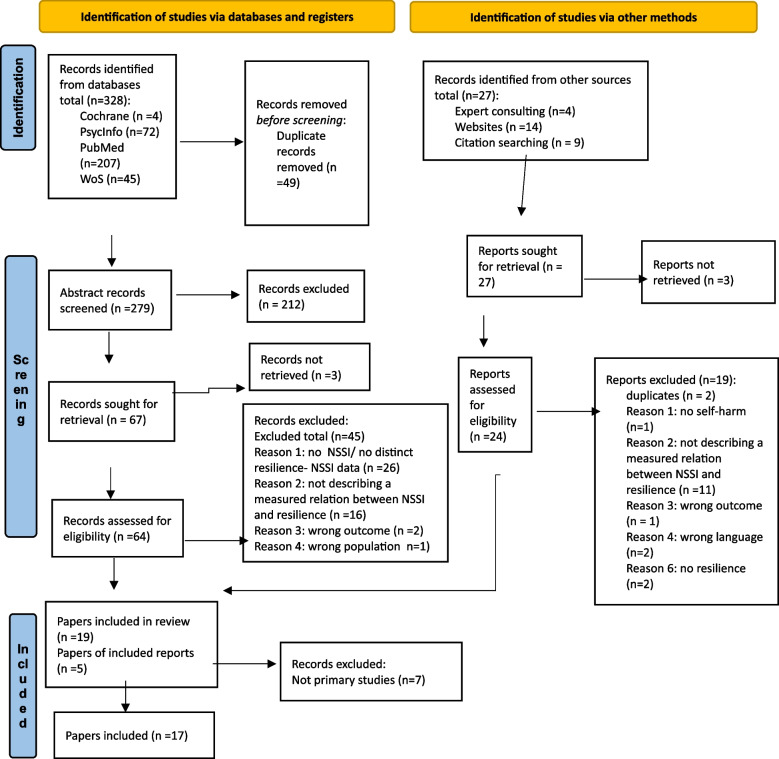
Method: For this systematic review was searched within PubMed, PsycINFO, the Cochrane Library, and Web of Science for currently published studies on the relationship between NSSI and resilience to provide a summary, following the Preferred Reporting Items for Meta-analysis and Meta-Analysis. Second, it determines the magnitude of this relationship by calculating a random effects size, using the meta-package of R.
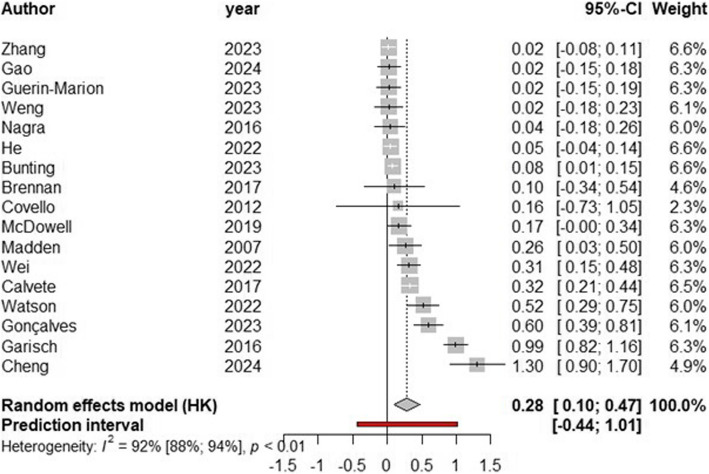
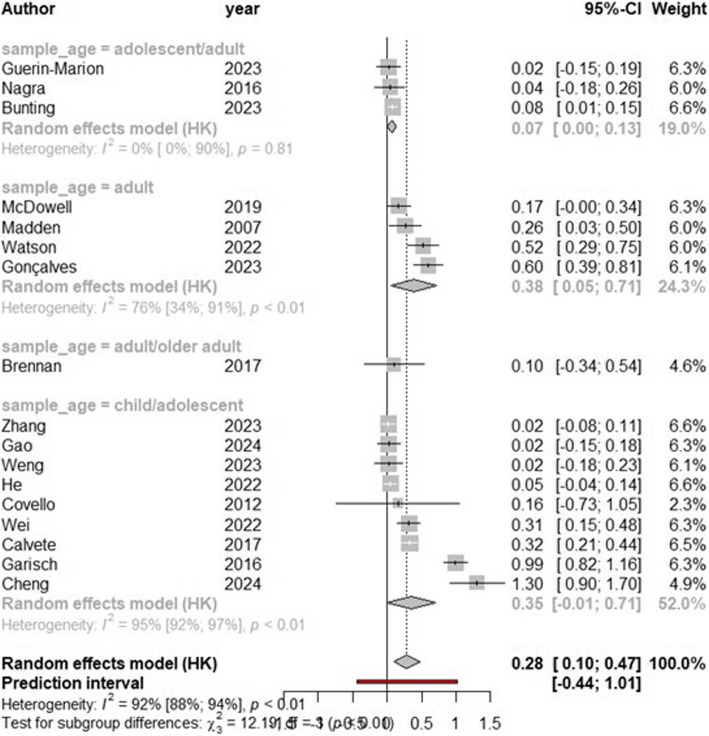
Results: Included were 17 studies with a total sample size of 12,273 participants (Mage = 17.56, range: 12.93-27.50, SD = 3.95; female: 59.5%) and a NSSI sample size of 4,767 (38.8%). The pooled results indicate a small to moderate relationship between resilience and NSSI, with a random effects model effect size of 0.28 (95% CI: 0.10; 0.47), with higher levels or the presence of NSSI associated with lower levels of resilience. Most studies measured psychological resilience. Several reporting the moderator and mediator function of resilience, whereby higher resilience reduces the odds of developing NSSI in the case of stressful or traumatic events. A minority of studies reported effect sizes per resilience factor. Of which problem solving/coping and emotional reactivity were predominantly reported.
Conclusions: Resilience is related to NSSI. However, it also shows that resilience is mostly measured as a psychological and individual concept. This is contrary to the multimodal perspective of resilience as well as the multimodal and non-linear nature of the recovery process of NSSI. Therefor this review highlights the need for a holistic approach with a shift in focus to a multimodal perspective. More research is needed to understand the role of resilience within the nonlinear recovery process. This research should include the voices of people with lived experience.
Keywords: Nonsuicidal self-injury; Resilience.
© 2025. The Author(s).
Conflict of interest statement
Declarations. Ethics approval and consent to participate: Not applicable. Consent for publication: Not applicable. Competing interests: The authors declare no competing interests.
Figures
References
-
- Alessa L, Kliskey A. People, perceptions, and process. In: Ungar M, editor. multisystemic resilience: adaptation and transformation in contexts of change. Oxford: Oxford University Press; 2021. p 165.
-
- Aromataris E, Munn Z, editor. JBI manual for evidence synthesis. JBI; 2020.
-
- Balazs J, Brunner R. Nonsuicidal Self-Injury in Adolescents: Research and Clinical Practice. In Fiorillo A, Falkai P, Gorwood P, editors. Mental Health Research and Practice: From Evidence to Experience. Cambridge University Press; 2024. p. 19–26. 10.1017/9781009067287.003.
Publication types
MeSH terms
LinkOut - more resources
Full Text Sources
Medical
