


Multi-omics insights into the response of the gut microbiota and metabolites to albendazole deworming in captive Rhinopithecus brelichi
- PMID: 40336838
- PMCID: PMC12058082
- DOI: 10.3389/fmicb.2025.1581483
Multi-omics insights into the response of the gut microbiota and metabolites to albendazole deworming in captive Rhinopithecus brelichi
Abstract
Background: Parasite infection and deworming treatment affect the host gut microbiota. Exploring the response mechanism of the gut microbiota in Rhinopithecus brelichi (R. brelichi) to albendazole deworming treatment is of great value for protecting this critically endangered species.
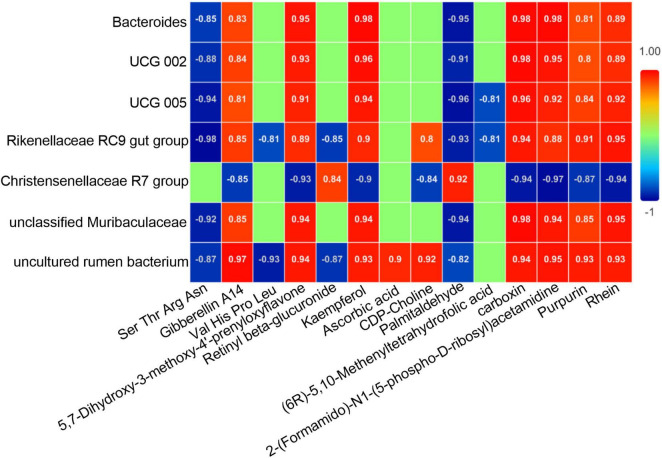
Methods and results: This study used metataxonomics and metabolomics to explore the responses of the gut microbiota and metabolites of R. brelichi to albendazole deworming treatment. The results showed that deworming significantly reduced the eggs per gram of feces (EPG). The 16S rRNA gene sequencing results showed that the richness and diversity of the gut microbiota in R. brelichi after deworming were significantly increased. Meanwhile, deworming treatment also changed the composition of the gut microbiota. At the genus level, the Christensenellaceae R7 group, UCG 002, UCG 005, uncultured rumen bacterium, and Rikenellaceae RC9 gut group were significantly enriched in the pre-deworming samples. Unclassified Muribaculaceae, Prevotella 9, and Bacteroides were significantly enriched in the post-deworming samples. Metabolomics analysis revealed that the relative abundance of 382 out of 1,865 metabolites showed significant differences between the pre- and post-deworming samples. Among them, 103 metabolites were annotated based on the HMDB and mainly classified into Prenol lipids, Carboxylic acids and derivatives, and Organooxygen compounds, etc. The KEGG enrichment analysis result indicated that these metabolites were mainly involved in energy, amino acid, lipid, and purine metabolism. Correlation analysis showed that Bacteroides and unclassified Muribaculaceae, whose relative abundances were upregulated after deworming treatment, were positively correlated with Kaempferol, 5,7-Dihydroxy-3-methoxy-4'-prenyloxyflavone, Purpurin, and Rhein, which have anti-parasitic activities. The Christensenellaceae R7 group, with a downregulated relative abundance after deworming treatment, was not only negatively correlated with the above four metabolites, but also positively correlated with Retinyl beta-glucuronide, which is a storage form of vitamin A, and positively correlated with CDP-Choline, which increases the host's susceptibility to Entamoeba histolytica and Plasmodium falciparum.
Conclusion: This study emphasizes that deworming treatment has an impact on the gut microbiota and metabolic functions of R. brelichi. By exploiting the correlations between differential microbiota and metabolites, potential probiotics or prebiotics can be explored, thereby enhancing the efficiency of deworming and reducing its side effects.
Keywords: 16S rRNA gene; R. brelichi; correlations; gut microbiota; non-targeted metabolomics.
Copyright © 2025 Qin, Han, Xi, Zhao, Li, Cui and Hao.
Conflict of interest statement
The authors declare that the research was conducted in the absence of any commercial or financial relationships that could be construed as a potential conflict of interest.
Figures


References
-
- Albuquerque M. M. S., Luz R. L. S. A., Rodrigues V. C., Roquini D. B., Umehara E., de Moraes J., et al. (2024). Oral administration of Kaempferol isolated from baccharis mattogrosensis enables in vivo activity against Schistosoma mansoni. Chem. Biodivers. 21:e202401452. 10.1002/cbdv.202401452 - DOI - PubMed
-
- Alqahtani F. S., Bahshwan S. M. A., Al-Qurashi M. M., Beyari E. A., Alghamdi M. A., Baty R. S., et al. (2024). Impact of dietary Bacillus toyonensis M44 as an antibiotic alternative on growth, blood biochemical properties, immunity, gut microbiota, and meat quality of IR broilers. Pak. Vet. J. 44 637–646. 10.29261/pakvetj/2024.215 - DOI
LinkOut - more resources
Full Text Sources
