Role of the multiple telomeric repeat arrays in integration, persistence, and efficacy of the commercial CVI988 vaccine
- PMID: 40338085
- PMCID: PMC12108085
- DOI: 10.1128/msphere.00142-25
Role of the multiple telomeric repeat arrays in integration, persistence, and efficacy of the commercial CVI988 vaccine
Abstract
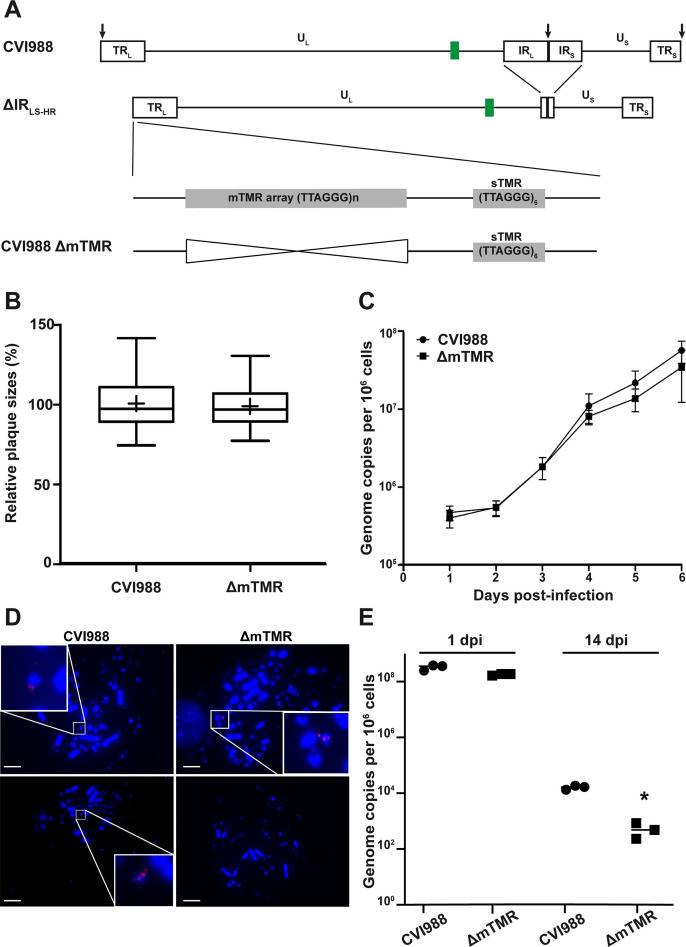
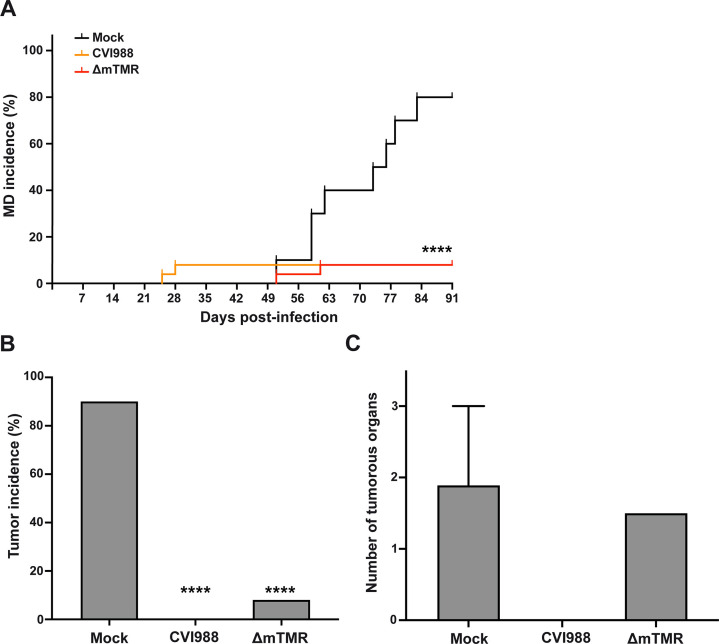
Marek's disease virus (MDV) is a highly oncogenic alphaherpesvirus that causes fatal T cell lymphomas in chickens. Oncogenic MDV strains can integrate their genome into the host telomeres of latently infected and tumor cells. This integration process is facilitated by telomeric repeat arrays (TMR) present at the ends of the MDV genome, which consist of the hexanucleotide (TTAGGG)n that is identical to host telomere sequences. In addition, integration of the virus genome is crucial for the development of lymphomas. Live-attenuated vaccines play a vital role in protecting chickens against this deadly disease, yet our understanding of their biology remains limited. Intriguingly, the commercial gold standard MDV vaccine, the live-attenuated MDV strain CVI988, also possesses TMR at the ends of its genome. In this study, we investigated the role of the multiple TMR arrays (mTMR) in vaccine virus integration, latency, reactivation, and protection against very virulent MDV. Our data revealed that the mTMR present in CVI988 are important for virus genome integration and maintenance in latently infected cells in vitro. In addition, virus latency, reactivation, and vaccine efficacy were reduced in an mTMR deleted mutant compared to the wild-type vaccine. These results provide valuable insights into the biology of this important vaccine virus and shed light on the roles of the mTMR in vaccine integration, latency, and protection against very virulent MDV.IMPORTANCEMarek's disease virus (MDV) is an oncogenic herpesvirus and causes lethal lymphomas in chickens. The gold standard vaccine is the live-attenuated MDV strain CVI988 (a.k.a. Rispens). CVI988 is extensively used in chickens worldwide due to its high efficacy in preventing disease and lymphomas. The CVI988 vaccine harbors telomere arrays (TMR) at the ends of its genome. TMR facilitate genome integration of oncogenic MDV strains into the host telomeres. This study provides critical insights into the biology of the widely used MDV vaccine strain CVI988, demonstrating the crucial role of mTMR in viral genome integration, latency, and protection against very virulent MDV. Furthermore, our findings enhance the understanding of MDV vaccine biology and may guide future strategies to improve Marek's disease control.
Keywords: CVI988; MDV vaccine; Rispens; genome integration; herpesvirus; telomeres; vaccine effectiveness.
Conflict of interest statement
The authors declare no conflict of interest.
Figures
References
-
- Schat KA, Nair V. 2017. Neoplastic Diseases, p 513–673. In Swayne DE (ed), Diseases of poultry. John Wiley & Sons, Inc; Hoboken, NJ, USA.
-
- Rispens BH, van Vloten H, Mastenbroek N, Maas HJ, Schat KA. 1972. Control of Marek’s disease in the Netherlands. I. Isolation of an avirulent Marek’s disease virus (strain CVI 988) and its use in laboratory vaccination trials. Avian Dis 16:108–125. - PubMed
-
- Rispens BH, van Vloten H, Mastenbroek N, Maas JL, Schat KA. 1972. Control of Marek’s disease in the Netherlands. II. Field trials on vaccination with an avirulent strain (CVI 988) of Marek’s disease virus. Avian Dis 16:126–138. - PubMed
MeSH terms
Substances
Grants and funding
LinkOut - more resources
Full Text Sources