


Association between radiographic severity with health-related quality of life in elderly women with knee osteoarthritis: A cross-sectional study
- PMID: 40338869
- PMCID: PMC12061131
- DOI: 10.1371/journal.pone.0319482
Association between radiographic severity with health-related quality of life in elderly women with knee osteoarthritis: A cross-sectional study
Abstract
Background and aims: Knee osteoarthritis (OA) is a common chronic condition among the elderly, leading to a decline in OA patients' quality of life. This study aimed to investigate the relationship between radiographic severity and health-related quality of life (HRQoL) in elderly women with knee OA.
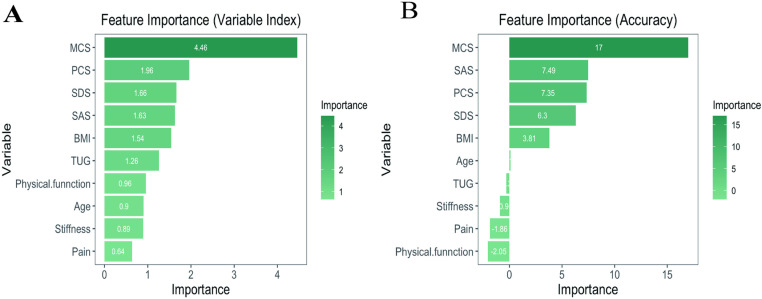
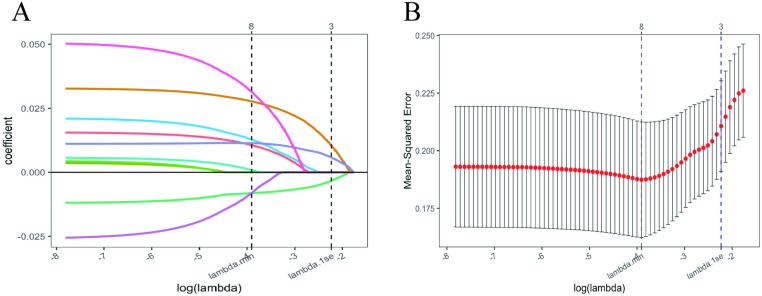
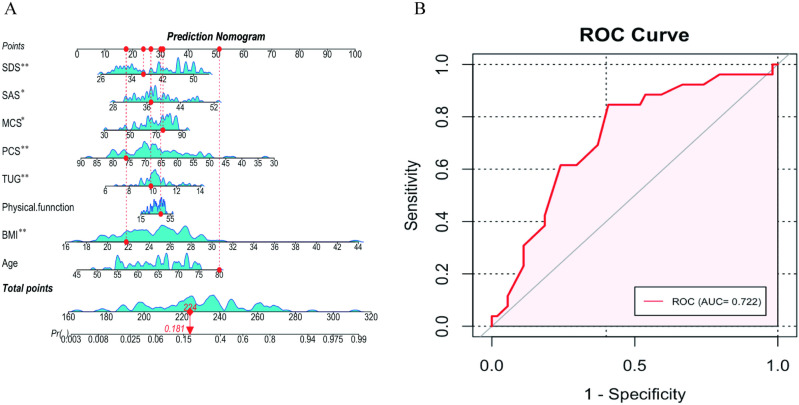
Methods: A total of 80 elderly women with knee OA were enrolled in this study. Radiographic severity was assessed with the Kellgren-Lawrence (K/L) scale, we divided the subjects into early (1-2) and late (3-4) according to the K/L stage. HRQoL assessment was conducted using the MOS item Short-Form 36 (SF-36). The association of HRQoL with knee OA severity was estimated using logistic regression. Applied a random forest model to assess the importance and accuracy of relevant variables in the occurrence of OA. The LASSO (Least Absolute Shrinkage and Selection Operator) regression was then used to identify key factors associated with OA, which were incorporated into the development of a risk prediction nomogram model. Furthermore, a receiver operating characteristic (ROC) curve was constructed to evaluate the model's discriminative ability for OA.
Result: The mean age of the patients was 64.7 ± 6.74 years, and the mean course of disease was 5.01 ± 2.12 years. HRQoL score (SF-36 PCS and MCS) was significantly worse in the late-stage group compared to the early group (p < 0.05). The late group K/L scale has a negative correlation with SF-36 PCS (r = -0.598) and MCS (r = -0.625) and a strong positive correlation. In logistic regression analysis, the K/L scale were significantly associated with SF-36MCS (OR = 0.86, p = 0.041), SF-36 PCS (OR = 0.85, p = 0.025) and TUG (OR = 1.80, p = 0.001). The nomogram model based on key OA risk factors identified by LASSO regression demonstrated substantial predictive value for OA, with an area under the curve (AUC) of 72.2%.
Conclusion: The radiographic severity of knee OA was correlated with health-related quality of life. The HRQoL is an important predictive indicator of the severity of knee OA severity, which might provide beneficial management and treatment for patients with knee OA.
Copyright: © 2025 Song et al. This is an open access article distributed under the terms of the Creative Commons Attribution License, which permits unrestricted use, distribution, and reproduction in any medium, provided the original author and source are credited.
Conflict of interest statement
The authors have declared that no competing interests exist.
Figures
References
MeSH terms
LinkOut - more resources
Full Text Sources
