


Data Interoperability and Harmonization in Cardiovascular Genomic and Precision Medicine
- PMID: 40340425
- PMCID: PMC12173165
- DOI: 10.1161/CIRCGEN.124.004624
Data Interoperability and Harmonization in Cardiovascular Genomic and Precision Medicine
Abstract
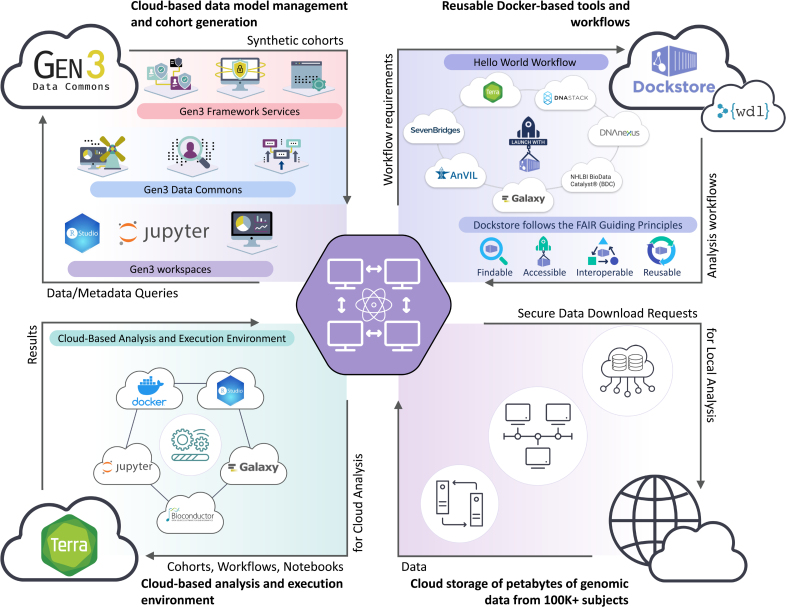
Despite advances in cardiovascular care and improved outcomes, fragmented healthcare systems, nonequitable access to health care, and nonuniform and unbiased collection and access to healthcare data have exacerbated disparities in healthcare provision and further delayed the technological-enabled implementation of precision medicine. Precision medicine relies on a foundation of accurate and valid omics and phenomics that can be harnessed at scale from electronic health records. Big data approaches in noncardiovascular healthcare domains have helped improve efficiency and expedite the development of novel therapeutics; therefore, applying such an approach to cardiovascular precision medicine is an opportunity to further advance the field. Several endeavors, including the American Heart Association Precision Medicine platform and public-private partnerships (such as BigData@Heart in Europe), as well as cloud-based platforms, such as Terra used for the National Institutes of Health All of Us, are attempting to temporally and ontologically harmonize data. This state-of-the-art review summarizes best practices used in cardiovascular genomic and precision medicine and provides recommendations for systems' requirements that could enhance and accelerate the integration of these platforms.
Keywords: big data; electronic health records; natural language processing; phenomics; translational research, biomedical.
Conflict of interest statement
All authors declare no conflicts of interest, no relevant relationships to disclose, and no funding received from any companies or organizations related to the subject of this article.
Figures

References
-
- Armoundas AA, Narayan SM, Arnett DK, Spector-Bagdady K, Bennett DA, Celi LA, Friedman PA, Gollob MH, Hall JL, Kwitek AE, et al. ; on behalf of the American Heart Association Institute for Precision Cardiovascular Medicine; Council on Cardiovascular and Stroke Nursing; Council on Lifelong Congenital Heart Disease and Heart Health in the Young; Council on Cardiovascular Radiology and Intervention; Council on Hypertension; Council on the Kidney in Cardiovascular Disease; and Stroke Council. Use of artificial intelligence in improving outcomes in heart disease: a scientific statement from the American Heart Association. Circulation. 2024;149:e1028. doi: 10.1161/CIR.0000000000001201 - PMC - PubMed
-
- NIH. NIH broadens genomic data-sharing policy. Cancer Discov. 2014;4:OF4. doi: 10.1158/2159-8290 - PubMed
-
- Bota P, Thambiraj G, Bollepalli SC, Armoundas AA. Artificial intelligence algorithms in cardiovascular medicine: an attainable promise to improve patient outcomes or an inaccessible investment? Curr Cardiol Rep. 2024;26:1477–1485. doi: 10.1007/s11886-024-02146-y - PubMed
-
- Donnelly WJ. Viewpoint: patient-centered medical care requires a patient-centered medical record. Acad Med. 2005;80:33–38. doi: 10.1097/00001888-200501000-00009 - PubMed
Publication types
MeSH terms
LinkOut - more resources
Full Text Sources
Medical
