


Divergent transmission dynamics and drug resistance evolution of HIV-1 CRF01_AE and CRF07_BC in Tianjin, China (2013-2022)
- PMID: 40340650
- PMCID: PMC12063264
- DOI: 10.1186/s12985-025-02704-y
Divergent transmission dynamics and drug resistance evolution of HIV-1 CRF01_AE and CRF07_BC in Tianjin, China (2013-2022)
Abstract
Background: Tianjin, a major hub in northern China, faces rising HIV-1 infections dominated by CRF01_AE and CRF07_BC. This study elucidated their divergent transmission patterns and drug resistance dynamics to guide targeted interventions.
Methods: This study included samples identified as CRF01_AE and CRF07_BC subtypes through various methods between 2013 and 2022. BEAST software was used to examine the spatiotemporal transmission patterns of these subtypes in Tianjin. By integrating HIV-TRACE, we constructed high-risk transmission clusters and identified drug resistance mutations (DRMs) based on the Stanford HIV Drug Resistance Database. Finally, the birth-death skyline serial (BDSKY) model was employed to dynamically assess the effective reproductive number (Re) of both subtypes to predict future transmission dynamics.
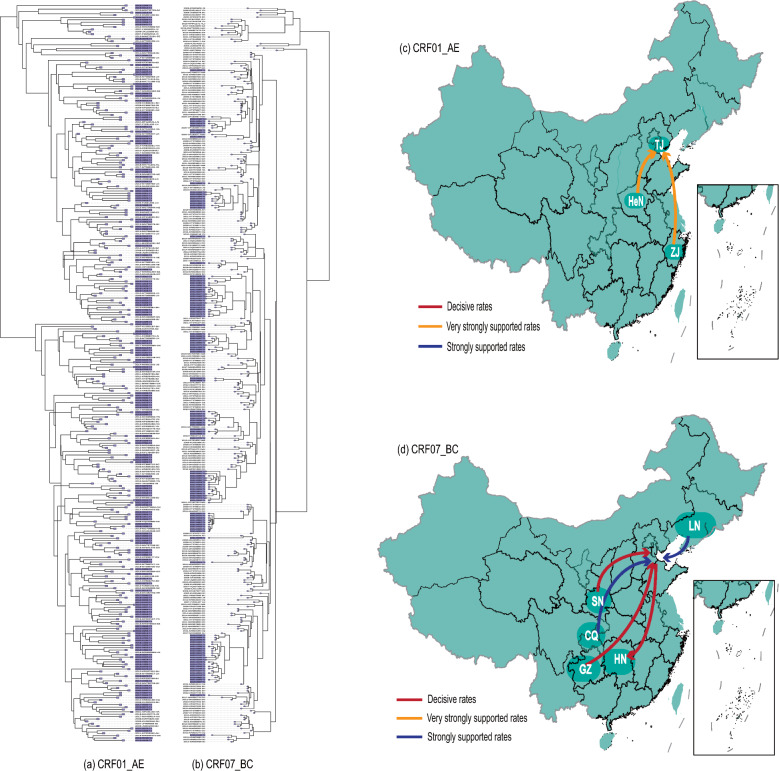
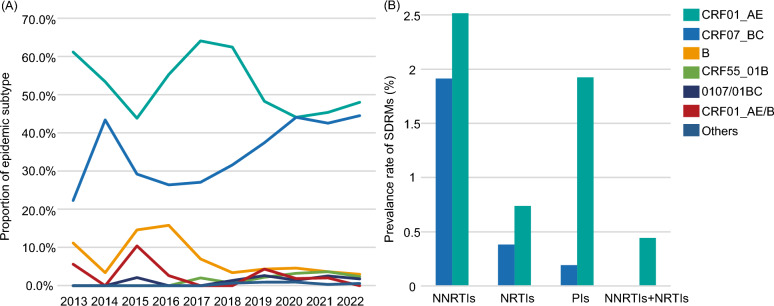
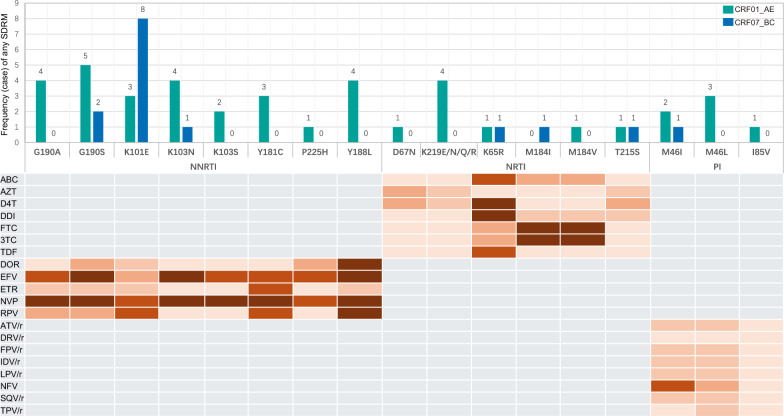
Results: CRF01_AE might be introduced in 1988 from Henan and Zhejiang, forming multiple small clusters (< 10 nodes) and spreading through both heterosexual and men who have sex with men (MSM) in Tianjin, while CRF07_BC from Chongqing and Guizhou, et al. in 2004, experiencing explosive local transmission and forming a large cluster of 170 nodes primarily among MSM under 30 years old (P < 0.05). Phylogenetic analysis indicated that CRF01_AE has a significantly higher evolutionary rate (2.08 × 10⁻3 vs. 1.48 × 10⁻3 substitutions/site/year, P < 0.05), while CRF07_BC demonstrates a greater cluster formation capacity (56.6% vs. 37.1%, P < 0.05). CRF01_AE showed a higher mutation occurrence rate (5.18% vs. 2.49%, P < 0.05), particularly with non-nucleoside reverse transcriptase inhibitor (NNRTI) associated mutations (e.g., K101E). Although CRF07_BC had a lower resistance burden, the emergence of K103E mutations suggests a need for vigilance regarding potential decreases in sensitivity to newer NNRTIs. BDSKY modeling revealed that the Re for CRF01_AE dropped below 1 after 2016, whereas CRF07_BC's Re remains above 1, indicating that the risk of transmission still exists.
Conclusion: Subtype-specific strategies are critical: intensified resistance monitoring for CRF01_AE and cluster-focused interventions for CRF07_BC, particularly among young MSM.
Keywords: DRMs; HIV-1; Phylodynamic analysis; Transmission dynamics.
© 2025. The Author(s).
Conflict of interest statement
Declarations. Ethics approval and consent to participate: This study was approved by the Review Committee (Ethical Review Number: X231028769) of the National Center for AIDS/STD Control and Prevention, Chinese Center for Disease Control and Prevention. Consent for publication: Not applicable. Competing interests: The authors declare no competing interests.
Figures


References
-
- UNAIDS, Global HIV & AIDS statistics: 2022 fact sheet. 2022
-
- Prevention, C.f.D.C.a., HIV Surveillance Report, 2021. 2023. 34
Publication types
MeSH terms
Substances
Grants and funding
LinkOut - more resources
Full Text Sources
Medical
