


Association between life satisfaction, sleep disturbance and mental health problems among the migrant older adults with children: a conditional process analysis based on per capita bedroom area
- PMID: 40340910
- PMCID: PMC12060403
- DOI: 10.1186/s12877-025-05957-y
Association between life satisfaction, sleep disturbance and mental health problems among the migrant older adults with children: a conditional process analysis based on per capita bedroom area
Abstract
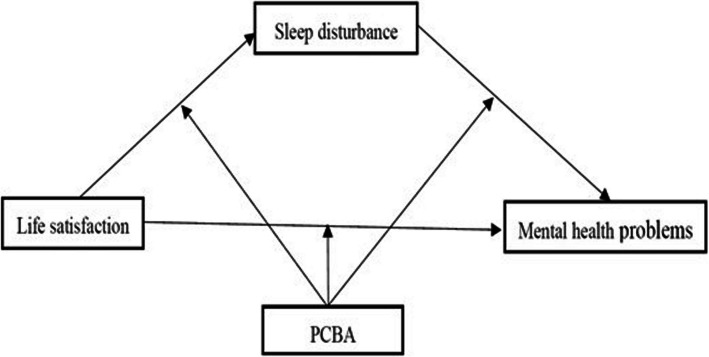
Background: The relationship between life satisfaction and mental health problems had been confirmed in many existed studies, but the underlying mediating and moderating effect of sleep disturbance and per capita bedroom area (PCBA) behind this association had never been identified. This study aimed to explore the mediating role of sleep disturbance and the moderating effect of PCBA on the association between life satisfaction and mental health problems.
Methods: Multistage cluster random sampling method was used to select the participants and finally 613 migrant older adults with children (MOAC) were included in the survey. A conditional process model was performed to examine the relationship between life satisfaction and mental health problems, as well as the mediating effect of sleep disturbance and the moderating effect of PCBA.
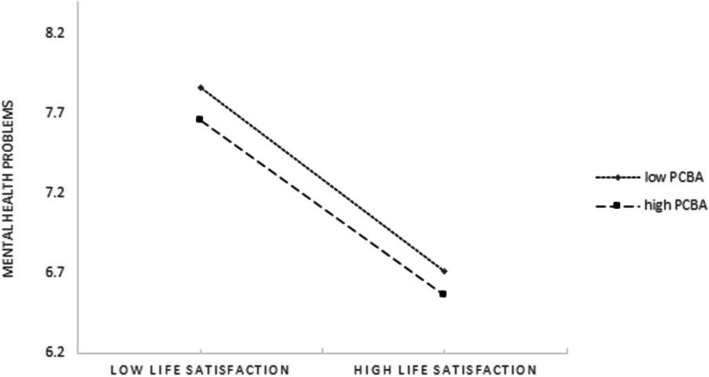
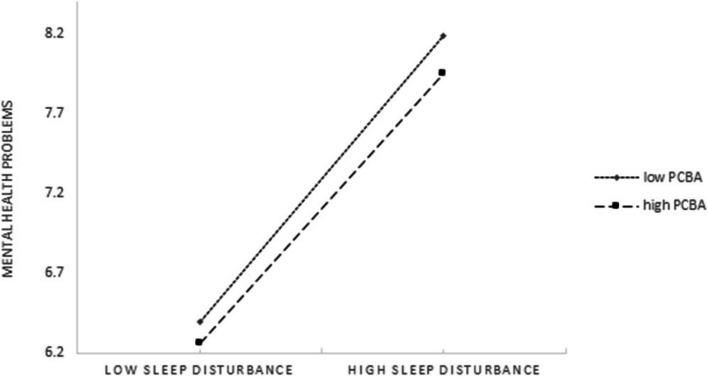
Results: Life satisfaction was negatively associated with mental health problems, and sleep disturbance could mediate their association. Furthermore, the direct effect of life satisfaction on mental health problems and the indirect effect of sleep disturbance in the relationship were moderated by PCBA, but it only moderated the direct effect and the second indirect link (sleep disturbance-mental health problems) of the mediating effect. Both these two effects were stronger for MOAC with a low level of PCBA.
Conclusions: Life satisfaction had negative effect on mental health problems. PCBA moderated the direct effect of life satisfaction on mental health problems and the mediating effect of sleep disturbance on mental health problems. For MOAC with a low level of life satisfaction and high sleep disturbance, particularly those with a low level of PCBA, targeted implication for the community, family members and MOAC were proposed to improve the mental health of MOAC.
Keywords: Conditional process analysis; Life satisfaction; Mental health problems; Migrant older adults following children; Per capita bedroom area; Sleep disturbance.
© 2025. The Author(s).
Conflict of interest statement
Declarations. Ethics approval and consent to participate: The survey and data use have obtained the written informed consent of all participants. The research program of this was reviewed and approved by the ethical committee of Shandong University (No. 20180225) and was in accordance with the Declaration of Helsinki. Consent for publication: Not Applicable. Competing interests: The authors declare no competing interests.
Figures
References
-
- National Bureau of Statistics of China. The Seventh National Population Census Bulletin (No. 7) - Urban and Rural Population and Mobile Population (in Chinese). China Statistics. 2021;05:13.
-
- China Migrant Population Development report 2018. http://www.nhc.gov.cn/wjw/xwdt/201812/a32a43b225a740c4bff8f2168b0e9688.s...
-
- Fanlei K, Mei K, Cheng L, Sixue L, Jun L. Progress of domestic and international research related to elderly people who move with the family. Chin J Gerontol. 2020;40(11):2443–7.
-
- Xi S, Song Y, Li X, Li M, Lu Z, Yang Y, Wang Y. Local-Migrant Gaps in Healthcare Utilization Between Older Migrants and Local Residents in China. J Am Geriatr Soc. 2020;68(7):1560–7. - PubMed
MeSH terms
Grants and funding
- No. 71804094/National Natural Science Foundation of China
- No.2016M592161/China Postdoctoral Science Foundation
- No. ZR2016GB02/Natural Science Foundation of Shandong Province
- No. 201603021/Shandong Provincial Postdoctoral Science Foundation
- No. 2022KJGL01, No. 2018JC055/Fundamental Research Funds for the Central Universities
LinkOut - more resources
Full Text Sources
Medical
