


Factors influencing the decision to discontinue treatment due to chemotherapy-induced peripheral neuropathy among patients with metastatic breast cancer: a best-worst scaling
- PMID: 40347310
- PMCID: PMC12065726
- DOI: 10.1007/s00520-025-09508-4
Factors influencing the decision to discontinue treatment due to chemotherapy-induced peripheral neuropathy among patients with metastatic breast cancer: a best-worst scaling
Abstract
Purpose: To measure the importance of factors that influence the decision to discontinue treatment due to chemotherapy-induced peripheral neuropathy (CIPN) among patients with metastatic breast cancer (mBC).
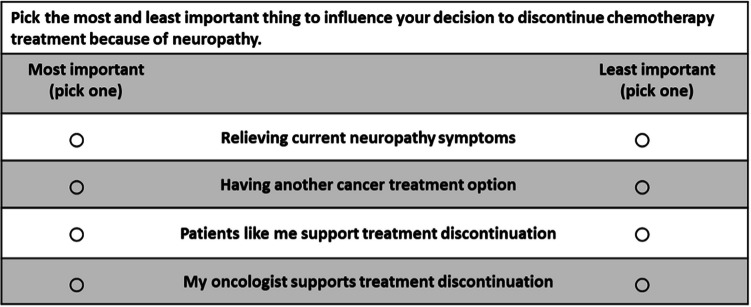
Methods: An online survey incorporating a best-worst scaling (BWS) was conducted among women in the USA with mBC and experiencing CIPN. In the BWS, women chose the most and least important factors influencing their decision to discontinue treatment due to CIPN. Seven factors were included: relieving current neuropathy symptoms, reducing risk of long-term neuropathy, having another cancer treatment option, understanding the risk of treatment discontinuation, and receiving support for treatment discontinuation from the oncologist, loved ones, or patients with similar experiences. To measure the importance of each factor, a conditional logit model estimated coefficients, which were subsequently rescaled to importance scores that summed to 100. The dependent variable was the choice of a factor as most or least important across seven choice tasks.
Results: The sample included 189 women with a mean age of 52.5 (SD = 12.65) years, 52.9% were White, 33.9% were Black, and 64.6% held a bachelor's degree or higher. When faced with the decision to discontinue treatment due to CIPN, the most important factors were having another cancer treatment option (score 23.5), followed by understanding the risk of treatment discontinuation (score 19.2), and reducing risk of long-term neuropathy (score 19.1). The least important factors in the decision to discontinue treatment due to CIPN were: support from loved ones (score 5.2) and support from other patients (score 3.3).
Conclusion: When faced with the decision to discontinue treatment due to CIPN, women with mBC attributed more importance to survival and reducing the risk of long-term CIPN. Knowledge of what matters most to patients may assist with shared decision-making to optimize therapeutic outcomes in patients receiving neurotoxic chemotherapy.
Keywords: Best–worst scaling; Chemotherapy-induced peripheral neuropathy; Metastatic breast cancer; Patient preferences.
© 2025. The Author(s).
Conflict of interest statement
Declarations. Ethics approval: All procedures performed in studies involving human participants were in accordance with the ethical standards of the Virginia Commonwealth University Institutional Review Board, and with the 1964 Helsinki declaration and its later amendments or comparable ethical standards. Consent to participate: Informed consent was obtained from all individual participants included in the study. Conflicts of interest: The authors declare no competing interests relevant to the content of this article. Dr. Teresa M. Salgado received funding from Boehringer Ingelheim for diabetes-related research. Dr. John F.P. Bridges consults for Boehringer Ingelheim and Otsuka and Lundbeck, and holds an Innovation in Regulatory Science Award from the Burroughs Wellcome Fund, all of which are outside the scope of the submitted work.
Comment in
-
Comment on "Factors influencing the decision to discontinue treatment due to chemotherapy-induced peripheral neuropathy among patients with metastatic breast cancer: a best-worst scaling".Support Care Cancer. 2025 Oct 8;33(11):917. doi: 10.1007/s00520-025-09999-1. Support Care Cancer. 2025. PMID: 41060431 No abstract available.
References
-
- Brady BL, Lucci M, Wilson K, Fox KM, Wojtynek J, Cooper C, Varker H, Chebili CL, Dokubo I (2021) Chemotherapy-induced peripheral neuropathy in metastatic breast cancer patients initiating intravenous paclitaxel/nab-paclitaxel. Am J Manag Care 27(1 Spec. No.):SP37-SP43 - PubMed
MeSH terms
Substances
Grants and funding
LinkOut - more resources
Full Text Sources
Medical
