


Occupational therapy and registered dietitian services to reduce fall risk among home delivered meal clients: a randomized controlled feasibility trial
- PMID: 40348980
- PMCID: PMC12065152
- DOI: 10.1186/s12877-025-06008-2
Occupational therapy and registered dietitian services to reduce fall risk among home delivered meal clients: a randomized controlled feasibility trial
Abstract
Background: Older adults increasingly prefer to age in place, but health and safety risks often threaten this independence. Home delivered meals, a key service under the Older Americans Act, provide essential nutritional support to homebound older adults, the majority of whom are at elevated risk for fall-related morbidity and mortality. Given the complex health conditions of homebound older adults, we conducted a feasibility randomized controlled trial (RCT) to evaluate our methods for testing four different service models designed to help reduce fall risk among home delivered meal recipients: (1) meals alone; (2) meals + registered dietitian nutritionist (RDN) services; (3) meals + occupational therapy (OT) services; or (4) meals + RDN + OT services. Findings will inform protocol modifications for our definitive RCT to improve fall-related outcomes among this population.
Methods: A four-arm, parallel-group feasibility RCT was conducted with one home delivered meal agency in the Midwest United States. Participants were eligible to participate if they were over 60 years old, were able to receive meals from our partner agency, had one diet-related health condition, and were at risk for falling. Feasibility outcomes included study eligibility, recruitment, retention, fidelity to RDN and OT services, and service acceptability.
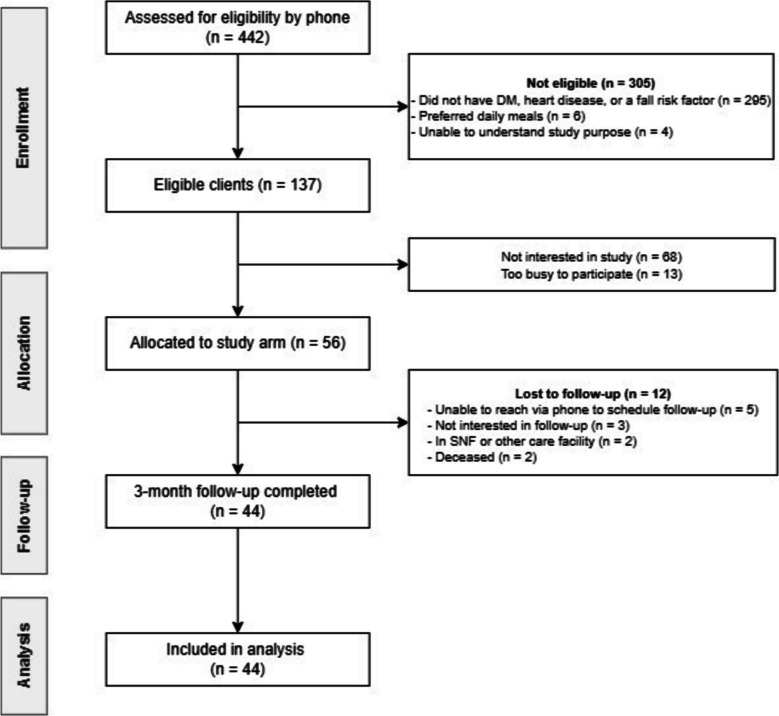
Results: Of 442 screened clients, 31% were eligible for participation, and 41% of eligible individuals were recruited (N = 56). Retention at three months was 79%. Fidelity rates were 84.5% for RDN services and 90.2% for OT services. Participants expressed high satisfaction with meal convenience and staff interactions but noted areas for improvement, including meal taste and inconsistent meal deliveries (e.g., timeliness; receiving correct meals).
Conclusions: The study identified several barriers to scaling this trial, including restrictive eligibility criteria and recruitment challenges. Protocol modifications for the definitive trial include broader eligibility, expanded recruitment areas, and increased flexibility in meal selection. Randomization procedures will also be adjusted to account for participants from the same household. This feasibility trial demonstrates the potential for integrating RDN and OT services into home delivered meal programs to address recipients' fall-related needs.
Trial registration: Clinicaltrials.gov; NCT06059404; 22/09/2023.
Keywords: Feasibility study; Home delivered meals; Homebound; Medical dietetics; Nutrition; Occupational therapy; Older adults; Randomized clinical trial.
© 2025. The Author(s).
Conflict of interest statement
Declarations. Ethics approval and consent to participate: This trial complied with the ethical rules stated in the Declaration of Helsinki. Informed consent was obtained from all study participants. Study activities were approved by the Institutional Review Board at The Ohio State University (#2023H0248). Consent for publication: Not applicable. Competing interests: The authors declare no competing interests.
Figures
References
-
- 2021 AARP home and community preferences survey. AARP. https://www.aarp.org/pri/topics/livable-communities/housing/2021-home-co.... Accessed 16 Jan 2025.
Publication types
MeSH terms
Associated data
Grants and funding
LinkOut - more resources
Full Text Sources
Medical
