


Methylation-based biological age and cardiotoxicity risk in breast cancer patients treated with trastuzumab
- PMID: 40349094
- PMCID: PMC12065287
- DOI: 10.1186/s40959-025-00340-7
Methylation-based biological age and cardiotoxicity risk in breast cancer patients treated with trastuzumab
Abstract
Background: Trastuzumab is an effective treatment for HER2-positive cancers that has known cardiotoxic properties. Discovering biomarkers that assess cardiotoxicity risk before trastuzumab therapy is essential for protecting the cardiovascular health of cancer patients.
Objective: To examine the associations between pre-treatment epigenetic age acceleration, circulating leukocyte composition, and candidate single nucleotide polymorphisms (SNPs) with cardiotoxicity risk in breast cancer patients receiving trastuzumab.
Methods: Among a retrospective cohort of HER2-positive breast cancer patients treated with trastuzumab at Moffitt Cancer Center, we profiled blood DNA methylation and genetic profiles. Epigenetic clocks and circulating leukocyte subsets were derived from MethylationEPIC BeadChip data, and candidate SNPs were measured using the Global Screening Array. Cardiotoxicity events (i.e., reductions in left ventricular ejection fraction, symptomatic heart failure), were identified in medical records. Logistic regression models, adjusted for traditional risk factors, estimated odds ratios (ORs) for biomarker associations with cardiotoxicity risk.
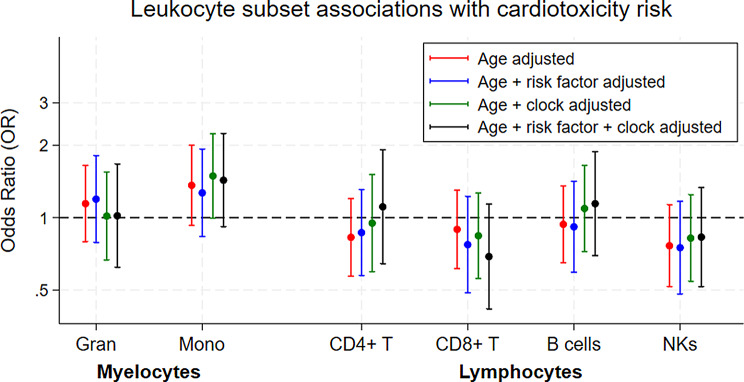
Results: Among 157 patients selected for this study, 39 (25%) experienced cardiotoxicities within one year of treatment initiation. rs776746 was inversely associated with cardiotoxicity risk (OR: 0.38, 95% CI: 0.14, 1.00, P = 0.05). After adjusting for traditional risk factors and leukocyte composition, the Hannum AgeAccel, Horvath AgeAccel, and Horvath Skin and Blood AgeAccel metrics were significantly positively associated with cardiotoxicity risk (ORs ranging between 1.62 and 1.89). Adding Horvath Skin and Blood AgeAccel to traditional cardiotoxicity risk factors significantly improved cardiotoxicity risk prediction (AUC: 0.75 vs. 0.79; P-diff = 0.04).
Conclusions: Pre-treatment epigenetic age acceleration appears to be a novel biomarker for cardiotoxicity risk that improves cardiotoxicity risk prediction.
Keywords: Biological age; Breast cancer; Cardiotoxicity; Epigenetic clocks; Trastuzumab.
© 2025. The Author(s).
Conflict of interest statement
Declarations. Ethical approval: All participants provided consent under Moffitt Cancer Center’s institutional Total Cancer Care protocol, with additional approvals for generating DNAm and genomic data from archived samples. The study is overseen by the Advarra Institutional Review Board. Competing interests: The authors declare no competing interests. Disclaimers: The authors have reported no relationships relevant to the contents of this paper to disclose.
Figures

References
-
- Giaquinto AN, Sung H, Miller KD, et al. Breast Cancer statistics, 2022. CA Cancer J Clin Oct. 2022;3. 10.3322/caac.21754.
LinkOut - more resources
Full Text Sources
Research Materials
Miscellaneous