. 2025 Jun;66(6):100824.
doi: 10.1016/j.jlr.2025.100824. Epub 2025 May 9.

Stearoyl-CoA desaturase 1 deficiency drives saturated lipid accumulation and increases liver and plasma acylcarnitines

Affiliations

Stearoyl-CoA desaturase 1 deficiency drives saturated lipid accumulation and increases liver and plasma acylcarnitines

Mugagga Kalyesubula et al. J Lipid Res. 2025 Jun.

Abstract

Stearoyl-CoA desaturase-1 (SCD1) is a critical regulator of lipogenesis that catalyzes the synthesis of MUFAs, mainly oleate (18:1n-9) and palmitoleate (16:1n-7) from saturated fatty acids, stearoyl-CoA (18:0) and palmitoyl-CoA (16:0), respectively. Elevated SCD1 expression and its products are associated with obesity, metabolic dysfunction-associated steatotic liver disease, insulin resistance, and cancer. Conversely, Scd1 deficiency diminishes de novo lipogenesis and protects mice against adiposity, hepatic steatosis, and hyperglycemia. Yet, the comprehensive impact of Scd1 deficiency on hepatic and circulating lipids remains incompletely understood. To further delineate the effects of SCD1 on lipid metabolism, we employed lipidomics on the liver from mice under a lipogenic high carbohydrate, very low-fat diet. We found that Scd1 deficiency leads to an accumulation of saturated lipids and an increase in hepatic and plasma acylcarnitines. Remarkably, transgenic replenishment of de novo oleate synthesis by human SCD5 in the liver of Scd1-deficient mice not only restored hepatic lipid desaturation levels but also attenuated acylcarnitine accumulation, highlighting the distinct role of SCD1 and oleate in regulating intracellular lipid homeostasis.

Keywords: SCD1; SCD5; acylcarnitines; lipidomics; oleate; saturated fatty acid.


Conflict of interest statement

Conflict of interest The author declares that they have no conflicts of interest with the contents of this article.

Figures

Fig. 1
Fig. 1
Global Scd1 deficiency altered the hepatic lipidome and increased saturated liver lipids under an HCD. A: PCA of lipids between GKO and HET mice. B: Heatmap and cluster analysis of hepatic lipids. C: Volcano plot showing the significance and fold change between GKO and HET mice of liver lipids. The significance of the lipids was considered at an FDR-corrected P value of 0.1 and a fold change of 2. Dots on the right denote lipid increase in the GKO mice, whereas dots on the left denote lipid decrease in the GKO mice. D: Acyl chain sum of the diglycerides. Relative abundance for each degree of total desaturation (number of double bonds) in E: Triglycerides and F: Phospholipids. ∗P < 0.05, ∗∗P < 0.01, ∗∗∗P < 0.001, and ∗∗∗∗P < 0.0001. Data are presented as mean + SD. HET, heterozygote mice. N = 6–8 mice.
Fig. 2
Fig. 2
Global Scd1 deficiency altered plasma lipids and increased saturated plasma lipids under an HCD. A: PCA of lipids between GKO and HET mice. B: Heatmap and cluster analysis of hepatic lipids. C: Volcano plot showing the significance and fold change between GKO and HET mice of liver lipids. The significance of the lipids was considered at an FDR-corrected P value of 0.1 and a fold change of 2. Dots on the right denote lipid increase in the GKO mice, whereas dots on the left denote lipid decrease in the GKO mice. D: Venn diagram displaying an overlap of lipid species increased in the GKO mice in the liver and plasma. E: Acyl chain sum of the diglycerides. Relative abundance for each degree of total desaturation (number of double bonds) in F: Triglycerides and G: Phospholipids. ∗P < 0.05 and ∗∗P < 0.01. Data are presented as mean + SD. H: Correlation analysis between liver and plasma for C16:0 acylcarnitines and C18:0 acylcarnitines. HET, heterozygote mice. N = 6–8 mice.
Fig. 3
Fig. 3
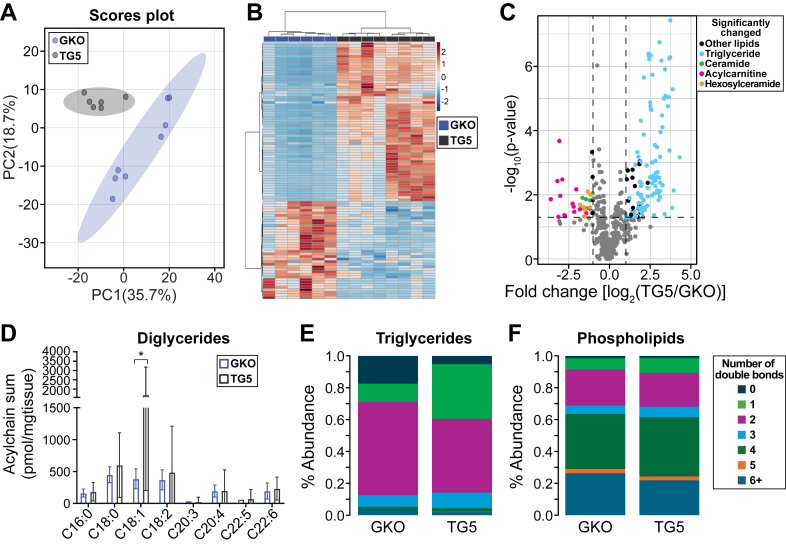
Expression of the human SCD5 in the livers of GKO mice restores desaturation in the hepatic lipidome. A: PCA of lipids between 5TG and GKO. B: Heatmap and cluster analysis of hepatic lipids. C: Volcano plot showing the significance and fold change between 5TG and GKO mice of liver lipids. The significance of the lipids was considered at an FDR-corrected P value of 0.1 and a fold change of 2. Dots on the right denote lipid increase in the 5TG mice, whereas dots on the left denote lipid decrease in the 5TG mice. D: Acyl chain sum of the diglycerides. Relative abundance for each degree of total desaturation (number of double bonds) in E: Triglycerides and F: Phospholipids. ∗P < 0.05. 5TG, GKO mice with the expression of human SCD5 in the liver. N = 6–8 mice.
Fig. 4
Fig. 4
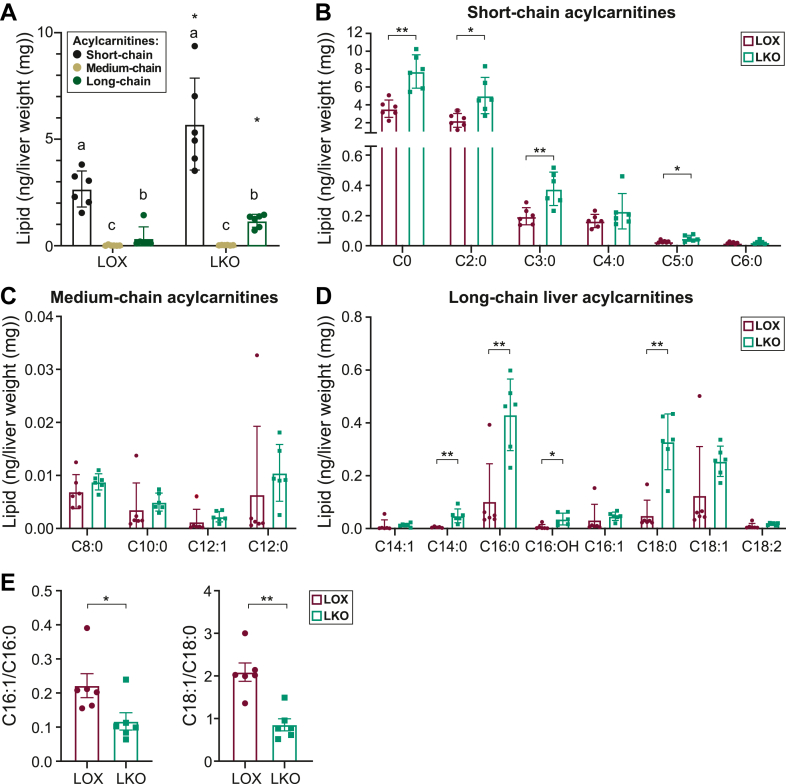
Liver-specific Scd1 deficiency increases hepatic acylcarnitines. A: Pooled liver short-, medium-, and long-chain acylcarnitines. B: Liver carnitine (C0) and short-chain acylcarnitines. C: Liver medium-chain acylcarnitines. D: Liver long-chain acylcarnitines. E: C16:1/C16:0 and C18:1/C18:0 desaturation indices. ∗P < 0.05, ∗∗P < 0.01, and ∗∗∗P < 0.001. Data are presented as mean ± SD. Means not connected by the same letter within a genotype were significantly different. ∗Denotes differences between genotypes within the same chain length. N = 6 mice. LOX, Lox control mice.
Fig. 5
Fig. 5
Liver-specific Scd1 deficiency increases circulating acylcarnitines. A: Pooled plasma short, medium, and long chain acylcarnitines. B: Plasma carnitine and short-chain acylcarnitines, C: Plasma medium-chain acylcarnitines, and D: Plasma long-chain acylcarnitines. E: C16:1/C16:0 and C18:1/C18:0 desaturation indices. F: Correlation analysis between liver and plasma for C14:0 acylcarnitines, C16:0 acylcarnitines, and C18:0 acylcarnitines. ∗P < 0.05, ∗∗P < 0.01, ∗∗∗P < 0.001. Data are presented as Mean ± SD. Means not connected by the same letter within a genotype were significantly different. ∗Denotes differences between genotypes within the same chain length. N = 6 mice. LOX, Lox control mice.
Fig. 6
Fig. 6
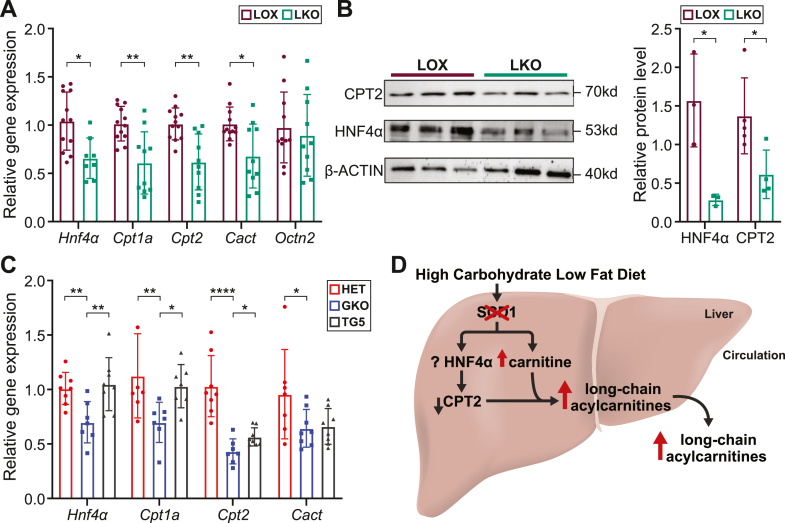
Liver-specific Scd1 deficiency alters the expression of hepatic genes related to acylcarnitine metabolism. A: Relative expression of hepatic genes related to acylcarnitine metabolism in LKO and LOX mice N = 9–12 mice. B: Western blot and associated densitometric quantification of liver CPT2, HNF4α, and β-ACTIN. N = 3–5 mice. C: Relative expression of hepatic genes related to acylcarnitine metabolism in HET, GKO, and TG5 mice. N = 6–8 mice. D: Summary: By elevating liver carnitine and lowering liver Cpt2, hepatic Scd1 deficiency under an HCD leads to increased long-chain acylcarnitines in the liver and the circulation. Cact, carnitine/acylcarnitine translocase (solute carrier family 25 member 20); Cpt1a, carnitine palmitoyltransferase 1A; Cpt2, carnitine palmitoyltransferase 2; Hnf4α, hepatocyte nuclear factor 4 alpha; Octn2, solute carrier family 22 member 5. ∗P < 0.05, ∗∗P < 0.01, ∗∗∗P < 0.001, and ∗∗∗∗P < 0.0001. Data are presented as mean + SD. HET, heterozygote mice; LOX, Lox control mice; 5TG, GKO mice with the expression of human SCD5 in the liver.

References

    1. Miyazaki M., Flowers M.T., Sampath H., Chu K., Otzelberger C., Liu X., et al. Hepatic stearoyl-CoA desaturase-1 deficiency protects mice from carbohydrate-induced adiposity and hepatic steatosis. Cell Metab. 2007;6:484–496. - PubMed
    1. ALJohani A.M., Syed D.N., Ntambi J.M. Insights into stearoyl-CoA desaturase-1 regulation of systemic metabolism. Trends Endocrinol. Metab. 2017;28:831–842. - PMC - PubMed
    1. Cases S., Smith S.J., Zheng Y.-W., Myers H.M., Lear S.R., Sande E., et al. Identification of a gene encoding an acyl CoA:diacylglycerol acyltransferase, a key enzyme in triacylglycerol synthesis. Proc. Natl. Acad. Sci. U. S. A. 1998;95:13018–13023. - PMC - PubMed
    1. Miyazaki M., Ntambi J.M. Role of stearoyl-coenzyme A desaturase in lipid metabolism. Prostaglandins Leukot. Essent. Fatty Acids. 2003;68:113–121. - PubMed
    1. Castro L.F.C., Wilson J.M., Gonçalves O., Galante-Oliveira S., Rocha E., Cunha I. The evolutionary history of the stearoyl-CoA desaturase gene family in vertebrates. BMC Evol. Biol. 2011;11:132. - PMC - PubMed

LinkOut - more resources