Global, Regional, and National Burden of Cardiovascular Diseases Associated with Particulate Matter Pollution: A Systematic Analysis of Deaths and Disability-Adjusted Life Years with Projections to 2030
- PMID: 40351694
- PMCID: PMC12059744
- DOI: 10.31083/RCM27056
Global, Regional, and National Burden of Cardiovascular Diseases Associated with Particulate Matter Pollution: A Systematic Analysis of Deaths and Disability-Adjusted Life Years with Projections to 2030
Abstract
Background: This research assesses how fine particulate matter (PM2.5) pollution influences cardiovascular diseases (CVDs) globally.
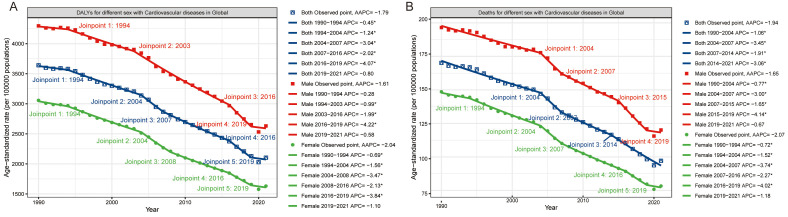
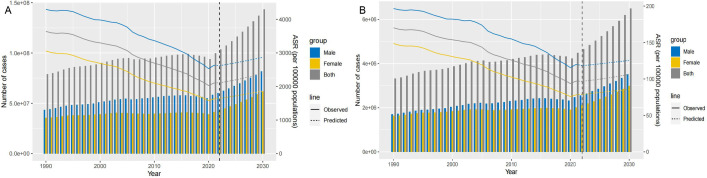
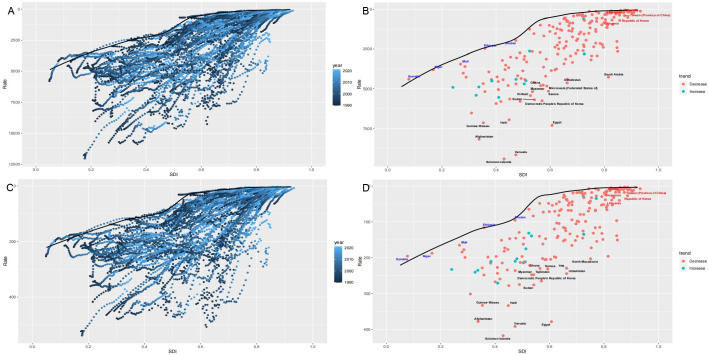
Methods: Utilizing data from the 2021 Global Burden of Disease (GBD) study, we assessed the impact of PM2.5 pollution on CVDs in individuals aged 25 and older. The health burden was quantified using measures such as disability-adjusted life years (DALYs), age-standardized rates (ASRs), and the effective annual percentage change (EAPC). Joinpoint regression models were used to describe the temporal trends of CVD burdens, while the Bayesian age-period-cohort (BAPC) models were employed to project the CVD burdens through 2030. Frontier analysis was conducted to identify potential areas for improvement and gaps between the development statuses of different countries. Decomposition analysis was applied to assess the impact of population growth, aging, and epidemiological changes on the burden of CVDs.
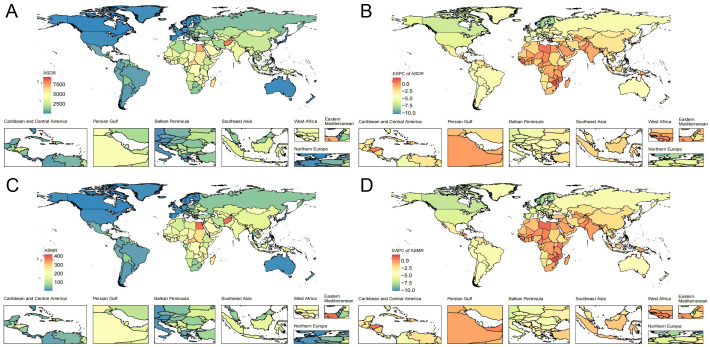
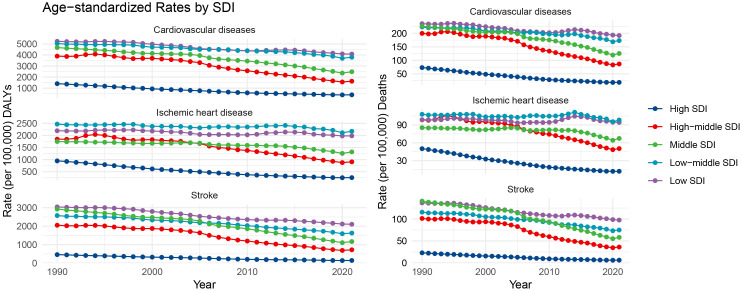
Results: Despite a decline in ASRs for both sexes, males continued to bear a disproportionate burden of CVDs. While substantial reductions in ASRs have been noted in Western Europe and High-income North America, smaller decreases in the EAPC have been seen in South Asia, Oceania, and Western Sub-Saharan Africa; however, Oceania faces the highest mortality burden. An inverse relationship between the sociodemographic index (SDI) and ASRs is evident nationally. Meanwhile, Afghanistan and Egypt reported elevated ASRs, and Iceland recorded the lowest rate. Projections suggest a potential reversal in ASRs by 2021. A decomposition analysis revealed that intracerebral hemorrhage poses the greatest burden in middle SDI regions, while ischemic heart disease is notably burdensome in high SDI and high-middle SDI regions.
Conclusions: This study highlights the disproportionate burden of CVDs associated with PM2.5 pollution, particularly in males and lower SDI regions, with significant regional disparities and projections indicating potential reversals in trends.
Keywords: Global Burden of Disease; cardiovascular diseases; fine particulate matter; ischemic heart disease; stroke.
Copyright: © 2025 The Author(s). Published by IMR Press.
Conflict of interest statement
The authors declare no conflict of interest.
Figures
References
-
- GBD 2021 Risk Factors Collaborators Global burden and strength of evidence for 88 risk factors in 204 countries and 811 subnational locations, 1990-2021: a systematic analysis for the Global Burden of Disease Study 2021. Lancet . 2024;403:2162–2203. doi: 10.1016/S0140-6736(24)00933-4. [published correction appears in Lancet. 2024; 404: 244. doi: 10.1016/S0140-6736(24)01458-2] - DOI - PMC - PubMed
-
- Maung TZ, Bishop JE, Holt E, Turner AM, Pfrang C. Indoor Air Pollution and the Health of Vulnerable Groups: A Systematic Review Focused on Particulate Matter (PM), Volatile Organic Compounds (VOCs) and Their Effects on Children and People with Pre-Existing Lung Disease. International Journal of Environmental Research and Public Health . 2022;19:8752. doi: 10.3390/ijerph19148752. - DOI - PMC - PubMed
-
- Poulsen AH, Sørensen M, Hvidtfeldt UA, Ketzel M, Christensen JH, Brandt J, et al. Concomitant exposure to air pollution, green space and noise, and risk of myocardial infarction: a cohort study from Denmark. European Journal of Preventive Cardiology . 2024;31:131–141. doi: 10.1093/eurjpc/zwad306. - DOI - PubMed
-
- Guo LH, Lin LZ, Zhou Y, Jalaludin B, Morawska L, Dharmage SC, et al. Global, regional, and national burden of ischemic heart disease attributable to ambient PM2.5 from 1990 to 2019: An analysis for the global burden of disease study 2019. Environmental Research . 2024;241:117635. doi: 10.1016/j.envres.2023.117635. - DOI - PubMed
-
- Zhang S, Liu C, Wu P, Li H, Zhang Y, Feng K, et al. Burden and Temporal Trends of Valvular Heart Disease-Related Heart Failure From 1990 to 2019 and Projection Up to 2030 in Group of 20 Countries: An Analysis for the Global Burden of Disease Study 2019. Journal of the American Heart Association . 2024;13:e036462. doi: 10.1161/JAHA.124.036462. - DOI - PMC - PubMed
LinkOut - more resources
Full Text Sources