


Network analysis of the relationship between self-management, self-efficacy, and quality of life among diabetes mellitus patients
- PMID: 40352172
- PMCID: PMC12059861
- DOI: 10.52225/narra.v5i1.2029
Network analysis of the relationship between self-management, self-efficacy, and quality of life among diabetes mellitus patients
Abstract
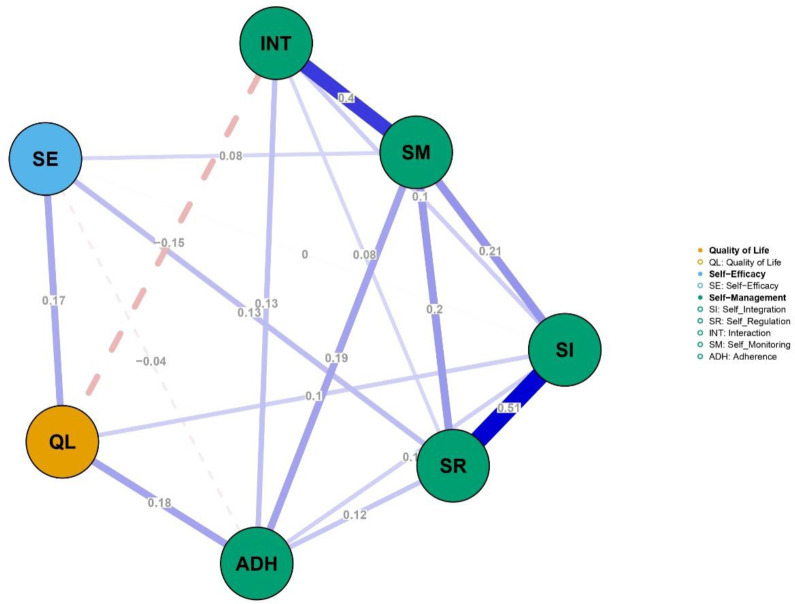
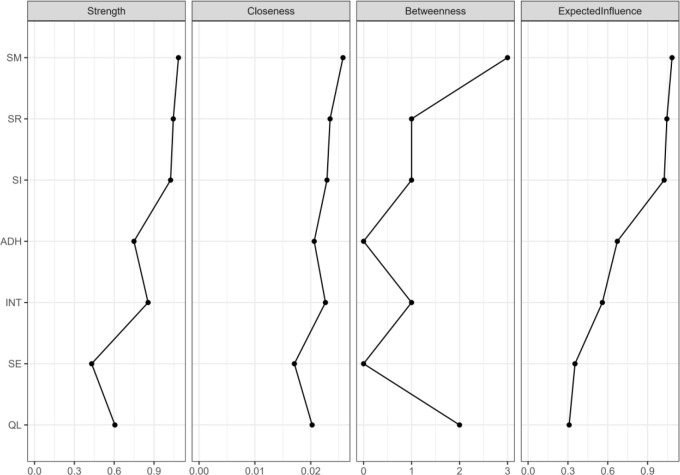
Diabetes mellitus (DM) requires constant self-management and self-efficiency, which affects the quality of life among patients. It is important to understand the complex interplay between these factors to improve the results of treatment. The aim of this study was to explore the relationship between self-management, self-efficacy, and quality of life among diabetes mellitus patients. A cross-sectional study of 363 diabetes patients from three public hospitals in Cao Lanh City, Vietnam, was conducted. Self-management, self-efficacy, and quality of life were assessed using the 35-item Diabetes Self-Management Instrument (DSMI), the 6-item Self-Efficacy for Managing Chronic Disease Scale (SECD6), and the 5-item European Quality of Life 5 Dimensions 5 Level Version (EQ-5D-5L), respectively. Network analysis was performed to visually describe the relationship between self-management (which includes five domains of self-integration, self-regulation, interaction with health professionals and other significant people, self-monitoring, and medication adherence), self-efficacy, and quality of life. The network analysis showed that self-monitoring had the highest centrality. Two subscales of self-management, adherence and self-integration, were directly and positively correlated with quality of life, while the interaction was directly and negatively correlated with quality of life. Self-efficacy was positively correlated with self-regulation and self-monitoring, while it was negatively correlated with adherence. A direct positive correlation was also found between self-efficacy and quality of life. In conclusion, these findings highlight the pivotal role of self-management and self-efficacy in enhancing quality of life. Future studies should focus on patient education interventions to enhance adherence and self-efficacy, ultimately improving the quality of life in people with diabetes.
Keywords: Adherence; Vietnam; quality of life; self-efficacy; self-management.
© 2025 The Author(s).
Conflict of interest statement
All the authors declare that there are no conflicts of interest.
Figures
References
-
- Tri MT, Khue NT, Khoa VT, et al. Patient views on quality of life and hospital care: Results from a qualitative study among Vietnamese patients with diabetes. Front Commun (Lausanne) 2022;7:894435.
-
- Huayanay-Espinoza IE, Guerra-Castañon F, Reyes-Diaz M, et al. Quality of life and self-efficacy in patients with type 2 diabetes mellitus in a Peruvian public hospital. Medwave 2021;21(2):e8133. - PubMed
-
- International Diabetes Federation. IDF diabetes atlas. 2021. Available from: https://diabetesatlas.org/atlas/tenth-edition/. Accessed: 20 December 2024.
-
- International Diabetes Federation. Diabetes facts and figures. 2021. Available from: https://idf.org/about-diabetes/diabetes-facts-figures/. Accessed: 20 December 2024.
MeSH terms
Associated data
LinkOut - more resources
Full Text Sources
Medical