


Association between severe lumbar disc degeneration and end-stage hip or knee osteoarthritis requiring joint replacement surgery: a population-based cohort study with a 26-year follow-up
- PMID: 40353908
- PMCID: PMC12069494
- DOI: 10.1007/s00402-025-05908-7
Association between severe lumbar disc degeneration and end-stage hip or knee osteoarthritis requiring joint replacement surgery: a population-based cohort study with a 26-year follow-up
Abstract
Introduction: An association between intervertebral disc degeneration (IDD) and osteoarthritis (OA) of the hip and knee has been found previously. However, studies using MRI-evaluated IDD grades with large sample sizes are lacking. Total hip and knee arthroplasty (THA and TKA) can be considered an indicator of clinically evident end-stage OA.
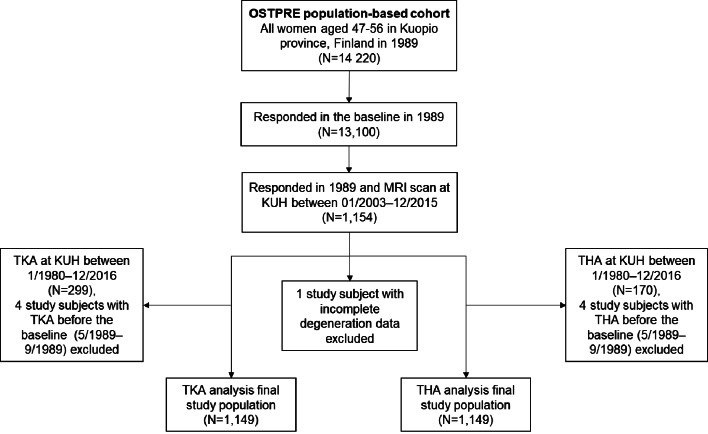
Materials and methods: The study population consisted of 1,153 postmenopausal Finnish women with clinical back problems, of whom 166 had THA and 295 had TKA during the 26-year follow-up. The study was based on the prospective OSTPRE cohort established in 1989 and Finnish Arthroplasty Register data. The IDD severity was graded from T2-weighted lumbar MRI images using the five-grade Pfirrmann classification. Five intervertebral levels (L1-L2 to L5-S1) were studied (5,765 discs). Cox regression with a time-dependent covariate was used to calculate hazard ratios (HRs) for THA and TKA to account for exposure time for severe degeneration.
Results: A higher hazard for THA was observed in women with severe IDD at the L1-L2 (HR 2.66, 95% CI 1.48-4.80), L2-L3 (HR 1.97, CI 1.15-3.38), L5-S1 (HR 1.69, 95% CI 1.16-2.46) and the L1-S1 (HR 2.19, 95% CI 1.53-3.15) intervertebral levels. Adjustment with potential confounders did not alter the results. Women with severe IDD had an elevated hazard for TKA at the L1-S1 mean degeneration (HR 1.50, CI 1.11-2.02) analysis. However, in the adjusted model, the statistical significance of this association was lost (HR 1.34, 95% CI 0.98-1.84). Higher BMI increased the hazard for both THA and TKA; however, the effect was more substantial for TKA.
Conclusions: The present study supports the association between lumbar IDD and hip OA. A weak association between lumbar IDD and knee OA was observed. Further research is needed to investigate the causality of the relationship between IDD and OA.
Keywords: Arthroplasty; Intervertebral disc degeneration; Lumbar spine; Magnetic resonance imaging; Osteoarthritis.
© 2025. The Author(s).
Conflict of interest statement
Declarations. Competing interests: The authors declare no competing interests.
References
-
- Vos T, Abajobir AA, Abbafati C et al (2017) Global, regional, and National incidence, prevalence, and years lived with disability for 328 diseases and injuries for 195 countries, 1990–2016: a systematic analysis for the global burden of disease study 2016. Lancet 390:1211. 10.1016/S0140-6736(17)32154-2 - DOI - PMC - PubMed
-
- Brinjikji W, Diehn FE, Jarvik JG, Carr CM, Kallmes DF, Murad MH, Luetmer PH (2015) MRI findings of disc degeneration are more prevalent in adults with low back pain than in asymptomatic controls: A systematic review and meta-analysis. Am J Neuroradiol 36:2394–2399. 10.3174/ajnr.A4498 - DOI - PMC - PubMed
MeSH terms
LinkOut - more resources
Full Text Sources
Medical
