


The neurotoxicity of Paraquat and its degradation products on drosophila melanogaster
- PMID: 40355491
- PMCID: PMC12069668
- DOI: 10.1038/s41598-025-86413-0
The neurotoxicity of Paraquat and its degradation products on drosophila melanogaster
Abstract
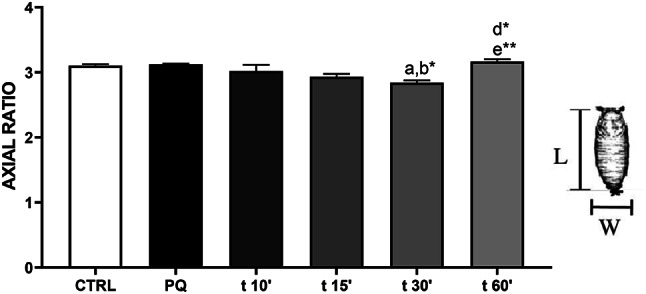
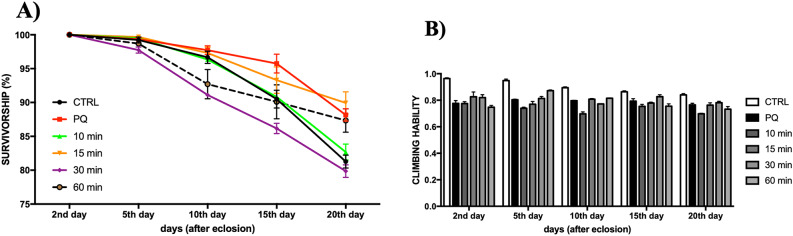
Photodegradation is a promising technique for remediating contaminated environmental matrices. It demonstrates significant potential in transforming organic contaminants into carbon dioxide, water, and inorganic anions through degradation reactions that involve transient oxidizing species, mainly hydroxyl radicals generated by ultraviolet (UV) irradiation. In this study, we investigated whether the photodegradation of Paraquat (PQ) with UV irradiation reduced its toxicity in Drosophila melanogaster. Our results indicate that ingesting PQ degradation products by larvae resulted in a low axial ratio (pupal volume). In the adults, it resulted in markedly diminished climbing ability in a time-dependent manner after 10 days of feeding. In addition, exposure of D. melanogaster to photodegradation of PQ reduced acetylcholinesterase and citrate synthase activities but improved oxidative stress, as evidenced by protein carbonyl, and lactate production. These results suggest that the photodegradation of PQ with UV irradiation produced PQ fragments with higher toxicity than PQ, while the precise mechanism of its action requires further investigation.
Keywords: Drosophila melanogaster; Degradation products; Neurotoxicity; Photodegradation; UV irradiation.
© 2025. The Author(s).
Conflict of interest statement
Declarations. Competing interests: The authors declare no competing interests.
Figures
References
-
- Geisseler, D. & Scow, K. M. Long-term effects of mineral fertilizers on soil microorganisms – A review. Soil Biol. Biochem.75, 54–63. 10.1016/j.soilbio.2014.03.023 (2014). - DOI
-
- Carvalho, F. P. Pesticides, environment, and food safety. Food Energy Secur.6 (2), 48–60. 10.1002/fes3.108 (2017). - DOI
-
- Albrecht, A. J. P., Albrecht, L. P. & Silva, A. F. M. Agronomic implications of paraquat ban in Brazil. Adv. Weed Sci.40 (spe1), e020220040–seventy. 10.51694/AdvWeedSci/2022;40 (2022). - DOI
-
- Sartori, F. & Vidrio, E. Environmental fate and ecotoxicology of paraquat: a California perspective. Toxicol. Environ. Chem.100 (5–7), 479–517. 10.1080/02772248.2018.1460369 (2018). - DOI
MeSH terms
Substances
LinkOut - more resources
Full Text Sources
Molecular Biology Databases
