


Exploring the association between dietary caffeine and chronic musculoskeletal pain: a cross-sectional analysis of NHANES
- PMID: 40357035
- PMCID: PMC12066468
- DOI: 10.3389/fnut.2025.1570403
Exploring the association between dietary caffeine and chronic musculoskeletal pain: a cross-sectional analysis of NHANES
Abstract
Background: The association between dietary caffeine intake and chronic musculoskeletal pain (CMP) remains unclear, with previous studies yielding conflicting results. This study aims to investigate the association between dietary caffeine intake and CMP.
Methods: This cross-sectional study utilized data from the 2009-2010 National Health and Nutrition Examination Survey (NHANES) in the United States. We employed multivariable logistic regression models, restricted cubic spline regression (RCS), stratified analysis, and sensitivity analysis to evaluate the association between dietary caffeine intake and CMP.
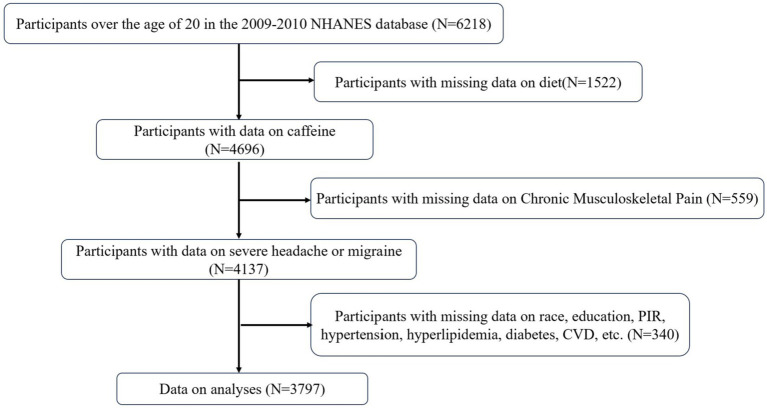
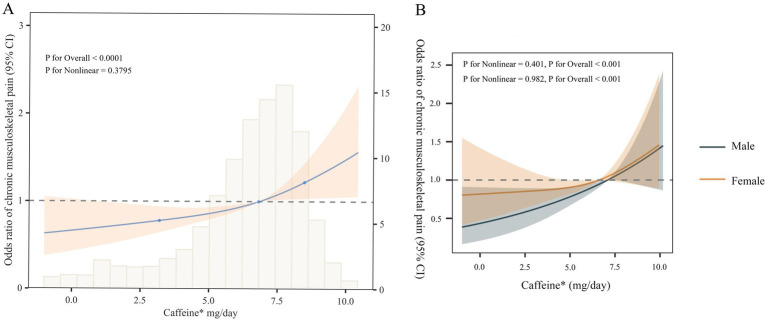
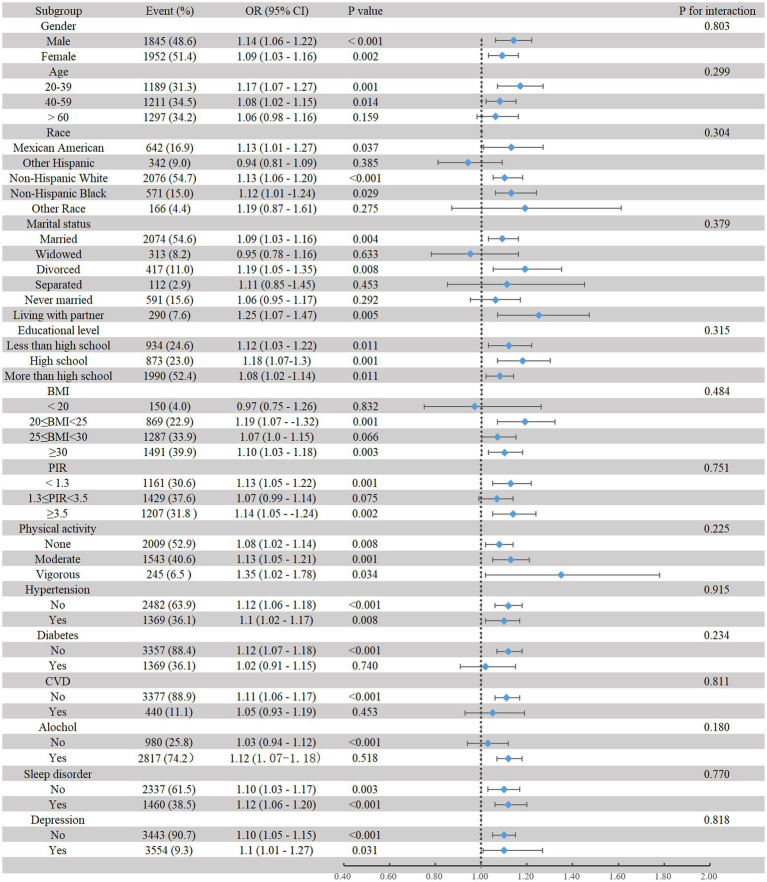
Results: The study comprised 3,797 participants, with a mean age of 50.11 ± 17.57 years and a CMP prevalence of 18.41%. After full adjustment, multivariable logistic regression and RCS regression indicated a linear positive correlation between dietary caffeine intake and CMP. For each one-unit increase in log-transformed dietary caffeine intake, the risk of CMP increased by 8.35% (OR: 1.0835, 95% CI: 1.0351, 1.1358). Compared with the Q1 (-1.00-5.44 mg/d), the ORs for individuals in the Q2 (5.45-6.83 mg/d), Q3 (6.84-7.85 mg/d), and Q4 (7.86-11.48 mg/d) were 1.1556 (95% CI: 0.8866, 1.5075, p = 0.2852), 1.4256 (95% CI: 1.1006, 1.8505, p = 0.0074), and 1.5238 (95% CI: 1.1685, 1.9920, p = 0.0020), respectively. Additionally, stratified and sensitivity analyses yielded similar results.
Conclusion: The study revealed a positive relationship between dietary caffeine intake and CMP, suggesting that higher caffeine consumption may be linked to an increased risk of CMP. Based on these findings, CMP patients may benefit from reducing their caffeine intake.
Keywords: NHANES; caffeine; chronic musculoskeletal pain; cross-sectional study; logistic regression; restricted cubic spline regression; sensitivity analysis.
Copyright © 2025 Liao, Zeng, Chen, Liu and Zhou.
Conflict of interest statement
The authors declare that the research was conducted in the absence of any commercial or financial relationships that could be construed as a potential conflict of interest.
Figures
References
-
- You Y, Zhou Y, Chen H, Kancheva AK, Carrillo-Larco RM, Yuan C, et al. Association of chronic pain with incidence and progression of cardiometabolic multimorbidity in middle-aged and older populations: a multicohort study. Pain Rep. (2025) 10:e1211. doi: 10.1097/PR9.0000000000001211, PMID: - DOI - PMC - PubMed
LinkOut - more resources
Full Text Sources
