


Recent updates of the MPEXS2.1-DNA Monte Carlo code for simulations of water radiolysis under ion irradiation
- PMID: 40360565
- PMCID: PMC12075733
- DOI: 10.1038/s41598-025-00875-w
Recent updates of the MPEXS2.1-DNA Monte Carlo code for simulations of water radiolysis under ion irradiation
Abstract
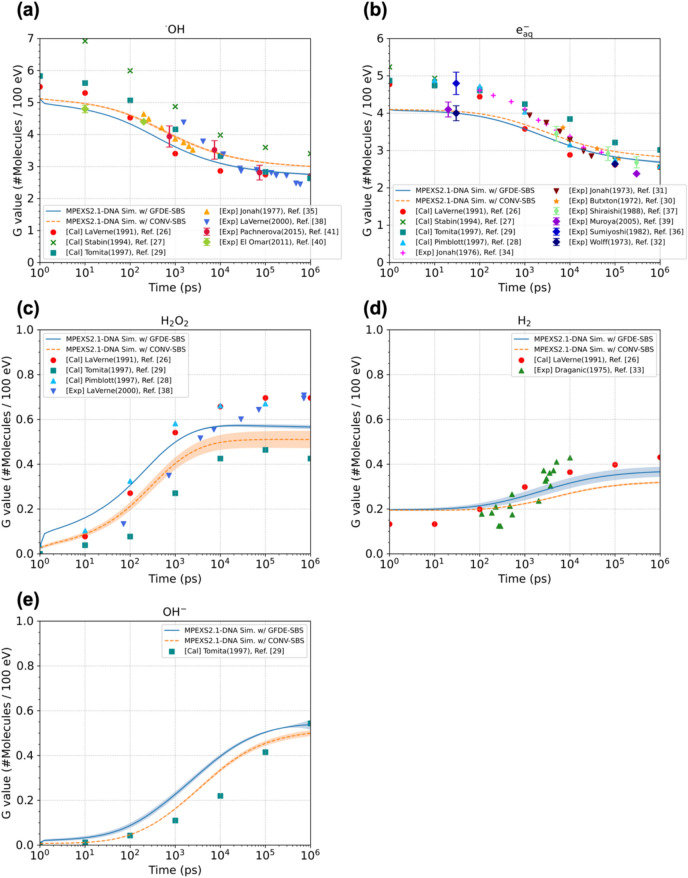
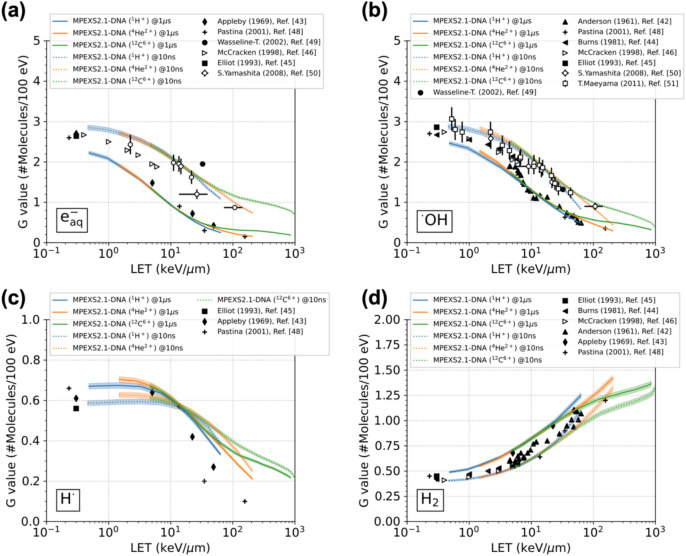
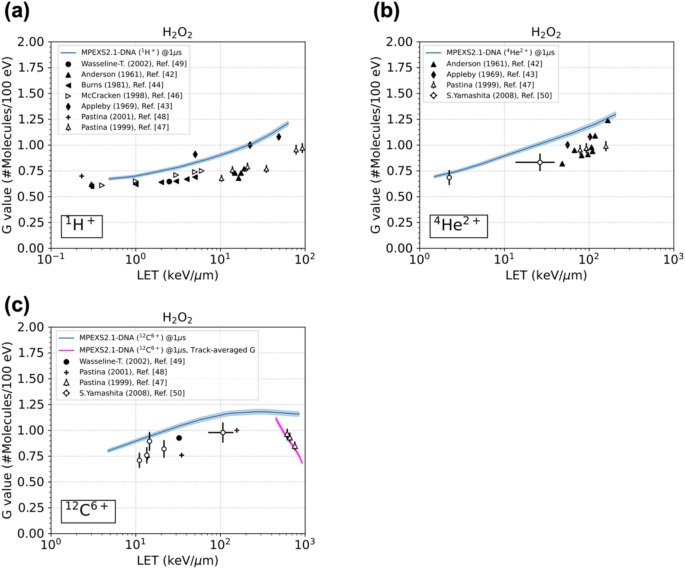
To improve radiotherapy, especially that with ion beams such as proton and carbon ion beams, the mechanisms of interactions induced by ionizing radiation must be understood. MPEXS2.1-DNA is a Monte Carlo simulation code developed for water radiolysis studies and DNA damage simulations that uses GPU devices for fast computation. However, the original chemistry model in MPEXS2.1-DNA did not include detailed chemical reactions for reactive oxygen species (ROS), e.g., O•-, O2, O2•-, HO2•, HO2-. In the present study, drawing the former work on the step-by-step (SBS) model for the RITRACKS code, we implemented an alternative SBS model into MPEXS2.1-DNA to increase the capabilities and computational speed of water radiolysis simulations under ion irradiation. This model is based on the theory of Green's function of the diffusion equation (GFDE-SBS). Also, we implemented multiple ionization processes which enhance ROS generation under high-LET irradiation. We compared the simulation results obtained by GFDE-SBS with experimental data from previous studies. The validation results demonstrated that the GFDE-SBS model accurately reproduced the measured radiation chemical yields of major species, such as hydroxyl radicals and hydrogen peroxide. Furthermore, the computational speed of GFDE-SBS was increased approximately ten times faster than the original model due to the changes in time stepping. Additionally, simulations using a Fricke dosimeter confirmed that this model is reliable for long-term simulations over seconds. These improvements enable simulations of radiation interactions and can help in the study of DNA damage mechanisms.
Keywords: GPGPU; Monte Carlo simulation; Radiation chemistry; Radiation physics; Water radiolysis simulation.
© 2025. The Author(s).
Conflict of interest statement
Declarations. Competing interests: The authors declare no competing interests. Research involving human and animal rights: This article does not contain any studies with human participants or animals performed by any of the authors.
Figures
References
-
- Hirayama, R. et al. Contributions of direct and indirect actions in cell killing by High-LET radiations. Radiat. Res.171(212–218), 217 (2009). - PubMed
-
- Hamza, A., Broch, H. & Vasilescu, D. Quantum molecular simulation of the H abstraction at C4′ of DNA sugar moiety by the free radical OH. J. Mol. Struct. (Thoechem)491, 237–247. 10.1016/S0166-1280(99)00126-8 (1999).
-
- Hirayama, R. et al. OH Radicals from the Indirect Actions of X-Rays Induce Cell Lethality and Mediate the Majority of the Oxygen Enhancement Effect. Radiation Research180, 514–523, 510 (2013). - PubMed
-
- Murakami, K. et al. in 2013 IEEE Nuclear Science Symposium and Medical Imaging Conference (2013 NSS/MIC). 1–7. 2013.
-
- Henderson, N. et al. A CUDA Monte Carlo simulator for radiation therapy dosimetry based on Geant4. SNA + MC 2013 - Joint International Conference on Supercomputing in Nuclear Applications + Monte Carlo, 04204 (2014).
MeSH terms
Substances
Grants and funding
LinkOut - more resources
Full Text Sources
