


Social frailty in community-dwelling older adults: a scoping review
- PMID: 40360975
- PMCID: PMC12070721
- DOI: 10.1186/s12877-025-05971-0
Social frailty in community-dwelling older adults: a scoping review
Abstract
Background: The rising global population of older adults has increased attention on social frailty, significantly affecting physical, cognitive, and mental health.
Objectives: This review systematically examines social frailty in community-dwelling older adults by exploring theoretical frameworks, measurement tools, determinants, health outcomes, and potential interventions.
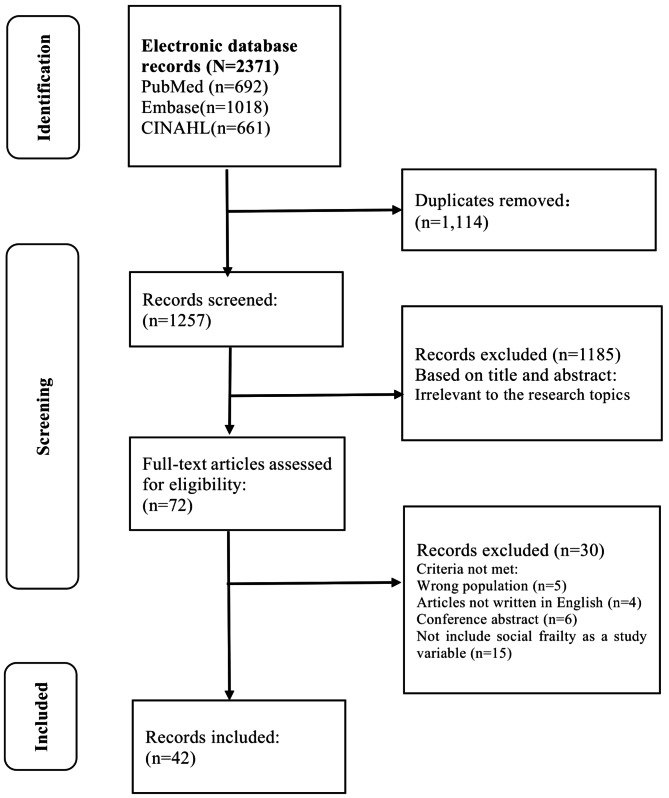
Methods: A scoping review following PRISMA-ScR guidelines was conducted with searches across PubMed, Embase, and CINAHL databases, covering studies up to November 4, 2024. Of the 2371 articles, 42 were included in the synthesis. The review focused on community-dwelling older adults aged 60 and above, aiming to understand the role of social frailty in this population's health and well-being.
Results: The findings revealed that social frailty is a complex, multidimensional phenomenon determined by physical function decline, cognitive impairment, and depression. It is also linked to adverse outcomes, including increased risks of cognitive decline, depression, disabilities, and mortality. The growing evidence underscores the need for targeted interventions to disrupt the cycle of worsening frailty. The variability in existing measurement tools, limiting their broad applicability, suggested a need for standardization and cross-cultural validation. We identified potential intervention strategies, including multicomponent physical exercise, social networking enhancement, and digital health interventions, but only one RCT specifically examined a robotic pet intervention targeting social frailty, and its findings were not significant.
Conclusion: Social frailty measurement tools are based on two primary frameworks: one grounded in the Deficit Accumulation Model, suited for secondary data analysis and prospective or periodic screening, and the other based on the Social Needs Fulfillment Theory, which uses brief-item tools but requires validation in specific contexts. Social frailty is associated with increased morbidity and mortality among community-dwelling older adults. The studies employed physical workouts, social networking, and digital health interventions, showed a significant improvement in social engagement. However, none specifically aimed at reducing social frailty, underscoring the urgent need for the specific interventions and management for social frailty.
Keywords: Community-dwelling older adults; Health outcomes; Measurements; Scoping review; Social frailty.
© 2025. The Author(s).
Conflict of interest statement
Declarations. Competing interests: The authors declare no competing interests. Ethics declaration: Not applicable. Consent to publish: Not applicable. Consent to participate: Not applicable.
References
Publication types
MeSH terms
LinkOut - more resources
Full Text Sources
