. 2025 May 13;20(1):22.
doi: 10.1186/s13012-025-01427-6.

When the parts are greater than the whole: how understanding mechanisms can advance implementation research

Affiliations

When the parts are greater than the whole: how understanding mechanisms can advance implementation research

Elvin H Geng et al. Implement Sci. .

Abstract

Background: Does the importance of context in implementation imply that generalizing about the effects of strategies is ultimately limited? Conceptual approaches for generalizing in the presence of significant contextual heterogeneity could advance implementation research but require novel perspectives.

Main body: Drawing from perspectives from Realist approaches, Pearl's transportability framework and philosophy of science, this paper outlines a mechanism-based approach to generalizing about the effects of implementation strategies. We suggest that understanding mechanisms creates a conceptual bridge between the effects of a strategy and the influence of the implementation context. Using directed acyclic graphs to represent the mechanisms of strategies, we show how conceptualizing mediators of overall effects offer a basis for considering the effects of context. Hence, theorizing and testing a mechanistic understanding enriches the ways in which we can consider how context could change those effects. Such an approach allows us to understand how a strategy works within a given implementation context, determine what information from new contexts are needed to infer across contexts, and if that information is available, what those effects would be - thereby advancing generalizing in implementation research. We consider particular implementation strategies (e.g., Community Adherence Groups and practice facilitation) as examples to illustrate generalizing into different contexts.

Conclusion: Mechanisms can help implementation research by simultaneously accommodating the importance of context as well as the imperative to generalize. A shift towards a mechanism-focused approach that goes beyond identifying barriers and facilitators can enhance the value of implementation research.

Keywords: Context; Generalizability; Implementation strategies; Mechanisms.


Conflict of interest statement

Declarations. Ethics approval and consent to participate: No human subjects involved. Consent for publication: No individual data. Competing interests: Elvin Geng, MD, MPH receives funding from Viiv Healthcare for training activities. All other authors have no competing interests to declare.

Figures

Fig. 1
Fig. 1
Traditional vs. Modern Generalization. A traditional approach to generalizing take effects observed in a study and seeks to apply those effects in a larger population external to the study (Panel A). If the underlying units of interest (whether patient, providers or health care units) is well characterized, the sampling probabilities into the study are known, typical threats to validity are adequately managed (e.g., measurement error), and the study itself does not create an artifactual environment, findings can be used to infer (with statistical uncertainty) about effects in the external population and contexts. Implementation research often assumes, in contrast, there is a meaningful diversity of contexts in the real world. This implies that the effects of any implementation strategy will differ across those contexts. Instead of identifying a single effect that applies in all contexts, the field may need to seek effects in one context in a way that enables inferring in other external contexts (Panel B), even when the effects will differ. We seek an approach to generalizing such that a study (Panel B) in one of the three contexts (Context A) can be used to infer about effects in other contexts such as Context B (where the strategy improves outcomes by threefold) or Context C (where the strategy has no effect). Is that possible?
Fig. 2
Fig. 2
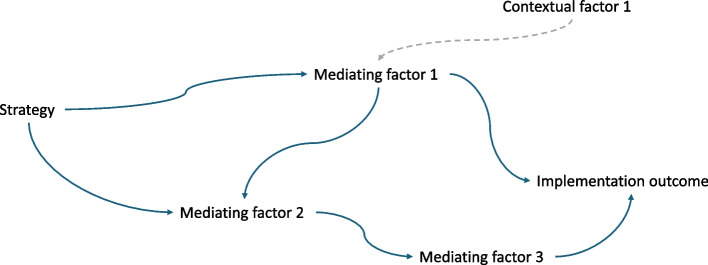
Representing mechanisms of implementation strategies. We use a diagram (using conventions of a directed acyclic graph) to illustrate the components of a mechanism. In this representation, a Strategy (S) is the implementation actions undertaken to change an implementing outcome. Mediators (M) are all the nodes or steps in a directed pathway from the Strategy to the Outcome (O) passes. Pathways (P) are all unique directed paths from the Strategy to the Outcome. For illustrative purposes, the Strategy (e.g., training) in this diagram acts through three mediators and through three different pathways. Pathway 1 is S-M1-O. Pathway 2 is S-M1-M2-M3-O. Pathway 3 is S-M2-M3-O. Note that M1 is not only a mediator of S through the S-M1-O pathway, but also a moderator of the effect of S-M2-M3-O (by also acting on M2). We consider the “mechanism” as all the mediators and pathways between S and O
Fig. 3
Fig. 3
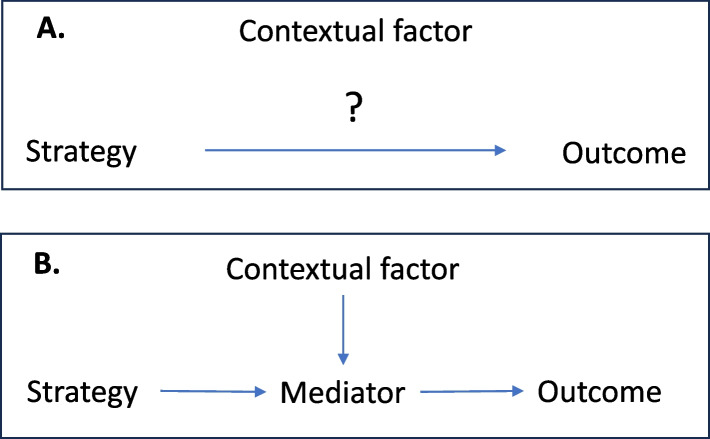
Mediators enables consideration of context. Absence of a hypothesized mechanism limits analysis of context (Panel A). Proposed mechanisms — in this case a single mediator for simplicity — offers a conceptual receptacle for how context might influence a strategy’s effects (Panel B). In the convention of directed acyclic diagrams, two arrows that point into one node implies that the effect of each arrow is influenced by the other, in this case representing how context effects the effect of the strategy on the outcome
Fig. 4
Fig. 4
Mechanism and Context for CAG’s. A directed acyclic graph representing how a Community Adherence Group — a strategy composed of a forming a group of patients to distribute medications to each other — has effects (Panel A). Once offered, all effects of a CAG are mediated by acceptability and participation in the group, with subsequent steps that operate through four mediators drawn from the literature: (1) opportunity costs, (2) activation, (3) social support and (4) decongestion of clinics. Each mediator represented in this graph invites consideration of how specific contextual elements (that differ between two contexts) could influence the strategy. Each (Panel B) contextual effect is shown in red and includes for illustrative purposes (1) geography and rurality, (2) level of stigma and (3) human resources for health
Fig. 5
Fig. 5
Mechanism and Context for Facilitation. Simplified mechanistic representation of healthcare facilitation for illustrative purposes. In this simplified diagram, this strategy is portrayed as a facilitator engaging with a new organizational network to provide resources and skill for change. The strategy unfolds through three key mediators: (1) acceptance into the care system, which involves gaining the healthcare system's approval and support for new practices; (2) buy-in from leadership, needed for securing broader organizational support; and (3) cultivation of internal champions who advocate for and sustain the new initiatives (Panel A). These elements work together to build (5) trust and coherence around the proposed activities. The diagram’s mediators invite consideration of organizational readiness for change as a contextual factor that could play a crucial role in the process by acting on acceptance (Panel B). The unit's ability to experiment with new activities depends on creating slack in the system—essentially, allowing resources and time for experimentation with new processes and approaches. This slack is necessary for testing and refining new ways of thinking, ensuring that the healthcare system can adapt and integrate innovative practices

References

    1. Huebschmann AG, Leavitt IM, Glasgow RE. Making health research matter: a call to increase attention to external validity. Annu Rev Public Health. 2019;11:45–63. 10.1146/annurev-publhealth-. - PubMed
    1. Tomoaia-Cotisel A, Scammon DL, Waitzman NJ, Cronholm PF, Halladay JR, Driscoll DL, et al. Context matters: the experience of 14 research teams in systematically reporting contextual factors important for practice change. Ann Fam Med. 2013;11(Suppl 1):S115. Available from: http://www.annfammed.org/content/11/Suppl_1/S115.abstract. - PMC - PubMed
    1. Taylor SL, Dy S, Foy R, Hempel S, McDonald KM, Øvretveit J, et al. What context features might be important determinants of the effectiveness of patient safety practice interventions? BMJ Qual Safety. 2011;20(7):611. Available from: http://qualitysafety.bmj.com/content/20/7/611.abstract. - PubMed
    1. Dopson S, Fitzgerald L. The active role of context. In: Knowledge to action? Oxford University Press; 2005. p. 79–103.
    1. McCormack B, Kitson A, Harvey G, Rycroft-Malone J, Titchen A, Seers K. Getting evidence into practice: the meaning of `context’. J Adv Nurs. 2002;38(1):94–104. 10.1046/j.1365-2648.2002.02150.x. - PubMed

Publication types

MeSH terms

LinkOut - more resources