


Protective Effect of Lactic Acid Bacteria Isolated from Ripened Foods Against Listeria monocytogenes in Plant-Based Fermented Dry-Cured Sausages
- PMID: 40361574
- PMCID: PMC12071225
- DOI: 10.3390/foods14091491
Protective Effect of Lactic Acid Bacteria Isolated from Ripened Foods Against Listeria monocytogenes in Plant-Based Fermented Dry-Cured Sausages
Abstract
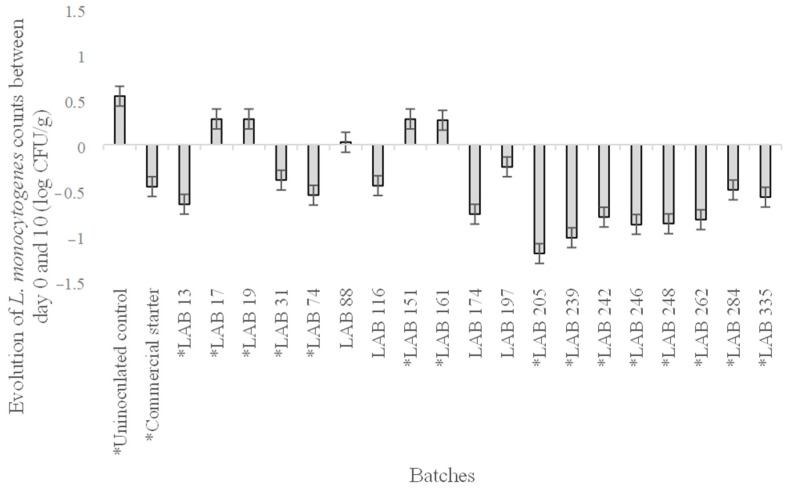
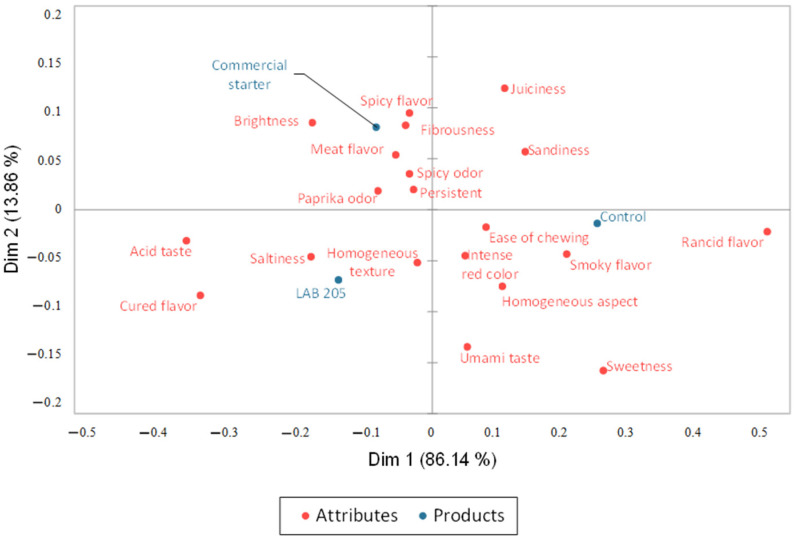
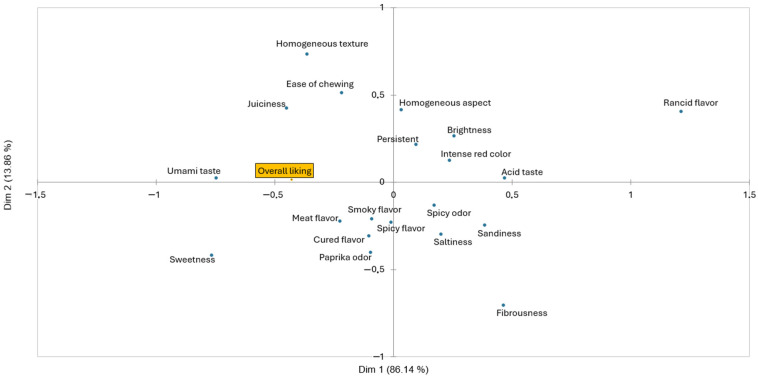
The aim of the study was to use a commonly employed technology in the meat industry, the inoculation of a biocontrol starter, in the processing of a plant-based fermented dry-cured sausage analog to improve its safety against possible Listeria monocytogenes contamination. Challenge tests were used to select suitable lactic acid bacteria (LAB) for the analog under industrial production conditions. First, 20 LAB strains were tested in vitro and five of them were further tested by stuffing the ingredients under industrial conditions. The L. monocytogenes counts highlighted Latilactobacillus sakei 205 as the most protective one, achieving a reduction of 2.6 log CFU/g. Further, a triangular test and Check-All-That-Apply test were performed to understand the organoleptic differences that could be expected in the final product. The batch inoculated with Llb. sakei 205 did not show any sensory differences from the commercial batch. Therefore, Llb. sakei 205 was identified as a potential protective starter due to the microbiological and sensory results. This pioneering study applied biocontrol starters to plant-based meat analogs, aligning with clean-label trends.
Keywords: biocontrol; clean label; meat product analog; plant-based analog; ready to eat.
Conflict of interest statement
The authors declare no conflicts of interest.
Figures
References
-
- Wild F., Czerny M., Janssen A., Kole A., Zunabovic M., Domig K. The Evolution of a Plant-Based Alternative to Meat: From Niche Markets to Widely Accepted Meat Alternatives. Agro. Food Ind. Hi Tech. 2014;21:45–49.
-
- Muhialdin B.J., Ubbink J. Effects of PH and Aging on the Texture and Physicochemical Properties of Extruded Pea Protein Isolate. Food Hydrocoll. 2023;140:108639. doi: 10.1016/j.foodhyd.2023.108639. - DOI
-
- Yadav P., Ahlawat S., Gauri Jairath G., Monika Rani M., Bishnoi S. Studies on Physico-Chemical Properties and Shelf Life of Developed Chicken Meat Analogue Rolls. Haryana Vet. 2015;54:25–28.
-
- Silberbauer A., Schmid M. Packaging Concepts for Ready-to-Eat Food: Recent Progress. J. Packag. Technol. Res. 2017;1:113–126. doi: 10.1007/s41783-017-0019-9. - DOI
Grants and funding
LinkOut - more resources
Full Text Sources
Miscellaneous
